


Page 266 - Clinical Application of Mechanical Ventilation
P. 266
232    Chapter 8


                                            Malfunction and Misuse of Alarms


                                            The Joint Commission (TJC) reviewed 23 reported deaths or injuries related to
                                            long-term mechanical ventilation and found 19 deaths and four in coma. Sixty-
                                            five percent of the deaths or injuries were related to the malfunction or misuse of
                                            ventilator alarms. A breakdown of the causes revealed that the alarms were either
                                            turned off or set incorrectly, no alarm was available for certain disconnections,
                                            testing of alarms was not performed, or response to alarm was delayed or absent
                                            (NYSNA, 2002).
                                             These tragedies could be prevented by implementing regular preventive maintenance
                                            and testing of alarm systems on ventilators and monitors. The alarms must also be suf-
                                            ficiently audible with respect to the room design, distance, and noise level of the im-
                                            mediate patient care area. Over dependence on alarms should be avoided and emphasis
                                            should be placed on frequent direct observation and assessment of the patient-ventilator
                                            system.

                                            Barotrauma


                                            Barotrauma is the term used to describe lung tissue injury or rupture that results from the
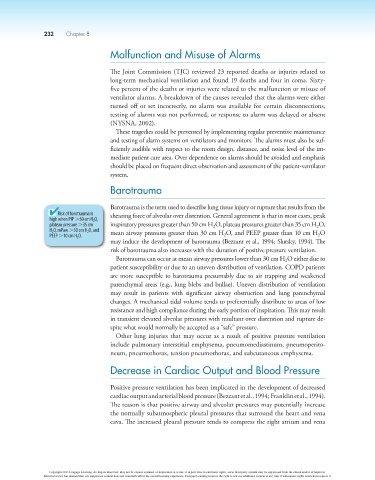
                          Risk of barotrauma is   shearing force of alveolar over distention. General agreement is that in most cases, peak
                        high when PIP .50 cm H 2 O,
                        plateau pressure .35 cm   inspiratory pressures greater than 50 cm H O, plateau pressures greater than 35 cm H O,
                                                                             2
                                                                                                               2
                        H 2 O, mPaw .30 cm H 2 O, and   mean airway pressures greater than 30 cm H O, and PEEP greater than 10 cm H O
                        PEEP .10 cm H 2 O.                                       2                             2
                                            may induce the development of barotrauma (Bezzant et al., 1994; Slutsky, 1994). The
                                            risk of barotrauma also increases with the duration of positive pressure ventilation.
                                             Barotrauma can occur at mean airway pressures lower than 30 cm H O either due to
                                                                                                     2
                                            patient susceptibility or due to an uneven distribution of ventilation. COPD patients
                                            are more susceptible to barotrauma presumably due to air trapping and weakened
                                            parenchymal areas (e.g., lung blebs and bullae). Uneven distribution of ventilation
                                            may  result  in  patients  with  significant  airway  obstruction  and  lung  parenchymal
                                            changes. A mechanical tidal volume tends to preferentially distribute to areas of low
                                            resistance and high compliance during the early portion of inspiration. This may result
                                            in transient elevated alveolar pressures with resultant over distention and rupture de-
                                            spite what would normally be accepted as a “safe” pressure.
                                             Other lung injuries that may occur as a result of positive pressure ventilation
                                            include pulmonary interstitial emphysema, pneumomediastinum, pneumoperito-
                                            neum, pneumothorax, tension pneumothorax, and subcutaneous emphysema.

                                            Decrease in Cardiac Output and Blood Pressure


                                            Positive pressure ventilation has been implicated in the development of decreased
                                            cardiac output and arterial blood pressure (Bezzant et al., 1994; Franklin et al., 1994).
                                            The reason is that positive airway and alveolar pressures may potentially increase
                                            the normally subatmospheric pleural pressures that surround the heart and vena
                                            cava. The increased pleural pressure tends to compress the right atrium and vena


                        Copyright 2013 Cengage Learning. All Rights Reserved. May not be copied, scanned, or duplicated, in whole or in part. Due to electronic rights, some third party content may be suppressed from the eBook and/or eChapter(s).
                      Editorial review has deemed that any suppressed content does not materially affect the overall learning experience. Cengage Learning reserves the right to remove additional content at any time if subsequent rights restrictions require it.

