


Page 269 - Clinical Application of Mechanical Ventilation
P. 269
Initiation of Mechanical Ventilation  235


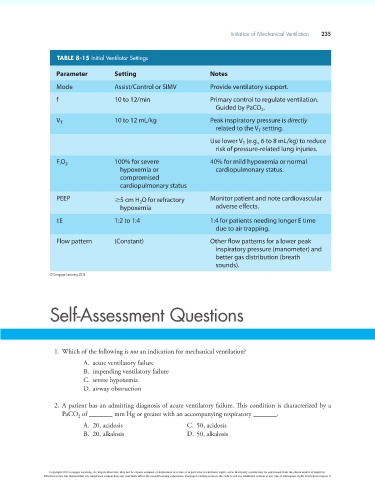
                          TABLE 8-15 Initial Ventilator Settings

                          Parameter          Setting                        Notes

                          Mode               Assist/Control	or	SIMV         Provide	ventilatory	support.

                          f                  10	to	12/min                   Primary	control	to	regulate	ventilation.
                                                                              Guided	by	PaCO .
                                                                                             2
                          V T                10	to	12	mL/kg                 Peak	inspiratory	pressure	is	directly
                                                                              related	to	the	V 	setting.
                                                                                            T
                                                                            Use	lower	V 	(e.g.,	6	to	8	mL/kg)	to	reduce
                                                                                       T
                                                                              risk	of	pressure-related	lung	injuries.
                          F O 2              100%	for	severe	               40%	for	mild	hypoxemia	or	normal
                           I
                                               hypoxemia	or	                  cardiopulmonary	status.
                                               compromised
                                               cardiopulmonary	status

                          PEEP               ≥5	cm	H O	for	refractory	      Monitor	patient	and	note	cardiovascular
                                                     2
                                               hypoxemia                      adverse	effects.
                          I:E                1:2	to	1:4                     1:4	for	patients	needing	longer	E	time
                                                                              due	to	air	trapping.
                          Flow	pattern       (Constant)                     Other	flow	patterns	for	a	lower	peak
                                                                              inspiratory	pressure	(manometer)	and
                                                                              better	gas	distribution	(breath
                                                                              sounds).

                        © Cengage Learning 2014


                        Self-Assessment Questions


                          1. Which of the following is not an indication for mechanical ventilation?
                                   A.  acute ventilatory failure
                                   B.  impending ventilatory failure
                                   C.  severe hypoxemia
                                   D. airway obstruction


                          2. A patient has an admitting diagnosis of acute ventilatory failure. This condition is characterized by a
                            PaCO  of _______ mm Hg or greater with an accompanying respiratory _______.
                                 2
                                   A.  20, acidosis                  C.  50, acidosis
                                   B.  20, alkalosis                 D. 50, alkalosis


                        Copyright 2013 Cengage Learning. All Rights Reserved. May not be copied, scanned, or duplicated, in whole or in part. Due to electronic rights, some third party content may be suppressed from the eBook and/or eChapter(s).
                      Editorial review has deemed that any suppressed content does not materially affect the overall learning experience. Cengage Learning reserves the right to remove additional content at any time if subsequent rights restrictions require it.

