


Page 448 - Clinical Application of Mechanical Ventilation
P. 448
414    Chapter 12


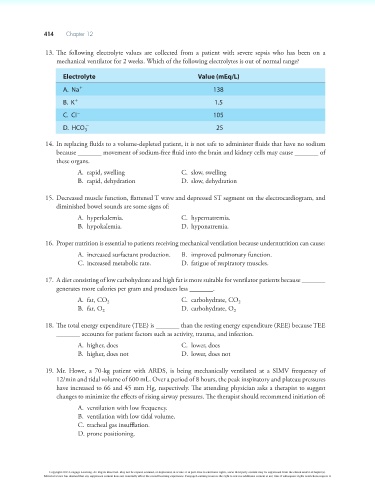
                      	13.	The	 following	 electrolyte	 values	 are	 collected	 from	 a	 patient	 with	 severe	 sepsis	 who	 has	 been	 on	 a
                          mechanical	ventilator	for	2	weeks.	Which	of	the	following	electrolytes	is	out	of	normal	range?

                            Electrolyte                                 Value (mEq/L)

                            A.  Na 1                                         138
                            B.  K 1                                           1.5

                            C.  Cl 2                                         105
                            D.  HCO 	-                                        25
                                   3

                      	14.	In	replacing	fluids	to	a	volume-depleted	patient,	it	is	not	safe	to	administer	fluids	that	have	no	sodium
                          because	_______	movement	of	sodium-free	fluid	into	the	brain	and	kidney	cells	may	cause	_______	of
                          these	organs.
                        	        A.	 rapid,	swelling	              C.	 slow,	swelling
                        	        B.	 rapid,	dehydration	           D.	 slow,	dehydration


                      	15.	Decreased	muscle	function,	flattened	T	wave	and	depressed	ST	segment	on	the	electrocardiogram,	and
                          diminished	bowel	sounds	are	some	signs	of:

                        	        A.	 hyperkalemia.	                C.	 hypernatremia.
                        	        B.	 hypokalemia.	                 D.	 hyponatremia.


                      	16.	Proper	nutrition	is	essential	to	patients	receiving	mechanical	ventilation	because	undernutrition	can	cause:
                        	        A.	 increased	surfactant	production.	  B.	 improved	pulmonary	function.
                        	        C.	 increased	metabolic	rate.	    D.	 fatigue	of	respiratory	muscles.

                      	17.	A	diet	consisting	of	low	carbohydrate	and	high	fat	is	more	suitable	for	ventilator	patients	because	_______
                          generates	more	calories	per	gram	and	produces	less	_______.
                        	        A.	 fat,	CO 	                     C.	 carbohydrate,	CO 2
                                           2
                        	        B.	 fat,	O 	                      D.	 carbohydrate,	O 2
                                         2

                      	18.	The	total	energy	expenditure	(TEE)	is	_______	than	the	resting	energy	expenditure	(REE)	because	TEE
                          _______	accounts	for	patient	factors	such	as	activity,	trauma,	and	infection.

                        	        A.	 higher,	does	                 C.	 lower,	does
                        	        B.	 higher,	does	not	             D.	 lower,	does	not


                      	19.	Mr.	 Howe,	 a	 70-kg	 patient	 with	 ARDS,	 is	 being	 mechanically	 ventilated	 at	 a	 SIMV	 frequency	 of
                          12/min	and	tidal	volume	of	600	mL.	Over	a	period	of	8	hours,	the	peak	inspiratory	and	plateau	pressures
                          have	increased	to	66	and	45	mm	Hg,	respectively.	The	attending	physician	asks	a	therapist	to	suggest
                          changes	to	minimize	the	effects	of	rising	airway	pressures.	The	therapist	should	recommend	initiation	of:
                        	        A.	 ventilation	with	low	frequency.
                        	        B.	 ventilation	with	low	tidal	volume.
                        	        C.	 tracheal	gas	insufflation.
                        	        D.	prone	positioning.


                        Copyright 2013 Cengage Learning. All Rights Reserved. May not be copied, scanned, or duplicated, in whole or in part. Due to electronic rights, some third party content may be suppressed from the eBook and/or eChapter(s).
                      Editorial review has deemed that any suppressed content does not materially affect the overall learning experience. Cengage Learning reserves the right to remove additional content at any time if subsequent rights restrictions require it.

