


Page 443 - Clinical Application of Mechanical Ventilation
P. 443
Management of Mechanical Ventilation  409


                                             lung	and	may	increase	the	incidence	of	barotrauma (volutrauma).	Therefore,	the
                        barotrauma (volutrauma): Air
                        leak into the pleural space caused   traditional	approach	in	the	selection	of	tidal	volume	may	exacerbate	or	perpetuate
                        by excessive pressure or volume in   lung	injury	in	patients	with	ALI	or	ARDS	and	increase	the	risk	of	mortality	and
                        the lung parenchyma.
                                             nonpulmonary	organ	and	system	failure	(Petrucci	et	al.,	2004;	The	Acute	Respira-
                                             tory	Distress	Syndrome	Network,	2000).

                                             Volume Selection.	In	volume-targeted	ventilation	for	patients	with	ALI	or	ARDS,
                            The tidal volume selected
                          for patients with ALI or ARDS   the	tidal	volumes	selected	should	result	in	a	plateau	pressure	of	,35	cm	H O
                                                                                                                 2
                          should result in a plateau   (Thompson	et	al.,	2001).	Plateau	pressure	is	used	as	a	target	pressure	because	it
                          pressure of ,35 cm H 2 O.
                                             reflects	the	condition	of	the	lung	parenchyma.	For	the	reason	of	lung	protection,
                                             the	lowest	tidal	volume	that	meets	the	patient’s	minimal	oxygenation	and	ventila-
                                             tion	requirements	should	be	used.

                                             Complications.	Use	of	low	tidal	volume	ventilation	should	be	done	with	care	as	it
                                             may	lead	to	complications	such	as	acute	hypercapnia,	increased	work	of	breathing,
                                             dyspnea,	severe	acidosis,	and	atelectasis	(Kallet	et	al.,	2001).

                                             Prone Positioning


                                             Prone	positioning	(PP)	has	been	used	as	a	“stop-gap”	strategy	to	improve	the
                        prone positioning (PP): Place-
                        ment of the patient in a face-down   ventilation,	oxygenation,	and	pulmonary	perfusion	status	of	patients	with	acute
                        position in a bed.   respiratory	failure	and	ARDS.	Following	PP,	there	is	a	rapid	increase	in	oxygen-
                                             ation	measurements	(e.g.,	SpO ,	PaO ,	SaO )	and	improvement	in	lung	compli-
                                                                        2
                                                                              2
                                                                                    2
                                             ance	(Relvas	et	al.,	2003).	The	oxygen	requirement,	intrapulmonary	shunting,	and
                                             inspiratory	pressures	are	reduced	as	well	(Breiburg,	2000;	Fletcher	et	al.,	2003).
                            PP has been used
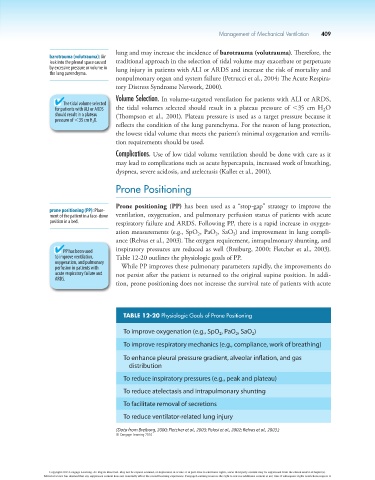
                          to improve ventilation,   Table	12-20	outlines	the	physiologic	goals	of	PP.
                          oxygenation, and pulmonary
                          perfusion in patients with   While	PP	improves	these	pulmonary	parameters	rapidly,	the	improvements	do
                          acute respiratory failure and   not	persist	after	the	patient	is	returned	to	the	original	supine	position.	In	addi-
                          ARDS.
                                             tion,	prone	positioning	does	not	increase	the	survival	rate	of	patients	with	acute


                                                TABLE 12-20 Physiologic Goals of Prone Positioning

                                                To improve oxygenation (e.g., SpO , PaO , SaO )
                                                                                     2
                                                                                          2
                                                                               2
                                                To improve respiratory mechanics (e.g., compliance, work of breathing)
                                                To enhance pleural pressure gradient, alveolar inflation, and gas
                                                  distribution
                                                To reduce inspiratory pressures (e.g., peak and plateau)

                                                To reduce atelectasis and intrapulmonary shunting

                                                To facilitate removal of secretions
                                                To reduce ventilator-related lung injury

                                             (Data from Breiburg, 2000; Fletcher et al., 2003; Pelosi et al., 2002; Relvas et al., 2003.)
                                             © Cengage Learning 2014


                        Copyright 2013 Cengage Learning. All Rights Reserved. May not be copied, scanned, or duplicated, in whole or in part. Due to electronic rights, some third party content may be suppressed from the eBook and/or eChapter(s).
                      Editorial review has deemed that any suppressed content does not materially affect the overall learning experience. Cengage Learning reserves the right to remove additional content at any time if subsequent rights restrictions require it.

