


Page 445 - Clinical Application of Mechanical Ventilation
P. 445
Management of Mechanical Ventilation  411


                                                 Conventional Ventilation                   Ventilation Plus TGI


                                                                                                                     Courtesy of Valley Inspired Products, Burnsville,   MN. Used with permission.


                                                        A                                     B
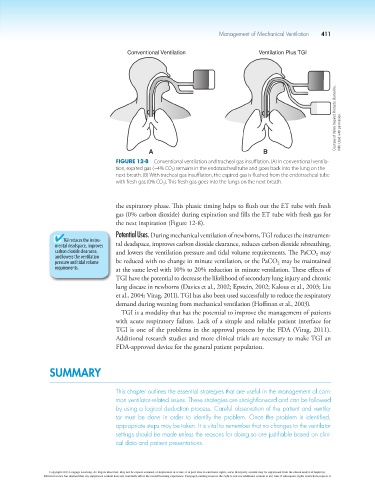
                                             Figure 12-8  Conventional ventilation and tracheal gas insufflation. (A) In conventional ventila-
                                             tion, expired gas (~4% CO 2 ) remains in the endotracheal tube and goes back into the lung on the
                                             next breath. (B) With tracheal gas insufflation, the expired gas is flushed from the endotracheal tube
                                             with fresh gas (0% CO 2 ). This fresh gas goes into the lungs on the next breath.


                                             the	expiratory	phase.	This	phasic	timing	helps	to	flush	out	the	ET	tube	with	fresh
                                             gas	(0%	carbon	dioxide)	during	expiration	and	fills	the	ET	tube	with	fresh	gas	for
                                             the	next	inspiration	(Figure	12-8).
                                             Potential Uses.	During	mechanical	ventilation	of	newborns,	TGI	reduces	the	instrumen-
                            TGI reduces the instru-
                          mental deadspace, improves   tal	deadspace,	improves	carbon	dioxide	clearance,	reduces	carbon	dioxide	rebreathing,
                          carbon dioxide clearance,   and	lowers	the	ventilation	pressure	and	tidal	volume	requirements.	The	PaCO 	may
                          and lowers the ventilation                                                           2
                          pressure and tidal volume   be	reduced	with	no	change	in	minute	ventilation,	or	the	PaCO 	may	be	maintained
                                                                                                  2
                          requirements.      at	the	same	level	with	10%	to	20%	reduction	in	minute	ventilation.	These	effects	of
                                             TGI	have	the	potential	to	decrease	the	likelihood	of	secondary	lung	injury	and	chronic
                                             lung	disease	in	newborns	(Davies	et	al.,	2002;	Epstein,	2002;	Kalous	et	al.,	2003;	Liu
                                             et	al.,	2004;	Virag,	2011).	TGI	has	also	been	used	successfully	to	reduce	the	respiratory
                                             demand	during	weaning	from	mechanical	ventilation	(Hoffman	et	al.,	2003).
                                               TGI	is	a	modality	that	has	the	potential	to	improve	the	management	of	patients
                                             with	acute	respiratory	failure.	Lack	of	a	simple	and	reliable	patient	interface	for
                                             TGI	is	one	of	the	problems	in	the	approval	process	by	the	FDA	(Virag,	2011).
                                             Additional	research	studies	and	more	clinical	trials	are	necessary	to	make	TGI	an
                                             FDA-approved	device	for	the	general	patient	population.


                        SUMMARY


                                             This chapter outlines the essential strategies that are useful in the management of com-
                                             mon ventilator-related issues. These strategies are straightforward and can be followed
                                             by using a logical deduction process. Careful observation of the patient and ventila-
                                             tor must be done in order to identify the problem. Once the problem is identified,
                                             appropriate steps may be taken. It is vital to remember that no changes to the ventilator
                                             settings should be made unless the reasons for doing so are justifiable based on clini-
                                             cal data and patient presentations.


                        Copyright 2013 Cengage Learning. All Rights Reserved. May not be copied, scanned, or duplicated, in whole or in part. Due to electronic rights, some third party content may be suppressed from the eBook and/or eChapter(s).
                      Editorial review has deemed that any suppressed content does not materially affect the overall learning experience. Cengage Learning reserves the right to remove additional content at any time if subsequent rights restrictions require it.

