


Page 479 - Clinical Application of Mechanical Ventilation
P. 479
Pharmacotherapy for Mechanical Ventilation  445


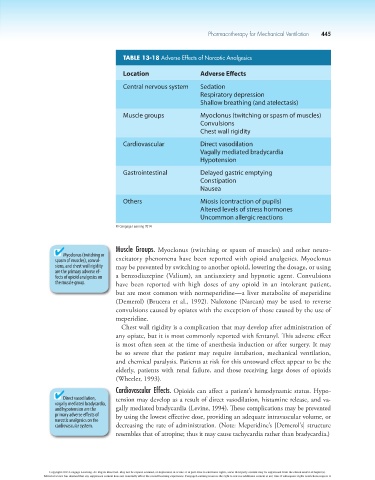
                                                TABLE 13-18 Adverse Effects of Narcotic Analgesics

                                                Location                 Adverse Effects

                                                Central nervous system   Sedation
                                                                         Respiratory depression
                                                                         Shallow breathing (and atelectasis)

                                                Muscle groups            Myoclonus (twitching or spasm of muscles)
                                                                         Convulsions
                                                                         Chest wall rigidity

                                                Cardiovascular           Direct vasodilation
                                                                         Vagally mediated bradycardia
                                                                         Hypotension
                                                Gastrointestinal         Delayed gastric emptying
                                                                         Constipation
                                                                         Nausea
                                                Others                   Miosis (contraction of pupils)
                                                                         Altered levels of stress hormones
                                                                         Uncommon allergic reactions
                                             © Cengage Learning 2014


                                             Muscle Groups. Myoclonus (twitching or spasm of muscles) and other neuro-
                            Myoclonus (twitching or
                          spasm of muscles), convul-  excitatory phenomena have been reported with opioid analgesics. Myoclonus
                          sions, and chest wall rigidity   may be prevented by switching to another opioid, lowering the dosage, or using
                          are the primary adverse ef-
                          fects of opioid analgesics on   a benzodiazepine (Valium), an antianxiety and hypnotic agent. Convulsions
                          the muscle group.  have  been  reported  with  high  doses  of  any  opioid  in  an  intolerant  patient,
                                             but are most common with normeperidine—a liver metabolite of meperidine
                                             (Demerol) (Brucera et al., 1992). Naloxone (Narcan) may be used to reverse
                                             convulsions caused by opiates with the exception of those caused by the use of
                                             meperidine.
                                               Chest wall rigidity is a complication that may develop after administration of
                                             any opiate, but it is most commonly reported with fentanyl. This adverse effect
                                             is most often seen at the time of anesthesia induction or after surgery. It may
                                             be  so  severe  that  the  patient  may  require  intubation,  mechanical  ventilation,
                                             and chemical paralysis. Patients at risk for this untoward effect appear to be the
                                             elderly,  patients  with  renal  failure,  and  those  receiving  large  doses  of  opioids
                                             (Wheeler, 1993).

                                             Cardiovascular Effects. Opioids can affect a patient’s hemodynamic status. Hypo-
                            Direct vasodilation,   tension may develop as a result of direct vasodilation, histamine release, and va-
                          vagally mediated bradycardia,
                          and hypotension are the   gally mediated bradycardia (Levine, 1994). These complications may be prevented
                          primary adverse effects of   by using the lowest effective dose, providing an adequate intravascular volume, or
                          narcotic analgesics on the
                          cardiovascular system.  decreasing the rate of administration. (Note: Meperidine’s [Demerol’s] structure
                                             resembles that of atropine; thus it may cause tachycardia rather than bradycardia.)


                        Copyright 2013 Cengage Learning. All Rights Reserved. May not be copied, scanned, or duplicated, in whole or in part. Due to electronic rights, some third party content may be suppressed from the eBook and/or eChapter(s).
                      Editorial review has deemed that any suppressed content does not materially affect the overall learning experience. Cengage Learning reserves the right to remove additional content at any time if subsequent rights restrictions require it.

