


Page 618 - Clinical Application of Mechanical Ventilation
P. 618
584    Chapter 18


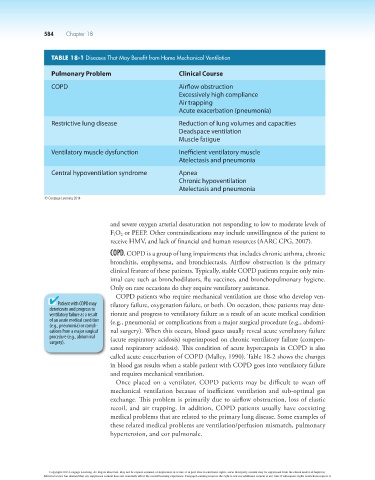
                        TABLE 18-1 Diseases That May Benefit from Home Mechanical Ventilation

                        Pulmonary Problem                         Clinical Course

                        COPD                                      Airflow obstruction
                                                                  Excessively high compliance
                                                                  Air trapping
                                                                  Acute exacerbation (pneumonia)
                        Restrictive lung disease                  Reduction of lung volumes and capacities
                                                                  Deadspace ventilation
                                                                  Muscle fatigue
                        Ventilatory muscle dysfunction            Inefficient ventilatory muscle
                                                                  Atelectasis and pneumonia

                        Central hypoventilation syndrome          Apnea
                                                                  Chronic hypoventilation
                                                                  Atelectasis and pneumonia
                      © Cengage Learning 2014


                                            and severe oxygen arterial desaturation not responding to low to moderate levels of
                                            F O  or PEEP. Other contraindications may include unwillingness of the patient to
                                             I
                                               2
                                            receive HMV, and lack of financial and human resources (AARC CPG, 2007).
                                            COPD. COPD is a group of lung impairments that includes chronic asthma, chronic
                                            bronchitis,  emphysema,  and  bronchiectasis.  Airflow  obstruction  is  the  primary
                                            clinical feature of these patients. Typically, stable COPD patients require only min-
                                            imal care such as bronchodilators, flu vaccines, and bronchopulmonary hygiene.
                                            Only on rare occasions do they require ventilatory assistance.
                                             COPD patients who require mechanical ventilation are those who develop ven-
                          Patient with COPD may   tilatory failure, oxygenation failure, or both. On occasion, these patients may dete-
                        deteriorate and progress to
                        ventilatory failure as a result   riorate and progress to ventilatory failure as a result of an acute medical condition
                        of an acute medical condition   (e.g., pneumonia) or complications from a major surgical procedure (e.g., abdomi-
                        (e.g., pneumonia) or compli-
                        cations from a major surgical   nal surgery). When this occurs, blood gases usually reveal acute ventilatory failure
                        procedure (e.g., abdominal   (acute respiratory acidosis) superimposed on chronic ventilatory failure (compen-
                        surgery).
                                            sated respiratory acidosis). This condition of acute hypercapnia in COPD is also
                                            called acute exacerbation of COPD (Malley, 1990). Table 18-2 shows the changes
                                            in blood gas results when a stable patient with COPD goes into ventilatory failure
                                            and requires mechanical ventilation.
                                             Once  placed  on  a  ventilator,  COPD  patients  may  be  difficult  to  wean  off
                                            mechanical ventilation because of inefficient ventilation and sub-optimal gas
                                            exchange. This problem is primarily due to airflow obstruction, loss of elastic
                                            recoil, and air trapping. In addition, COPD patients usually have coexisting
                                            medical problems that are related to the primary lung disease. Some examples of
                                            these related medical problems are ventilation/perfusion mismatch, pulmonary
                                            hypertension, and cor pulmonale.


                        Copyright 2013 Cengage Learning. All Rights Reserved. May not be copied, scanned, or duplicated, in whole or in part. Due to electronic rights, some third party content may be suppressed from the eBook and/or eChapter(s).
                      Editorial review has deemed that any suppressed content does not materially affect the overall learning experience. Cengage Learning reserves the right to remove additional content at any time if subsequent rights restrictions require it.

