


Page 622 - Clinical Application of Mechanical Ventilation
P. 622
588    Chapter 18


                                            Types of Ventilatory Support. If the patient does not have adequate spontaneous ven-
                                            tilation for an extended time, positive pressure or negative pressure ventilators are
                                            the equipment of choice. Positive pressure ventilation requires an artificial airway,
                                            whereas negative pressure ventilation can be provided without an artificial airway.
                                            One exception to this practice is the presence of significant airway obstruction.
                                             A backup ventilator may be necessary if the patient is totally dependent on me-
                          A backup ventilator may   chanical ventilation. For patients who are using mechanical ventilation on a part-
                        be necessary if the patient
                        is totally dependent on   time basis (e.g., during sleep), a backup system may not be needed or may not be
                        mechanical ventilation.  financially justifiable.
                                             Other methods of providing ventilatory support include the chest cuirass, raincoat
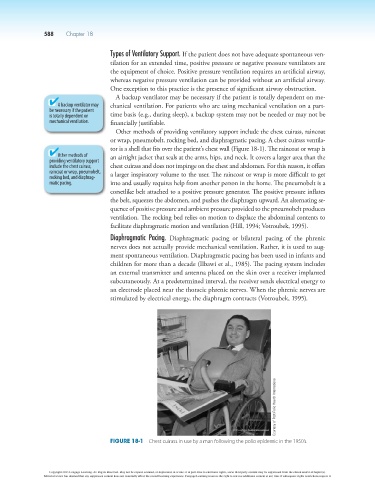
                                            or wrap, pneumobelt, rocking bed, and diaphragmatic pacing. A chest cuirass ventila-
                                            tor is a shell that fits over the patient’s chest wall (Figure 18-1). The raincoat or wrap is
                          Other methods of   an airtight jacket that seals at the arms, hips, and neck. It covers a larger area than the
                        providing ventilatory support
                        include the chest cuirass,   chest cuirass and does not impinge on the chest and abdomen. For this reason, it offers
                        raincoat or wrap, pneumobelt,   a larger inspiratory volume to the user. The raincoat or wrap is more difficult to get
                        rocking bed, and diaphrag-
                        matic pacing.       into and usually requires help from another person in the home. The pneumobelt is a
                                            corsetlike belt attached to a positive pressure generator. The positive pressure inflates
                                            the belt, squeezes the abdomen, and pushes the diaphragm upward. An alternating se-
                                            quence of positive pressure and ambient pressure provided to the pneumobelt produces
                                            ventilation. The rocking bed relies on motion to displace the abdominal contents to
                                            facilitate diaphragmatic motion and ventilation (Hill, 1994; Votroubek, 1995).

                                            Diaphragmatic  Pacing.  Diaphragmatic  pacing  or  bilateral  pacing  of  the  phrenic
                                            nerves does not actually provide mechanical ventilation. Rather, it is used to aug-
                                            ment spontaneous ventilation. Diaphragmatic pacing has been used in infants and
                                            children for more than a decade (Ilbawi et al., 1985). The pacing system includes
                                            an external transmitter and antenna placed on the skin over a receiver implanted
                                            subcutaneously. At a predetermined interval, the receiver sends electrical energy to
                                            an electrode placed near the thoracic phrenic nerves. When the phrenic nerves are
                                            stimulated by electrical energy, the diaphragm contracts (Votroubek, 1995).


                                                                                                 Courtesy of Post-Polio Health International


                                            Figure 18-1  Chest cuirass in use by a man following the polio epidemic in the 1950’s.


                        Copyright 2013 Cengage Learning. All Rights Reserved. May not be copied, scanned, or duplicated, in whole or in part. Due to electronic rights, some third party content may be suppressed from the eBook and/or eChapter(s).
                      Editorial review has deemed that any suppressed content does not materially affect the overall learning experience. Cengage Learning reserves the right to remove additional content at any time if subsequent rights restrictions require it.

