


Page 619 - Clinical Application of Mechanical Ventilation
P. 619
Mechanical Ventilation in Nontraditional Settings  585


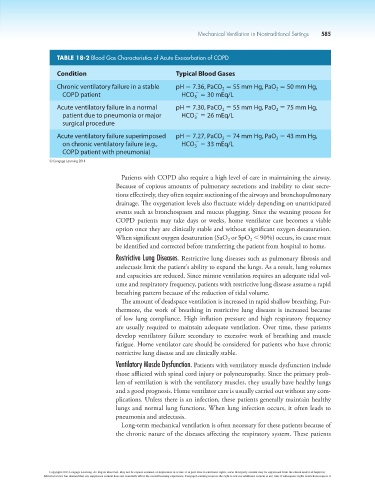
                          TABLE 18-2 Blood Gas Characteristics of Acute Exacerbation of COPD

                          Condition                              Typical Blood Gases

                          Chronic ventilatory failure in a stable   pH 5 7.36, PaCO  5 55 mm Hg, PaO  5 50 mm Hg,
                                                                                2
                                                                                                  2
                                                                        -
                            COPD patient                           HCO  5 30 mEq/L
                                                                       3
                          Acute ventilatory failure in a normal   pH 5 7.30, PaCO  5 55 mm Hg, PaO  5 75 mm Hg,
                                                                                2
                                                                                                  2
                                                                        -
                            patient due to pneumonia or major      HCO  5 26 mEq/L
                                                                       3
                            surgical procedure
                          Acute ventilatory failure superimposed   pH 5 7.27, PaCO  5 74 mm Hg, PaO  5 43 mm Hg,
                                                                                2
                                                                                                  2
                                                                        -
                            on chronic ventilatory failure (e.g.,   HCO  5 33 mEq/L
                                                                       3
                            COPD patient with pneumonia)
                        © Cengage Learning 2014
                                               Patients with COPD also require a high level of care in maintaining the airway.
                                             Because of copious amounts of pulmonary secretions and inability to clear secre-
                                             tions effectively, they often require suctioning of the airways and bronchopulmonary
                                             drainage. The oxygenation levels also fluctuate widely depending on unanticipated
                                             events such as bronchospasm and mucus plugging. Since the weaning process for
                                             COPD patients may take days or weeks, home ventilator care becomes a viable
                                             option once they are clinically stable and without significant oxygen desaturation.
                                             When significant oxygen desaturation (SaO  or SpO  , 90%) occurs, its cause must
                                                                                  2
                                                                                         2
                                             be identified and corrected before transferring the patient from hospital to home.
                                             Restrictive Lung Diseases. Restrictive lung diseases such as pulmonary fibrosis and
                                             atelectasis limit the patient’s ability to expand the lungs. As a result, lung volumes
                                             and capacities are reduced. Since minute ventilation requires an adequate tidal vol-
                                             ume and respiratory frequency, patients with restrictive lung disease assume a rapid
                                             breathing pattern because of the reduction of tidal volume.
                                               The amount of deadspace ventilation is increased in rapid shallow breathing. Fur-
                                             thermore, the work of breathing in restrictive lung diseases is increased because
                                             of low lung compliance. High inflation pressure and high respiratory frequency
                                             are usually required to maintain adequate ventilation. Over time, these patients
                                             develop ventilatory failure secondary to excessive work of breathing and muscle
                                             fatigue. Home ventilator care should be considered for patients who have chronic
                                             restrictive lung disease and are clinically stable.

                                             Ventilatory Muscle Dysfunction. Patients with ventilatory muscle dysfunction include
                                             those afflicted with spinal cord injury or polyneuropathy. Since the primary prob-
                                             lem of ventilation is with the ventilatory muscles, they usually have healthy lungs
                                             and a good prognosis. Home ventilator care is usually carried out without any com-
                                             plications. Unless there is an infection, these patients generally maintain healthy
                                             lungs and normal lung functions. When lung infection occurs, it often leads to
                                             pneumonia and atelectasis.
                                               Long-term mechanical ventilation is often necessary for these patients because of
                                             the chronic nature of the diseases affecting the respiratory system. These patients


                        Copyright 2013 Cengage Learning. All Rights Reserved. May not be copied, scanned, or duplicated, in whole or in part. Due to electronic rights, some third party content may be suppressed from the eBook and/or eChapter(s).
                      Editorial review has deemed that any suppressed content does not materially affect the overall learning experience. Cengage Learning reserves the right to remove additional content at any time if subsequent rights restrictions require it.

