


Page 625 - Clinical Application of Mechanical Ventilation
P. 625
Mechanical Ventilation in Nontraditional Settings  591


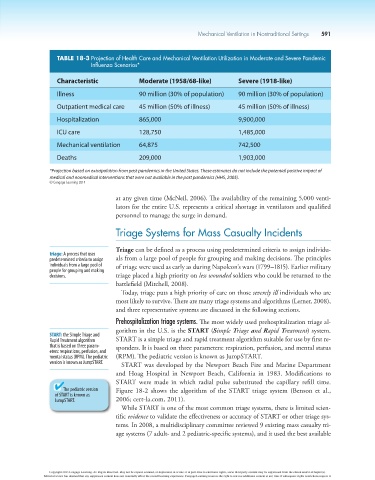
                          TABLE 18-3  Projection of Health Care and Mechanical Ventilation Utilization in Moderate and Severe Pandemic
                                     Influenza Scenarios*

                          Characteristic             Moderate (1958/68-like)         Severe (1918-like)
                          Illness                    90 million (30% of population)  90 million (30% of population)

                          Outpatient medical care    45 million (50% of illness)     45 million (50% of illness)

                          Hospitalization            865,000                         9,900,000
                          ICU care                   128,750                         1,485,000

                          Mechanical ventilation     64,875                          742,500

                          Deaths                     209,000                         1,903,000
                        *Projection based on extrapolation from past pandemics in the United States. These estimates do not include the potential positive impact of
                        medical and nonmedical interventions that were not available in the past pandemics (HHS, 2005).
                        © Cengage Learning 2014

                                             at any given time (McNeil, 2006). The availability of the remaining 5,000 venti-
                                             lators for the entire U.S. represents a critical shortage in ventilators and qualified
                                             personnel to manage the surge in demand.

                                             Triage Systems for Mass Casualty Incidents


                                             Triage can be defined as a process using predetermined criteria to assign individu-
                        triage: A process that uses
                        predetermined criteria to assign   als from a large pool of people for grouping and making decisions. The principles
                        individuals from a large pool of   of triage were used as early as during Napoleon’s wars (1799–1815). Earlier military
                        people for grouping and making
                        decisions.           triage placed a high priority on less wounded soldiers who could be returned to the
                                             battlefield (Mitchell, 2008).
                                               Today, triage puts a high priority of care on those severely ill individuals who are
                                             most likely to survive. There are many triage systems and algorithms (Lerner, 2008),
                                             and three representative systems are discussed in the following sections.

                                             Prehospitalization triage systems. The most widely used prehospitalization triage al-
                                             gorithm in the U.S. is the START (Simple Triage and Rapid Treatment) system.
                        START: the Simple Triage and
                        Rapid Treatment algorithm   START is a simple triage and rapid treatment algorithm suitable for use by first re-
                        that is based on three param-  sponders. It is based on three parameters: respiration, perfusion, and mental status
                        eters: respirations, perfusion, and
                        mental status (RPM). The pediatric   (RPM). The pediatric version is known as JumpSTART.
                        version is known as JumpSTART.   START was developed by the Newport Beach Fire and Marine Department
                                             and  Hoag  Hospital  in  Newport  Beach,  California  in  1983.  Modifications  to
                                             START  were  made  in  which  radial  pulse  substituted  the  capillary  refill  time.
                            The pediatric version   Figure 18-2 shows the algorithm of the START triage system (Benson et al.,
                          of START is known as
                          JumpSTART.         2006; cert-la.com, 2011).
                                               While START is one of the most common triage systems, there is limited scien-
                                             tific evidence to validate the effectiveness or accuracy of START or other triage sys-
                                             tems. In 2008, a multidisciplinary committee reviewed 9 existing mass casualty tri-
                                             age systems (7 adult- and 2 pediatric-specific systems), and it used the best available


                        Copyright 2013 Cengage Learning. All Rights Reserved. May not be copied, scanned, or duplicated, in whole or in part. Due to electronic rights, some third party content may be suppressed from the eBook and/or eChapter(s).
                      Editorial review has deemed that any suppressed content does not materially affect the overall learning experience. Cengage Learning reserves the right to remove additional content at any time if subsequent rights restrictions require it.

