


Page 629 - Clinical Application of Mechanical Ventilation
P. 629
Mechanical Ventilation in Nontraditional Settings  595


                                             ventilators in the stockpile (Wilgis, 2008). At the state level, each state has plans to
                                             distribute the SNS medicines and medical supplies to local communities as quickly
                                             as possible (CDC, 2010).
                                               Since  the  beginning  of  the  stockpile  program  for  mechanical  ventilators,  the
                            The LP-10 (discontinued   LP-10 and Uni-Vent Eagle 754 had been the two ventilators designated by the
                          in November of 2006) and
                          Uni-Vent Eagle 754 are being   federal government for mass casualty incidents (Malatino, 2008). The LP-10 (dis-
                          replaced with the LTV 1200   continued in November of 2006) and Uni-Vent Eagle 754 are being replaced with
                          (CareFusion) and Newport
                          HT50 portable ventilators.  the LTV 1200 (CareFusion) and Newport HT50 portable ventilators. Readers may
                                             refer to the manufacturer websites to obtain the respective technical specifications
                                             and operating manuals. Other than the ventilators in the federal SNS program,
                                             there are other portable ventilators that may be suitable for use in mass casualty
                                             incidents (e.g., EPV 100, Allied Healthcare Products, Inc.).


                                             Exclusion Criteria for Mechanical Ventilation


                                             The number of ventilators in the Strategic National Stockpile is clearly insufficient
                                             for the projected number of people needing mechanical ventilation in a major mass
                                             casualty incidence (AARC, 2006; HHS, 2005). Exclusion criteria for ventilator ac-
                                             cess have been developed to prioritize the allocation of a limited number of ventila-
                                             tors in the event of a mass casualty incident.
                            The NYS DOH exclusion
                          criteria are based on objective   For example, the New York State Department of Health (NYS DOH) outlined
                          clinical conditions and do not
                          rely on ethical or quality-of-  the exclusion criteria for ventilator access (NYS DOH, 2007). The exclusion criteria
                          life issues. Individuals meet-  are based on objective clinical conditions and do not rely on ethical or quality-of-
                          ing these exclusion criteria
                          would not be placed on a   life issues. They focus on a person’s history of cardiac arrest, presence of metastatic
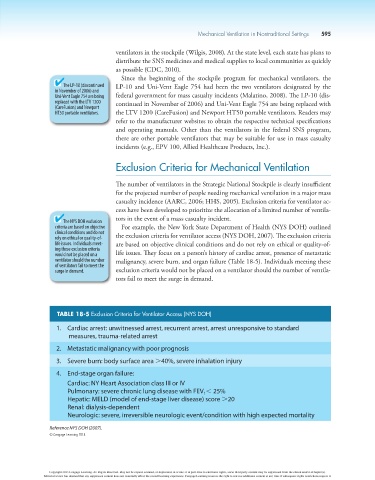
                          ventilator should the number   malignancy, severe burn, and organ failure (Table 18-5). Individuals meeting these
                          of ventilators fail to meet the
                          surge in demand.   exclusion criteria would not be placed on a ventilator should the number of ventila-
                                             tors fail to meet the surge in demand.


                          TABLE 18-5 Exclusion Criteria for Ventilator Access (NYS DOH)

                          1.  Cardiac arrest: unwitnessed arrest, recurrent arrest, arrest unresponsive to standard
                              measures, trauma-related arrest
                          2.  Metastatic malignancy with poor prognosis

                          3.  Severe burn: body surface area .40%, severe inhalation injury

                          4.  End-stage organ failure:
                              Cardiac: NY Heart Association class III or IV
                              Pulmonary: severe chronic lung disease with FEV , 25%
                                                                          1
                              Hepatic: MELD (model of end-stage liver disease) score .20
                              Renal: dialysis-dependent
                              Neurologic: severe, irreversible neurologic event/condition with high expected mortality

                        Reference NYS DOH (2007).
                        © Cengage Learning 2014


                        Copyright 2013 Cengage Learning. All Rights Reserved. May not be copied, scanned, or duplicated, in whole or in part. Due to electronic rights, some third party content may be suppressed from the eBook and/or eChapter(s).
                      Editorial review has deemed that any suppressed content does not materially affect the overall learning experience. Cengage Learning reserves the right to remove additional content at any time if subsequent rights restrictions require it.

