


Page 638 - Clinical Application of Mechanical Ventilation
P. 638
604    Chapter 18


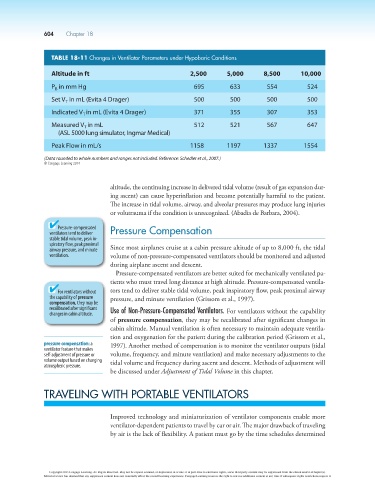
                        TABLE 18-11 Changes in Ventilator Parameters under Hypobaric Conditions

                        Altitude in ft                                2,500       5,000       8,500       10,000

                        P  in mm Hg                                    695         633         554           524
                          B
                        Set V  in mL (Evita 4 Drager)                  500         500         500           500
                             T
                        Indicated V in mL (Evita 4 Drager)             371         355         307           353
                                   T
                        Measured V in mL                               512         521         567           647
                                   T
                          (ASL 5000 lung simulator, Ingmar Medical)
                        Peak Flow in mL/s                             1158        1197        1337         1554

                      (Data rounded to whole numbers and ranges not included. Reference: Schedler et al., 2007.)
                      © Cengage Learning 2014


                                            altitude, the continuing increase in delivered tidal volume (result of gas expansion dur-
                                            ing ascent) can cause hyperinflation and become potentially harmful to the patient.
                                            The increase in tidal volume, airway, and alveolar pressures may produce lung injuries
                                            or volutrauma if the condition is unrecognized. (Abadia de Barbara, 2004).

                          Pressure-compensated   Pressure Compensation
                        ventilators tend to deliver
                        stable tidal volume, peak in-
                        spiratory flow, peak proximal
                        airway pressure, and minute   Since most airplanes cruise at a cabin pressure altitude of up to 8,000 ft, the tidal
                        ventilation.        volume of non-pressure-compensated ventilators should be monitored and adjusted
                                            during airplane ascent and descent.
                                             Pressure-compensated ventilators are better suited for mechanically ventilated pa-
                                            tients who must travel long distance at high altitude. Pressure-compensated ventila-
                          For ventilators without   tors tend to deliver stable tidal volume, peak inspiratory flow, peak proximal airway
                        the capability of pressure   pressure, and minute ventilation (Grissom et al., 1997).
                        compensation, they may be
                        recalibrated after significant   Use of Non-Pressure-Compensated Ventilators. For ventilators without the capability
                        changes in cabin altitude.
                                            of pressure compensation, they may be recalibrated after significant changes in
                                            cabin altitude. Manual ventilation is often necessary to maintain adequate ventila-
                                            tion and oxygenation for the patient during the calibration period (Grissom et al.,
                      pressure compensation: a   1997). Another method of compensation is to monitor the ventilator outputs (tidal
                      ventilator feature that makes
                      self-adjustment of pressure or   volume, frequency, and minute ventilation) and make necessary adjustments to the
                      volume output based on changing   tidal volume and frequency during ascent and descent. Methods of adjustment will
                      atmospheric pressure.
                                            be discussed under Adjustment of Tidal Volume in this chapter.


                      TRAVELING WITH PORTABLE VENTILATORS


                                            Improved technology and miniaturization of ventilator components enable more
                                            ventilator-dependent patients to travel by car or air. The major drawback of traveling
                                            by air is the lack of flexibility. A patient must go by the time schedules determined


                        Copyright 2013 Cengage Learning. All Rights Reserved. May not be copied, scanned, or duplicated, in whole or in part. Due to electronic rights, some third party content may be suppressed from the eBook and/or eChapter(s).
                      Editorial review has deemed that any suppressed content does not materially affect the overall learning experience. Cengage Learning reserves the right to remove additional content at any time if subsequent rights restrictions require it.

