


Page 637 - Clinical Application of Mechanical Ventilation
P. 637
Mechanical Ventilation in Nontraditional Settings  603


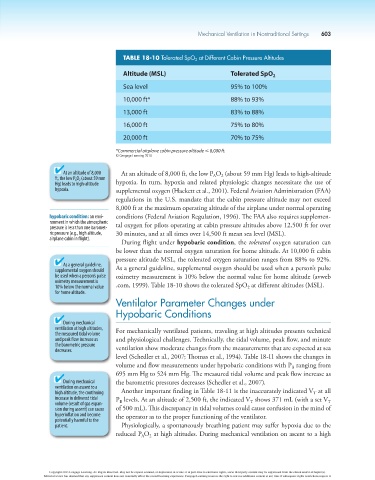
                                                TABLE 18-10 Tolerated SpO 2  at Different Cabin Pressure Altitudes

                                                Altitude (MSL)                     Tolerated SpO 2

                                                Sea level                          95% to 100%

                                                10,000 ft*                         88% to 93%
                                                13,000 ft                          83% to 88%

                                                16,000 ft                          75% to 80%
                                                20,000 ft                          70% to 75%

                                             *Commercial airplane cabin pressure altitude # 8,000 ft.
                                             © Cengage Learning 2014


                            At an altitude of 8,000   At an altitude of 8,000 ft, the low P O  (about 59 mm Hg) leads to high-altitude
                          ft, the low P A O 2  (about 59 mm                  A  2
                          Hg) leads to high-altitude   hypoxia. In turn, hypoxia and related physiologic changes necessitate the use of
                          hypoxia.           supplemental oxygen (Hackett et al., 2001). Federal Aviation Administration (FAA)
                                             regulations in the U.S. mandate that the cabin pressure altitude may not exceed
                                             8,000 ft at the maximum operating altitude of the airplane under normal operating
                        hypobaric condition: an envi-  conditions (Federal Aviation Regulation, 1996). The FAA also requires supplemen-
                        ronment in which the atmospheric   tal oxygen for pilots operating at cabin pressure altitudes above 12,500 ft for over
                        pressure is less than one baromet-
                        ric pressure (e.g., high altitude,   30 minutes, and at all times over 14,500 ft mean sea level (MSL).
                        airplane cabin in flight).
                                               During flight under hypobaric condition, the tolerated oxygen saturation can
                                             be lower than the normal oxygen saturation for home altitude. At 10,000 ft cabin
                                             pressure altitude MSL, the tolerated oxygen saturation ranges from 88% to 92%.
                            As a general guideline,   As a general guideline, supplemental oxygen should be used when a person’s pulse
                          supplemental oxygen should
                          be used when a person’s pulse   oximetry measurement is 10% below the normal value for home altitude (avweb
                          oximetry measurement is
                          10% below the normal value   .com, 1999). Table 18-10 shows the tolerated SpO  at different altitudes (MSL).
                                                                                        2
                          for home altitude.
                                             Ventilator Parameter Changes under
                                             Hypobaric Conditions
                            During mechanical
                          ventilation at high altitudes,   For mechanically ventilated patients, traveling at high altitudes presents technical
                          the measured tidal volume
                          and peak flow increase as   and physiological challenges. Technically, the tidal volume, peak flow, and minute
                          the barometric pressure
                          decreases.         ventilation show moderate changes from the measurements that are expected at sea
                                             level (Schedler et al., 2007; Thomas et al., 1994). Table 18-11 shows the changes in
                                             volume and flow measurements under hypobaric conditions with P  ranging from
                                                                                                       B
                                             695 mm Hg to 524 mm Hg. The measured tidal volume and peak flow increase as
                            During mechanical   the barometric pressures decreases (Schedler et al., 2007).
                          ventilation on ascent to a
                          high altitude, the continuing   Another important finding in Table 18-11 is the inaccurately indicated V  at all
                                                                                                              T
                          increase in delivered tidal   P  levels. At an altitude of 2,500 ft, the indicated V  shows 371 mL (with a set V
                          volume (result of gas expan-  B                                T                         T
                          sion during ascent) can cause   of 500 mL). This discrepancy in tidal volumes could cause confusion in the mind of
                          hyperinflation and become   the operator as to the proper functioning of the ventilator.
                          potentially harmful to the
                          patient.             Physiologically, a spontaneously breathing patient may suffer hypoxia due to the
                                             reduced P O  at high altitudes. During mechanical ventilation on ascent to a high
                                                      A
                                                        2


                        Copyright 2013 Cengage Learning. All Rights Reserved. May not be copied, scanned, or duplicated, in whole or in part. Due to electronic rights, some third party content may be suppressed from the eBook and/or eChapter(s).
                      Editorial review has deemed that any suppressed content does not materially affect the overall learning experience. Cengage Learning reserves the right to remove additional content at any time if subsequent rights restrictions require it.

