


Page 670 - Clinical Application of Mechanical Ventilation
P. 670
636    Chapter	19


                                             While the activated charcoal was being administered, the airways and lungs were
                          Repeat suctioning is   lavaged with normal saline and suctioned. This procedure was repeated until the
                        indicated because watery
                        brown secretions (stomach   return solution became clear.
                        content) have been suctioned   A chest radiograph done later showed that the ET tube was 4 cm above the
                        from the ET tube.
                                            carina. Hazy infiltrates were noted in both lungs indicating that the patient had
                                            aspirated.
                                             Another blood gas was drawn with the patient intubated and being bagged at a fre-
                                            quency of 20/min. The results were: pH 7.34, PCO  35 mm Hg, PO  350 mm Hg.
                                                                                      2
                                                                                                     2
                                            Initial Settings


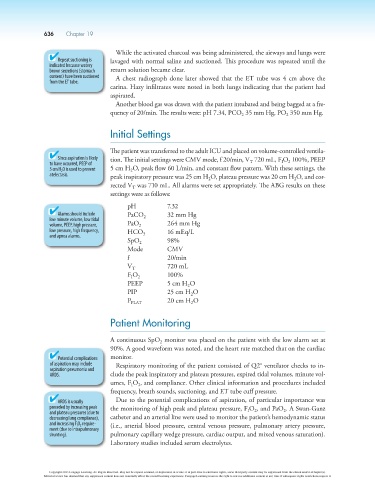
                                            The patient was transferred to the adult ICU and placed on volume-controlled ventila-
                           Since aspiration is likely   tion. The initial settings were CMV mode, f 20/min, V  720 mL, F O  100%, PEEP
                        to have occurred, PEEP of                                        T          I  2
                        5 cm H 2 O is used to prevent   5 cm H O, peak flow 60 L/min, and constant flow pattern. With these settings, the
                                                  2
                        atelectasis.        peak inspiratory pressure was 25 cm H O, plateau pressure was 20 cm H O, and cor-
                                                                            2
                                                                                                        2
                                            rected V  was 710 mL. All alarms were set appropriately. The ABG results on these
                                                   T
                                            settings were as follows:
                                                 pH           7.32
                          Alarms should include      PaCO     32 mm Hg
                        low minute volume, low tidal   2
                        volume, PEEP, high pressure,      PaO 2   264 mm Hg
                                                       -
                        low pressure, high frequency,      HCO    16 mEq/L
                        and apnea alarms.             3
                                                 SpO 2        98%
                                                 Mode         CMV
                                                 f            20/min
                                                 V T          720 mL
                                                 F O 2        100%
                                                  I
                                                 PEEP         5 cm H O
                                                                     2
                                                 PIP          25 cm H O
                                                                      2
                                                 P PLAT       20 cm H O
                                                                      2

                                            Patient Monitoring

                                            A continuous SpO  monitor was placed on the patient with the low alarm set at
                                                            2
                                            90%. A good waveform was noted, and the heart rate matched that on the cardiac
                           Potential complications   monitor.
                        of aspiration may include   Respiratory monitoring of the patient consisted of Q2° ventilator checks to in-
                        aspiration pneumonia and
                        ARDS.               clude the peak inspiratory and plateau pressures, expired tidal volumes, minute vol-
                                            umes, F O , and compliance. Other clinical information and procedures included
                                                  I
                                                     2
                                            frequency, breath sounds, suctioning, and ET tube cuff pressure.
                          ARDS is usually    Due to the potential complications of aspiration, of particular importance was
                        preceded by increasing peak   the monitoring of high peak and plateau pressure, F O , and PaO . A Swan-Ganz
                        and plateau pressures (due to                                   I  2        2
                        decreasing lung compliance),   catheter and an arterial line were used to monitor the patient’s hemodynamic status
                        and increasing F I O 2  require-  (i.e., arterial blood pressure, central venous pressure, pulmonary artery pressure,
                        ment (due to intrapulmonary
                        shunting).          pulmonary capillary wedge pressure, cardiac output, and mixed venous saturation).
                                            Laboratory studies included serum electrolytes.


                        Copyright 2013 Cengage Learning. All Rights Reserved. May not be copied, scanned, or duplicated, in whole or in part. Due to electronic rights, some third party content may be suppressed from the eBook and/or eChapter(s).
                      Editorial review has deemed that any suppressed content does not materially affect the overall learning experience. Cengage Learning reserves the right to remove additional content at any time if subsequent rights restrictions require it.

