


Page 715 - Clinical Application of Mechanical Ventilation
P. 715
Case	Studies  681


                                               On the third day following admission, the pulmonologist attempted to wean F.W.
                                             from bilevel PAP. She was placed on CPAP at 7.5 cm H O and ABGs were drawn
                                                                                             2
                                             an hour later; the results were as follows:
                                                   pH           7.16
                            CPAP alone increases the      PaCO  91 mm Hg
                          work of breathing. Patient    2
                          requires some mechanical      PaO 2   66 mm Hg
                          assistance via bilevel PAP (i.e.,      HCO    31 mEq/L
                                                         -
                          IPAP).                        3
                                                   SaO 2        90%
                                               As a result of her deteriorating blood gas results and clinical condition, F.W. was
                                             placed back on bilevel PAP at 12/6 cm H O for 24 hours. Over the next several
                                                                                  2
                                             days, she was gradually weaned to 1 L/min via nasal cannula during the day and bi-
                                             level PAP at night. The physician discussed several options with F.W. and her family,
                                             and it was decided that upon discharge from the hospital she would use nocturnal
                                             ventilation at home. Her total hospital stay was 11 days.
                                             Home Care Management


                                             Twenty-four hours prior to discharge from the hospital, the case manager contacted
                                             a local home medical equipment provider for respiratory services and a home care
                                             agency for nursing services. Among other health care professionals, this case was
                                             reviewed with the respiratory therapist. Due to the complexity of her pulmonary
                                             condition and special management requirements, the physician decided to directly
                                             communicate with the respiratory therapist from the medical equipment company.
                                               Arterial blood gases on day of discharge were as follows:
                                                   pH           7.32
                                                   PaCO 2       60 mm Hg
                                                   PaO 2        62 mm Hg
                                                         -
                                                   HCO          30 mEq/L
                                                        3
                                                   SaO 2        93%
                                                   Bilevel PAP   12/6 cm H O
                                                                         2
                                                   Oxygen         1 L/min via nasal cannula during the day and bilevel PAP
                                                                therapy at 12/6 cm H O, F O  of 24% at night
                                                                                       I
                                                                                  2
                                                                                         2
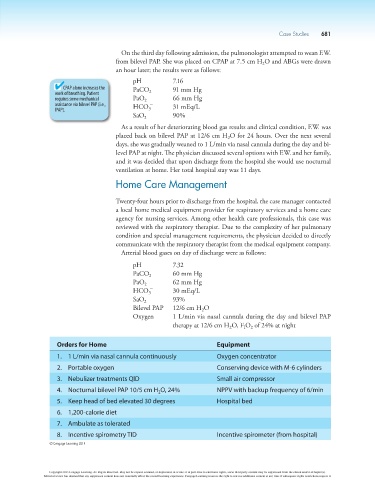
                          Orders for Home                                     Equipment
                          1.  1 L/min via nasal cannula continuously          Oxygen concentrator
                          2.  Portable oxygen                                 Conserving device with M-6 cylinders

                          3.  Nebulizer treatments QID                        Small air compressor
                          4.  Nocturnal bilevel PAP 10/5 cm H O, 24%          NPPV with backup frequency of 6/min
                                                           2
                          5.  Keep head of bed elevated 30 degrees            Hospital bed
                          6.  1,200-calorie diet

                          7.  Ambulate as tolerated
                          8.  Incentive spirometry TID                        Incentive spirometer (from hospital)
                        © Cengage Learning 2014


                        Copyright 2013 Cengage Learning. All Rights Reserved. May not be copied, scanned, or duplicated, in whole or in part. Due to electronic rights, some third party content may be suppressed from the eBook and/or eChapter(s).
                      Editorial review has deemed that any suppressed content does not materially affect the overall learning experience. Cengage Learning reserves the right to remove additional content at any time if subsequent rights restrictions require it.

