


Page 713 - Clinical Application of Mechanical Ventilation
P. 713
Case	Studies  679


                                             dyspnea in addition to orthopnea. She was placed on a monitor that revealed these
                            Paroxysmal nocturnal   vital signs: blood pressure of 160/80 mm Hg, heart rate of 128/min, respiratory
                          dyspnea and orthopnea are
                          signs of congestive heart   frequency of 28/min and labored, and SpO  of 85% on room air.
                                                                                  2
                          failure.
                                               Further  assessment  showed  11  to  21  pedal  edema,  jugular  vein  distension,
                                             bibasilar crackles, and wheezes throughout.
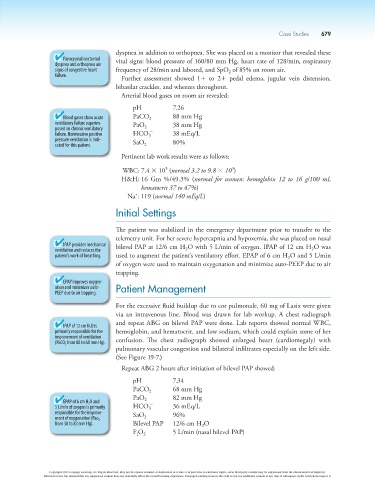
                                               Arterial blood gases on room air revealed:
                                                   pH           7.26
                            Blood gases show acute      PaCO 2   88 mm Hg
                          ventilatory failure superim-     PaO  38 mm Hg
                          posed on chronic ventilatory   2
                                                         -
                          failure. Noninvasive positive      HCO    38 mEq/L
                                                        3
                          pressure ventilation is indi-     SaO  80%
                          cated for this patient.      2
                                               Pertinent lab work results were as follows:
                                                              3
                                                                                   3
                                                WBC: 7.4 3 10  (normal 3.2 to 9.8 3 10 )
                                               H&H:  16  Gm  %/49.3%  (normal  for  women:  hemoglobin  12  to  16  g/100  mL
                                                      hematocrit 37 to 47%)
                                                    +
                                                 Na : 119 (normal 140 mEq/L)
                                             Initial Settings


                                             The patient was stabilized in the emergency department prior to transfer to the
                                             telemetry unit. For her severe hypercapnia and hypoxemia, she was placed on nasal
                            IPAP provides mechanical   bilevel PAP at 12/6 cm H O with 5 L/min of oxygen. IPAP of 12 cm H O was
                          ventilation and reduces the               2                                        2
                          patient’s work of breathing.  used to augment the patient’s ventilatory effort. EPAP of 6 cm H O and 5 L/min
                                                                                                      2
                                             of oxygen were used to maintain oxygenation and minimize auto-PEEP due to air
                                             trapping.
                            EPAP improves oxygen-
                          ation and minimizes auto-  Patient Management
                          PEEP due to air trapping.

                                             For the excessive fluid buildup due to cor pulmonale, 60 mg of Lasix were given
                                             via an intravenous line. Blood was drawn for lab workup. A chest radiograph
                                             and repeat ABG on bilevel PAP were done. Lab reports showed normal WBC,
                            IPAP of 12 cm H 2 O is
                          primarily responsible for the   hemoglobin, and hematocrit, and low sodium, which could explain some of her
                          improvement of ventilation
                          (PaCO 2  from 88 to 68 mm Hg).  confusion.  The  chest  radiograph  showed  enlarged  heart  (cardiomegaly)  with
                                             pulmonary vascular congestion and bilateral infiltrates especially on the left side.
                                             (See Figure 19-7.)
                                               Repeat ABG 2 hours after initiation of bilevel PAP showed:

                                                   pH           7.34
                                                   PaCO 2       68 mm Hg
                                                   PaO          82 mm Hg
                            EPAP of 6 cm H 2 O and     2   -
                          5 L/min of oxygen is primarily      HCO    36 mEq/L
                                                        3
                          responsible for the improve-     SaO  96%
                          ment of oxygenation (Pao 2    2
                          from 38 to 82 mm Hg).     Bilevel PAP   12/6 cm H O
                                                                         2
                                                   F O 2        5 L/min (nasal bilevel PAP)
                                                    I


                        Copyright 2013 Cengage Learning. All Rights Reserved. May not be copied, scanned, or duplicated, in whole or in part. Due to electronic rights, some third party content may be suppressed from the eBook and/or eChapter(s).
                      Editorial review has deemed that any suppressed content does not materially affect the overall learning experience. Cengage Learning reserves the right to remove additional content at any time if subsequent rights restrictions require it.

