


Page 128 - Cardiac Nursing
P. 128
LWBK340-c04_p097-110.qxd  30/06/2009  10:40 AM  Page 104 Aptara


                  104    PA R T  II / Physiologic and Pathologic Responses

                  greater than those associated with elevated cholesterol level, smok-
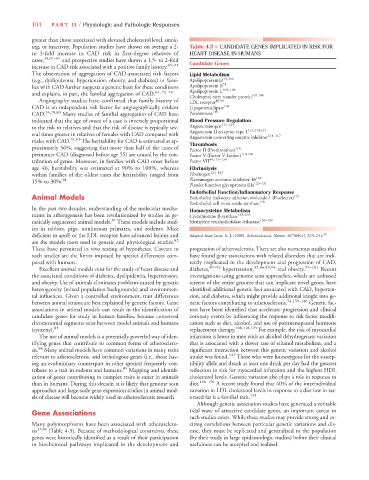
                  ing, or inactivity. Population studies have shown on average a 2-  Table 4-3 ■ CANDIDATE GENES IMPLICATED IN RISK FOR
                  to 3-fold increase in CAD risk in  first-degree relatives of  HEART DISEASE IN HUMANS
                  cases, 35,61–64  and prospective studies have shown a 1.5- to 2-fold  Candidate Genes
                  increase in CAD risk associated with a positive family history. 65–71
                  The observation of aggregation of CAD-associated risk factors  Lipid Metabolism
                  (e.g., dyslipidemia, hypertension, obesity, and diabetes) in fami-  Apolipoprotein(a) 74,102
                  lies with CAD further suggests a genetic basis for these conditions  Apolipoprotein B 51
                                                                                 103–106
                  and explains, in part, the familial aggregation of CAD. 64, 72–78  Apolipoprotein E  107,108
                                                                      Cholesterol ester transfer protein
                     Angiography studies have confirmed that family history of  LDL receptor 49,50
                  CAD is an independent risk factor for angiographically evident  Lipoprotein lipase 109
                  CAD. 76,79,80  Many studies of familial aggregation of CAD have  Paraoxonase 110
                  indicated that the age of onset of a case is inversely proportional  Blood Pressure Regulation
                  to the risk to relatives and that the risk of disease is typically sev-  Angiotensinogen 111–114  112,114,115
                  eral times greater in relatives of females with CAD compared with  Angiotensin II receptor, type 1  114–117
                                                                      Angiotensin-converting enzyme inhibitor
                  males with CAD. 61,63  The heritability for CAD is estimated at ap-  Thrombosis
                  proximately 56%, suggesting that more than half of the cases of  Factor II (Prothrombin) 118
                  premature CAD (diagnosed before age 55) are caused by the con-  Factor V (Factor V Leiden) 119,120
                  tribution of genes. Moreover, in families with CAD onset before  Factor VII 49,121–124
                  age 46, heritability was estimated at 90% to 100%, whereas  Fibrinolysis
                  within families of the oldest cases the heritability ranged from  Fibrinogen 124–127  128
                  15% to 30%. 61                                      Plasminogen activator inhibitor-1b
                                                                      Platelet function glycoprotein IIIa 129–131
                                                                      Endothelial Function/Inflammatory Response
                  Animal Models                                       Endothelial leukocyte adhesion molecule-1 (E-selectin) 132
                                                                      Endothelial cell nitric oxide synthase 129
                  In the past two decades, understanding of the molecular mecha-  Homocysteine Metabolism
                  nisms in atherogenesis has been revolutionized by studies in ge-  Cystathionine  -synthase 133–135
                                            81
                  netically engineered animal models. These models include stud-  Methylene tetrahydrofolate reductase 136–138
                  ies in rabbits, pigs, nonhuman primates, and rodents. Mice
                  deficient in apoE or the LDL receptor have advanced lesions and  Adapted from Lusis, A. J. [2000]. Atherosclerosis. Nature, 407[6801], 233–241. 27
                  are the models most used in genetic and physiological studies. 82
                  These have permitted in vivo testing of hypotheses. Caveats to  progression of atherosclerosis. There are also numerous studies that
                  such studies are the limits imposed by species differences com-  have found gene associations with related disorders that are indi-
                  pared with humans.                                  rectly implicated in the development and progression of CAD,
                     Excellent animal models exist for the study of heart disease and  diabetes,  87–92  hypertension, 35,46,93,94  and obesity. 95–101  Recent
                  the associated conditions of diabetes, dyslipidemia, hypertension,  investigations using genome scan approaches, which are unbiased
                  and obesity. Use of animals eliminates problems caused by genetic  screens of the entire genome that can implicate novel genes, have
                  heterogeneity (mixed population backgrounds) and environmen-  identified additional genetic loci associated with CAD, hyperten-
                  tal influences. Given a controlled environment, trait differences  sion, and diabetes, which might provide additional insight into ge-
                  between animal strains are best explained by genetic factors. Gene  netic factors contributing to atherosclerosis. 74,139–146  Genetic fac-
                  associations in animal models can result in the identification of  tors have been identified that accelerate progression and clinical
                  candidate genes for study in human families, because conserved  coronary events by influencing the response to risk factor modifi-
                  chromosomal segments exist between model animals and humans  cation such as diet, alcohol, and use of postmenopausal hormone
                  (synteny). 83                                       replacement therapy. 108,118,123  For example, the risk of myocardial
                     The use of animal models is a potentially powerful way of iden-  infarction is lower in men with an alcohol dehydrogenase variation
                  tifying genes that contribute to common forms of atherosclero-  that is associated with a slower rate of ethanol metabolism, and a
                     84
                  sis. Many animal models have common variations in many traits  significant interaction between this genetic variation and alcohol
                  relevant to atherosclerosis, and orthologous genes (i.e., those hav-  intake was found. 147  Those who were homozygous for the suscep-
                  ing an evolutionary counterpart in other species) frequently con-  tibility allele and drank at least one drink per day had the greatest
                  tribute to a trait in rodents and humans. 85  Mapping and identifi-  reduction in risk for myocardial infarction and the highest HDL
                  cation of genes contributing to complex traits is easier in animals  cholesterol levels. Genetic variation also plays a role in response to
                  than in humans. During this decade, it is likely that genome scan  diet. 148–150  A recent study found that 40% of the interindividual
                  approaches and large-scale gene expression studies in animal mod-  variation in LDL cholesterol levels in response to a diet low in sat-
                  els of disease will become widely used in atherosclerosis research.  urated fat is a familial trait. 151
                                                                        Although genetic association studies have generated a veritable
                  Gene Associations                                   tidal wave of attractive candidate genes, an important caveat to
                                                                      such studies exists. While these studies may provide strong and ex-
                  Many polymorphisms have been associated with atherosclero-  citing correlations between particular genetic variations and dis-
                  sis 27,86  (Table 4-3). Because of methodological constraints, these  ease, they must be replicated and generalized to the population
                  genes were historically identified as a result of their participation  (by their study in large epidemiologic studies) before their clinical
                  in biochemical pathways implicated in the development and  usefulness can be accepted and realized.

