


Page 126 - Cardiac Nursing
P. 126
LWBK340-c04_p097-110.qxd  30/06/2009  10:40 AM  Page 102 Aptara


                  102    PA R T  II / Physiologic and Pathologic Responses

                  Recently, attention has focused on a group of inherited gene muta-  Generally, the manifestation of CAD is caused by the interac-
                  tions in cardiac ion channels that cause long QT syndrome with an  tion of several genetic and environmental factors, with those pa-
                  increased risk for sudden death. The age of onset for long QT-  tients with the greatest number of risk factors, including genetic
                  related death is the early 30s, with men disproportionately affected.  and environmental, facing the highest risk at earlier ages. Several
                  Most cardiac events are precipitated by intense exercise or emo-  biochemical processes are involved in atherosclerosis formation,
                  tional stress, but they can also occur during sleep. Unfortunately,  progression, and culmination as acute coronary syndromes. Lipid
                  not all persons with long QT syndrome have previous symptoms or  and apolipoprotein metabolism, inflammatory response, endothe-
                  identifiable electrocardiographic abnormalities and may present  lial function, platelet function, thrombosis, fibrinolysis, homocys-
                  with sudden death. Antiarrhythmic agents and implantable defib-  teine metabolism, insulin sensitivity, and blood pressure regulation
                  rillators are used for the treatment of long QT syndrome, although  have been demonstrated to influence disease pathophysiology. 28–30
                  identification of the specific gene variants underlying this syndrome  Each of these biochemical processes involves the complex inter-
                  will almost certainly better direct prophylactic therapy. 14  play of enzymes, receptors, and ligands encoded by our genes, the
                                                                      expressions of which are also influenced by environmental factors.
                                                                      Genetic variations can modulate the  function of these con-
                     THE GENETICS OF                                  stituents, resulting in altered susceptibility to the development
                     CARDIOVASCULAR DISEASE                           and progression of CAD. 31  Several well-established environmen-
                                                                      tal risk factors that predispose to CAD have also been identified
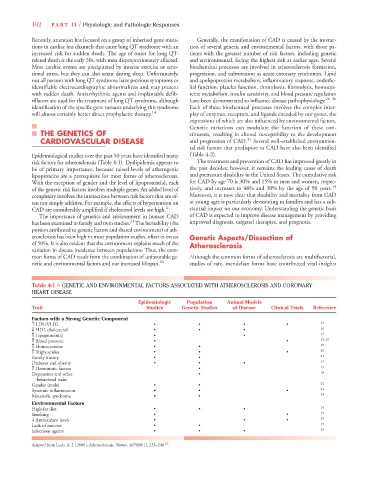
                  Epidemiological studies over the past 50 years have identified many  (Table 4-2).
                  risk factors for atherosclerosis (Table 4-1). Dyslipidemia appears to  The treatment and prevention of CAD has improved greatly in
                  be of primary importance, because raised levels of atherogenic  the past decades; however, it remains the leading cause of death
                  lipoproteins are a prerequisite for most forms of atherosclerosis.  and premature disability in the United States. The cumulative risk
                  With the exception of gender and the level of lipoprotein(a), each  for CAD by age 70 is 30% and 15% in men and women, respec-
                  of the genetic risk factors involves multiple genes. An added level of  tively, and increases to 48% and 30% by the age of 90 years. 44
                  complexity involves the interactions between risk factors that are of-  Moreover, it is now clear that disability and mortality from CAD
                  ten not simply additive. For example, the effects of hypertension on  at young ages is particularly devastating to families and has a sub-
                  CAD are considerably amplified if cholesterol levels are high. 24  stantial impact on our economy. Understanding the genetic basis
                     The importance of genetics and environment in human CAD  of CAD is expected to improve disease management by providing
                                                   21
                  has been examined in family and twin studies. The heritability (the  improved diagnosis, targeted therapies, and prognosis.
                  portion attributed to genetic factors and shared environment) of ath-
                  erosclerosis has been high in most population studies, often in excess  Genetic Aspects/Dissection of
                  of 50%. It is also evident that the environment explains much of the  Atherosclerosis
                  variation in disease incidence between populations. Thus, the com-
                  mon forms of CAD result from the combination of unfavorable ge-  Although the common forms of atherosclerosis are multifactorial,
                  netic and environmental factors and our increased lifespan. 24  studies of rare, mendelian forms have contributed vital insights


                  Table 4-1 ■ GENETIC AND ENVIRONMENTAL FACTORS ASSOCIATED WITH ATHEROSCLEROSIS AND CORONARY
                  HEART DISEASE
                                                     Epidemiologic   Population   Animal Models
                  Trait                                 Studies    Genetic Studies  of Disease   Clinical Trials  Reference
                  Factors with a Strong Genetic Component
                  c LDL/VLDL                              •              •              •             •          15
                  T HDL cholesterol                       •              •              •                        16
                  c Lipoprotein(a)                        •                             •                        17
                  c Blood pressure                        •                                           •          15,18
                  c Homocysteine                          •              •                                       19
                  c Triglycerides                         •              •                            •          20
                  Family history                          •              •                                       21
                  Diabetes and obesity                    •              •              •                        15
                  c Hemostatic factors                                   •                                       15
                  Depression and other                                   •                                       18
                    behavioral traits
                  Gender (male)                           •              •                                       22
                  Systemic inflammation                    •              •                            •          23
                  Metabolic syndrome                      •              •                                       24
                  Environmental Factors
                  High-fat diet                           •              •              •                        15
                  Smoking                                 •                                           •          15
                  T Antioxidant levels                    •                             •             •          25
                  Lack of exercise                        •              •                                       15
                  Infectious agents                       •              •              •                        26

                  Adapted from Lusis, A. J. [2000]. Atherosclerosis. Nature, 407[6801], 233–241. 27

