


Page 123 - Cardiac Nursing
P. 123
0/0
                              0/0
                             3
                              3
                             3
                                6/2
                                     1
                                     1
                                  009
                                6/2
                                  009
                           xd
                      7-1
                      7-1
                    09
                   p
                    09
                        10.
                          q
                           xd
                          q
                        10.
                          q
                                                9 A
                                                   p
                                                9 A
                                               e 9
                                               e 9
                                                   p
                                                     ra
                                                     ra
                                                   ta
                                                   p
                                                   ta
                                              g
                                        0 A
                                          M
                                        0 A
                                      0:4
                                      0:4
                                          M
                                              g
                                              g
                                            Pa
                                          M
                                            Pa
         LWB
         LWBK340-c04_
         LWB K34 0-c 04_ p pp097-110.qxd  30/06/2009  10:40 AM  Page 99 Aptara
            K34
                 04_
               0-c
                                                                                            C HAPTER 4 / Genetics    99
                                                                       segments that remain (termed exons) are spliced together, formings
                                                                       the mature mRNA; these abridged versions of our genes encode
                                                                       for proteins. In some cases, a length of newly transcribed RNA
                                                                       can be processed in different ways; the sequence of exons used can
                                                                       be spliced together in different combinations to make a variety of
                                                                       different proteins. Thus, a single gene can produce or express a di-
                                                                       verse series of protein products, depending on the cell type, tim-
                                                                       ing, and ambient activating conditions. This explains in part how
                                                                       identical embryonic cells differentiate to become a variety of dif-
                                                                       ferent tissues. Similarly, cardiac cells synthesize proteins required
                                                                       for that organ’s structure and function, whereas liver cells make
                                                                       proteins important in the metabolic functions of that organ.
                                                                         DNA AND HUMAN DIVERSITY
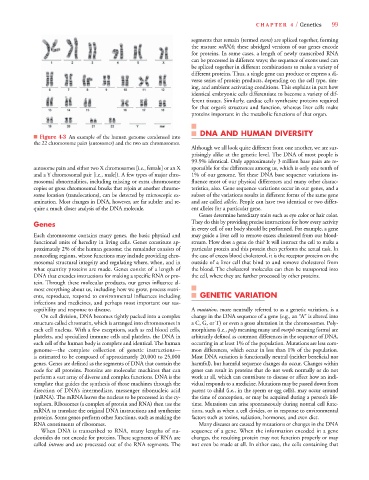
                   ■ Figure 4-3 An example of the human genome condensed into
                   the 22 chromosome pairs (autosomes) and the two sex chromosomes.
                                                                       Although we all look quite different from one another, we are sur-
                                                                       prisingly alike at the genetic level. The DNA of most people is
                                                                       99.9% identical. Only approximately 3 million base pairs are re-
                   autosome pairs and either two X chromosomes [i.e., female] or an X  sponsible for the differences among us, which is only one tenth of
                   and a Y chromosomal pair [i.e., male]). A few types of major chro-  1% of our genome. Yet these DNA base sequence variations in-
                   mosomal abnormalities, including missing or extra chromosome  fluence most of our physical differences and many other charac-
                   copies or gross chromosomal breaks that rejoin at another chromo-  teristics, also. Gene sequence variations occur in our genes, and a
                   some location (translocations), can be detected by microscopic ex-  subset of the variations results in different forms of the same gene
                   amination. Most changes in DNA, however, are far subtler and re-  and are called alleles. People can have two identical or two differ-
                   quire a much closer analysis of the DNA molecule.   ent alleles for a particular gene.
                                                                         Genes determine hereditary traits such as eye color or hair color.
                   Genes                                               They do this by providing precise instructions for how every activity
                                                                       in every cell of our body should be performed. For example, a gene
                   Each chromosome contains many genes, the basic physical and  may guide a liver cell to remove excess cholesterol from our blood-
                   functional units of heredity in living cells. Genes constitute ap-  stream. How does a gene do this? It will instruct the cell to make a
                   proximately 2% of the human genome; the remainder consists of  particular protein and this protein then performs the actual task. In
                   noncoding regions, whose functions may include providing chro-  the case of excess blood cholesterol, it is the receptor proteins on the
                   mosomal structural integrity and regulating where, when, and in  outside of a liver cell that bind to and remove cholesterol from
                   what quantity proteins are made. Genes consist of a length of  the blood. The cholesterol molecules can then be transported into
                   DNA that encodes instructions for making a specific RNA or pro-  the cell, where they are further processed by other proteins.
                   tein. Through these molecular products, our genes influence al-
                   most everything about us, including how we grow, process nutri-
                   ents, reproduce, respond to environmental influences including  GENETIC VARIATION
                   infections and medicines, and perhaps most important our sus-
                   ceptibility and response to disease.                A mutation, more neutrally referred to as a genetic variation, is a
                     On cell division, DNA becomes tightly packed into a complex  change in the DNA sequence of a gene (e.g., an “A” is altered into
                   structure called chromatin, which is arranged into chromosomes in  a C, G, or T) or even a gross alteration in the chromosomes. Poly-
                   each cell nucleus. With a few exceptions, such as red blood cells,  morphisms (i.e., poly meaning many and morph meaning forms) are
                   platelets, and specialized immune cells and platelets, the DNA in  arbitrarily defined as common differences in the sequence of DNA,
                   each cell of the human body is complete and identical. The human  occurring in at least 1% of the population. Mutations are less com-
                   genome—the complete collection of genetic instructions—  mon differences, which occur in less than 1% of the population.
                   is estimated to be composed of approximately 20,000 to 25,000  Most DNA variation is functionally neutral (neither beneficial nor
                   genes. Genes are defined as the segments of DNA that contain the  harmful), but harmful sequence changes do occur. Changes within
                   code for all proteins. Proteins are molecular machines that can  genes can result in proteins that do not work normally or do not
                   perform a vast array of diverse and complex functions. DNA is the  work at all, which can contribute to disease or affect how an indi-
                   template that guides the synthesis of those machines through the  vidual responds to a medicine. Mutations may be passed down from
                   direction of DNA’s intermediate, messenger ribonucleic acid  parent to child (i.e., in the sperm or egg cells), may occur around
                   (mRNA). The mRNA leaves the nucleus to be processed in the cy-  the time of conception, or may be acquired during a person’s life-
                   toplasm. Ribosomes (a complex of protein and RNA) then use the  time. Mutations can arise spontaneously during normal cell func-
                   mRNA to translate the original DNA instructions and synthesize  tions, such as when a cell divides, or in response to environmental
                   proteins. Some genes perform other functions, such as making the  factors such as toxins, radiation, hormones, and even diet.
                   RNA constituents of ribosomes.                        Many diseases are caused by mutations or changes in the DNA
                     When DNA is transcribed to RNA, many lengths of nu-  sequence of a gene. When the information encoded in a gene
                   cleotides do not encode for proteins. These segments of RNA are  changes, the resulting protein may not function properly or may
                   called introns and are processed out of the RNA segments. The  not even be made at all. In either case, the cells containing that

