


Page 146 - Cardiac Nursing
P. 146
LWBK340-c05_p111-131.qxd  09/09/2009  08:24 AM  Page 122 Aptara


                  122    PA R T  II / Physiologic and Pathologic Responses

                  Serum Amyloid A
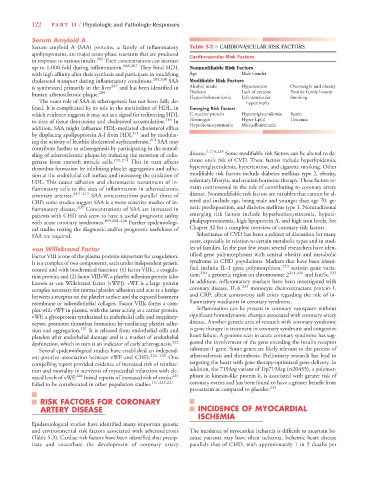
                  Serum amyloid A (SAA)  proteins, a  family of inflammatory  Table 5-3 ■ CARDIOVASCULAR RISK FACTORS
                  apolipoproteins, are major acute-phase reactants that are produced  Cardiovascular Risk Factors
                  in response to various insults. 205  Their concentrations can increase
                  up to 1,000-fold during inflammation. 206,207  They bind HDL  Nonmodifiable Risk Factors
                  with high affinity after their synthesis and participate in modifying  Age  Male Gender
                  cholesterol transport during inflammatory conditions. 205,208  SAA  Modifiable Risk Factors
                  is synthesized primarily in the liver 207  and has been identified in  Alcohol intake  Hypertension  Overweight and obesity
                  human atherosclerotic plaque. 209                   Diabetes         Lack of exercise  Positive family history
                                                                                                       Smoking
                                                                                       Left ventricular
                                                                      Hypercholesterolemia
                     The exact role of SAA in atherogenesis has not been fully de-       hypertrophy
                  fined. It is complicated by its role in the metabolism of HDL, in  Emerging Risk Factors
                  which evidence suggests it may act as a signal for redirecting HDL  C-reactive protein  Hypertriglyceridemia  Renin
                  to sites of tissue destruction and cholesterol accumulation. 210  In  Fibrinogen  Hyper-Lp(a)  Uricemia
                                                                      Hyperhomocysteinuria
                                                                                       Microalbuminuria
                  addition, SAA might influence HDL-mediated cholesterol efflux
                  by displacing apolipoprotein A-I from HDL 211  and by modulat-
                  ing the activity of lecithin cholesterol acyltransferase. 212  SAA may
                  contribute further to atherogenesis by participating in the remod-  7,174,228
                  eling of atherosclerotic plaque by inducing the secretion of colla-  disease.  Some modifiable risk factors can be altered to de-
                  genase from smooth muscle cells. 213,214  This in turn affects  crease one’s risk of CVD. These factors include hyperlipidemia,
                  thrombus formation by inhibiting platelet aggregation and adhe-  hypertriglyceridemia, hypertension, and cigarette smoking. Other
                  sion at the endothelial cell surface and increasing the oxidation of  modifiable risk factors include diabetes mellitus type 2, obesity,
                  LDL. This causes adhesion and chemotactic recruitment of in-  sedentary lifestyle, and ovarian hormone therapy. These factors re-
                  flammatory cells to the sites of inflammation in atherosclerotic  main controversial in the role of contributing to coronary artery
                  coronary arteries.  215–217  SAA concentrations parallel those of  disease. Nonmodifiable risk factors are variables that cannot be al-
                  CRP; some studies suggest SAA is a more sensitive marker of in-  tered and include age, being male and younger than age 70, ge-
                  flammatory disease. 205  Concentrations of SAA are increased in  netic predisposition, and diabetes mellitus type 1. Nontraditional
                  patients with CHD and seem to have a useful prognostic utility  emerging risk factors include hyperhomocystinemia, hypoal-
                  with acute coronary syndromes. 169,218–220  Further epidemiologi-  phalipoproteinemia, high lipoprotein A, and high iron levels. See
                  cal studies testing the diagnostic and/or prognostic usefulness of  Chapter 32 for a complete overview of coronary risk factors.
                  SAA are required.                                     Inheritance of CVD has been a subject of discussion for many
                                                                      years, especially in relation to certain metabolic types and in stud-
                  von Willebrand Factor                               ies of families. In the past few years, several researchers have iden-
                  Factor VIII is one of the plasma proteins important for coagulation.  tified gene polymorphisms with central obesity and metabolic
                  It is a complex of two components, each under independent genetic  syndrome in CHD populations. Markers that have been identi-
                                                                                                    229
                                                                                                       resistin gene varia-
                  control and with biochemical function: (1) factor VIIIc, a coagula-  fied include IL-1 gene polymorphism,  231,232  233
                                                                         230
                  tion protein; and (2) factor VIIIvW, a platelet adhesion protein (also  tion,  a genomic region on chromosome 2  and fam5c.
                  known as von Willebrand factor [vWF]). vWF is a large protein  In addition, inflammatory markers have been investigated with
                                                                                       234
                  complex necessary for normal platelet adhesion and acts as a bridge  coronary disease, IL-6,  monocyte chemoattractant protein-1,
                  between a receptor on the platelet surface and the exposed basement  and CRP; albeit controversy still exists regarding the role of in-
                  membrane or subendothelial collagen. Factor VIIIc forms a com-  flammatory mediators in coronary syndrome.
                  plex with vWF in plasma, with the latter acting as a carrier protein.  Inflammation can be present in coronary vasospasm without
                  vWF, a glycoprotein synthesized in endothelial cells and megakary-  significant homodynamic changes associated with coronary artery
                  ocytes, promotes thrombus formation by mediating platelet adhe-  disease. Another genetic area of research with coronary syndrome
                  sion and aggregation. 221  It is released from endothelial cells and  is gene therapy in treatment in coronary syndrome and congestive
                  platelets after endothelial damage and is a marker of endothelial  heart failure. A genome scan in acute coronary syndrome has sug-
                  dysfunction, which in turn is an indicator of early atherogenesis. 222  gested the involvement of the gene encoding the insulin receptor
                     Several epidemiological studies have established an independ-  substrate-1 gene. Some genes are likely relevant to the process of
                  ent positive association between vWF and CHD.  223–225  One  atherosclerosis and thrombosis. Preliminary research has lead to
                  compelling report provided evidence of increased risk of reinfarc-  targeting the heart with gene therapy-optimized gene delivery. In
                  tion and mortality in survivors of myocardial infarction with ele-  addition, the 719Arg variant of Trp719Arg (rs20455), a polymor-
                  vated levels of vWF. 226  Initial reports of increased risk of stroke 223  phism in kinesin-like protein 6, is associated with greater risk of
                  failed to be corroborated in other population studies. 157,223,227  coronary events and has been found to have a greater benefit from
                                                                      pravastatin as compared to placebo. 235

                     RISK FACTORS FOR CORONARY
                     ARTERY DISEASE                                      INCIDENCE OF MYOCARDIAL
                                                                         ISCHEMIA
                  Epidemiological studies have identified many important genetic
                  and environmental risk factors associated with atherosclerosis  The incidence of myocardial ischemia is difficult to ascertain be-
                  (Table 5-3). Cardiac risk factors have been identified that precip-  cause patients may have silent ischemia. Ischemic heart disease
                  itate and exacerbate the development of coronary artery  parallels that of CHD, with approximately 1 in 5 deaths per

