


Page 143 - Cardiac Nursing
P. 143
9/0
                               0
                                    009
                                  9/2
                       1-1
                    p11
                           qxd
                         31.
                                        8:2
                                                    19
                                                  e 1
                                                         ara
                                                       Apt
                                             M
                                           4 A
                                                 g
                                               P
         LWBK340-c05_p111-131.qxd  09/09/2009  08:24 AM  Page 119 Aptara
         L L LWB
               0-c
            K34
         LWB K34 0-c 05_ p11 1-1 31. qxd  0 9/0 9/2 009  0 0 8:2 4 A M  P a a g e 1 19  Apt ara
                 05_
                                               C HAPTER  5 / Atherosclerosis, Inflammation, and Acute Coronary Syndrome  119
                                       Oxidative                       the complex participation of proinflammatory mediators in the
                                        stress                         initiation and progression of CVD. 112
                         Endothelial                  Gender             Inflammation is a key feature of all stages of atherothromboge-
                         dysfunction                  and age          nesis. This paradigm shift has prompted the search for inflamma-
                                                                       tory, as well as hemostatic, markers, which may reflect current risk
                                                                       or predict future CVD. Their identification is also tantalizing in
                                                                       their potential to serve as targets for new therapeutic interventions,
                                                                       or provide more appropriate targeting of established therapies. It is
                                       a
                                       a
                                       a
                                     C C Card i i ov  s s s c u lar  Carbohydrate
                                     C
                                     Cardiovascular aa cularla cscasvasascular
                                              u
                                        d
                                               a
                                              u
                                       rd
                                       r r rdiovova
                                        d
                                        d
                   Dyslipidemia                                        critical to note that these serve as potential markers, because, at
                                          e
                                          e
                                           a
                                          e
                                          eas
                                        disease
                                        d d d d d d i i i i i s se a as e e e  metabolism
                                          s
                                          s
                                            s
                                            s
                                            s
                                            se
                                            s
                                           a
                                           a
                                            s
                                            s
                                                                       present, there remains insufficient evidence to support incorpora-
                                                                       tion of any of these risk markers into routine clinical practice. A
                                                                       description of those inflammatory markers with sustained and con-
                                                                       sistent evidence of a role in CVD is examined below.
                        Inflammation                 Insulin
                                                    resistance         Brain Natriuretic Peptide
                                    Thrombogenesis                     The heart is an endocrine organ. Natriuretic peptides are neuro-
                                                                       hormones produced by the heart, which participate in an impor-
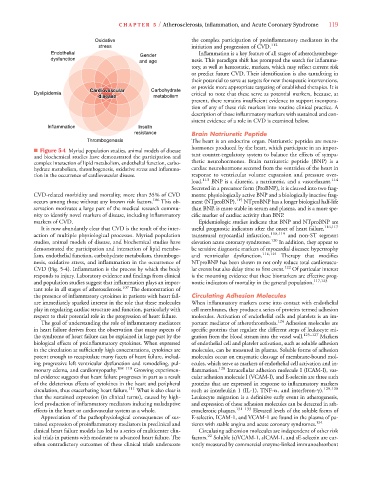
                   ■ Figure 5-4 Myriad population studies, animal models of disease
                   and biochemical studies have demonstrated the participation and  tant counter-regulatory system to balance the effects of sympa-
                   complex interaction of lipid metabolism, endothelial function, carbo-  thetic neurohormones. Brain natriuretic peptide (BNP) is  a
                   hydrate metabolism, thrombogenesis, oxidative stress and inflamma-  cardiac neurohormone secreted from the ventricles of the heart in
                   tion in the occurrence of cardiovascular disease.   response to ventricular volume expansion and pressure over-
                                                                       load. 113  BNP is a diuretic, a natriuretic, and a vasorelaxant. 114
                                                                       Secreted in a precursor form (ProBNP), it is cleaved into two frag-
                   CVD-related morbidity and mortality, more than 35% of CVD  ments: physiologically active BNP and a biologically inactive frag-
                   occurs among those without any known risk factors. 106  This ob-  ment (NTproBNP). 115  NTproBNP has a longer biological half-life
                   servation motivates a large part of the medical research commu-  than BNP, is more stable in serum and plasma, and is a more spe-
                   nity to identify novel markers of disease, including inflammatory  cific marker of cardiac activity than BNP.
                   markers of CVD.                                       Epidemiologic studies indicate that BNP and NTproBNP are
                     It is now abundantly clear that CVD is the result of the inter-  useful prognostic indicators after the onset of heart failure, 116,117
                   action of multiple physiological processes. Myriad population  transmural myocardial infarction, 118,119  and non-ST segment
                   studies, animal models of disease, and biochemical studies have  elevation acute coronary syndromes. 120  In addition, they appear to
                   demonstrated the participation and interaction of lipid metabo-  be sensitive diagnostic markers of myocardial diseases: hypertrophy
                   lism, endothelial function, carbohydrate metabolism, thromboge-  and ventricular  dysfunction. 116,121  Therapy that modifies
                   nesis, oxidative stress, and inflammation in the occurrence of  NTproBNP has been shown to not only reduce total cardiovascu-
                   CVD (Fig. 5-4). Inflammation is the process by which the body  lar events but also delay time to first event. 122  Of particular interest
                   responds to injury. Laboratory evidence and findings from clinical  is the mounting evidence that these biomarkers are effective prog-
                   and population studies suggest that inflammation plays an impor-  nostic indicators of mortality in the general population. 117,123
                   tant role in all stages of atherosclerosis. 107  The demonstration of
                   the presence of inflammatory cytokines in patients with heart fail-  Circulating Adhesion Molecules
                   ure immediately sparked interest in the role that these molecules  When inflammatory markers come into contact with endothelial
                   play in regulating cardiac structure and function, particularly with  cell membranes, they produce a series of proteins termed adhesion
                   respect to their potential role in the progression of heart failure.  molecules. Activation of endothelial cells and platelets is an im-
                     The goal of understanding the role of inflammatory mediators  portant mediator of atherothrombosis. 124  Adhesion molecules are
                   in heart failure derives from the observation that many aspects of  specific proteins that regulate the different steps of leukocyte mi-
                   the syndrome of heart failure can be explained in large part by the  gration from the blood stream into the vessel wall. 125–127  Markers
                   biological effects of proinflammatory cytokines. When expressed  of endothelial cell and platelet activation, such as soluble adhesion
                   in the circulation at sufficiently high concentrations, cytokines are  molecules, can be measured in plasma. Soluble forms of adhesion
                   potent enough to recapitulate many facets of heart failure, includ-  molecules occur on enzymatic cleavage of membrane-bound mol-
                   ing progressive left ventricular dysfunction and remodeling, pul-  ecules, which serve as markers of endothelial cell activation and in-
                   monary edema, and cardiomyopathy. 108–110  Growing experimen-  flammation. 128  Intracellular adhesion molecule I (ICAM-I), vas-
                   tal evidence suggests that heart failure progresses in part as a result  cular adhesion molecule I (VCAM-I), and E-selectin are three such
                   of the deleterious effects of cytokines in the heart and peripheral  proteins that are expressed in response to inflammatory markers
                   circulation, thus exacerbating heart failure. 111  What is also clear is  such as interleukin 1 (IL-1), TNF- , and interferon- ). 129,130
                   that the sustained expression (in clinical terms), caused by high-  Leukocyte migration is a definitive early event in atherogenesis,
                   level production of inflammatory mediators inducing maladaptive  and expression of these adhesion molecules can be detected in ath-
                   effects in the heart or cardiovascular system as a whole.  erosclerotic plaques. 131–133  Elevated levels of the soluble forms of
                     Appreciation of the pathophysiological consequences of sus-  E-selectin, ICAM-1, and VCAM-1 are found in the plasma of pa-
                   tained expression of proinflammatory mediators in preclinical and  tients with stable angina and acute coronary syndromes. 134
                   clinical heart failure models has led to a series of multicenter clin-  Circulating adhension molecules are independent of other risk
                   ical trials in patients with moderate to advanced heart failure. The  factors. 22  Soluble (s)VCAM-1, sICAM-1, and sE-selectin are cur-
                   often contradictory outcomes of these clinical trials underscore  rently measured by commercial enzyme-linked immunoabsorbent

