


Page 147 - Cardiac Nursing
P. 147
9/0
                               0
                                    009
                                  9/2
                       1-1
                    p11
                           qxd
                         31.
                                        8:2
                                                    23
                                                  e 1
                                                         ara
                                                       Apt
                                             M
                                           4 A
                                                 g
                                               P
         LWB
         LWBK340-c05_p111-131.qxd  09/09/2009  08:24 AM  Page 123 Aptara
         L L LWB K34 0-c 05_ p11 1-1 31. qxd  0 9/0 9/2 009  0 0 8:2 4 A M  P a a g e 1 23  Apt ara
                 05_
               0-c
            K34
                                               C HAPTER  5 / Atherosclerosis, Inflammation, and Acute Coronary Syndrome  123
                   year. 16,236  More than 16 million Americans had a history of my-  maintaining homeostasis of myocardial cells. Phosphate produc-
                                                               3
                   ocardial infarction or experienced angina pectoris in 2000. Ap-  tion is markedly reduced. Intracellular hydrogen ions and lactic
                   proximately every 1 minute, an American dies from a coronary  acid accumulate. Within a few minutes, ultrastructural changes
                   event. In developed countries, the number of coronary events par-  can be seen, including cell swelling and depletion of glycolic stores.
                   allels the number of coronary events in the United States.  The combination of hypoxia, reduced energy reserves, and acido-
                                                                                                       25
                     Racial and gender variations exist in the incidence, prevalence,  sis further hampers left ventricular function. Myocardial cells re-
                   presentations, and treatment responses. 7,228  Blacks have higher mor-  main viable for at least 20 minutes. After 20 minutes, irreversible
                                                                                       41
                   bidity and mortality rates from myocardial ischemia and they also  injury begins to occur. The actual events leading to cell death are
                   have a higher incidence of hypertension, obesity, and metabolic syn-  unknown. 237,238  It has been postulated that calcium overload may
                   drome. Their access to medical care often is delayed after a coronary  be a contributing factor because of the activation of various pro-
                   event. Indian-Asians have twice the incidence of CHD than whites in  teases and phospholipases. 21,22  The integrity of the sarcoplasmic
                   the United States. Asians tend to have higher levels of lipoprotein A.  membrane is damaged by these enzymes, leading to eventual cell
                   People of Mediterranean descent have a much lower incidence of is-  death. ATPases are impaired by anoxia, which results in the pro-
                   chemic heart disease. The incidence of ischemic heart disease is equal  duction of superoxides and hydrogen peroxide, both of which are
                   in men and postmenopausal women. Older adults experience higher  highly diffusible and induce cell damage. 239  In addition, oxidative
                   mortality and morbidity from ischemic heart disease and have more  stress causes a repertoire of cellular defenses to emerge. Ischemia
                   complications from multiple therapeutic interventions.  can lead to endogenous antioxidant factors to modulate injury by
                                                                       enzymatic pathways of cellular signals, which may determine the
                   Cellular Mechanisms and Events                      outcome of injury. 240  For example, mitogen-activated protein ki-
                   Caused by Myocardial Ischemia                       nase and nuclear factor- B inhibit injury and signal ICAM-1 to
                                                                                  241,242
                                                                       mediate injury.
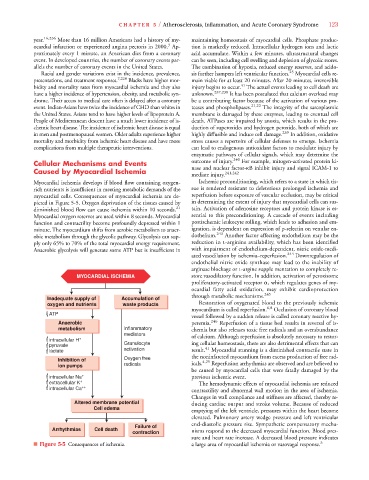
                   Myocardial ischemia develops if blood flow containing oxygen-  Ischemic preconditioning, which refers to a state in which tis-
                   rich nutrients is insufficient in meeting metabolic demands of the  sue is rendered resistant to deleterious prolonged ischemia and
                   myocardial cells. Consequences of myocardial ischemia are de-  reperfusion before exposure of vascular occlusion, may be critical
                   picted in Figure 5-5. Oxygen deprivation of the tissues caused by  in determining the extent of injury that myocardial cells can sus-
                   diminished blood flow can cause ischemia within 10 seconds. 21  tain. Activation of adenosine receptors and protein kinase is es-
                   Myocardial oxygen reserves are used within 8 seconds. Myocardial  sential to this preconditioning. A cascade of events including
                   function and contractility become profoundly depressed within 1  postischemic leukocyte rolling, which leads to adhesion and em-
                   minute. The myocardium shifts from aerobic metabolism to anaer-  igration, is dependent on expression of p-selectin on venular en-
                   obic metabolism through the glycolic pathway. Glycolysis can sup-  dothelium. 243  Another factor affecting endothelium may be the
                   ply only 65% to 70% of the total myocardial energy requirement.  reduction in L-arginine availability, which has been identified
                                                A
                                                A
                   Anaerobic glycolysis will generate some ATP but is insufficient in  with impairment of endothelium-dependent, nitric oxide-medi-
                                                                       ated vasodilation by ischemia–reperfusion. 244  Downregulation of
                                                                       endothelial nitric oxide synthase may lead to the inability of
                                                                       arginase blockage or L-argine supple mentation to completely re-
                                 MYOCARDIAL ISCHEMIA                   store vasodilatory function. In addition, activation of peroxisome
                                                                       proliferatory-activated receptor  , which regulates genes of my-
                                                                       ocardial  fatty acid oxidation, may exhibit cardioprotection
                                                                       through metabolic mechanisms. 245
                       Inadequate supply of     Accumulation of
                       oxygen and nutrients     waste products           Restoration of oxygenated blood to the previously ischemic
                                                                       myocardium is called reperfusion. 6,8  Occlusion of coronary blood
                        ATP
                                                                       vessel followed by a sudden release is called coronary reactive hy-
                           Anaerobic                                   peremia. 246  Reperfusion of a tissue bed results in reversal of is-
                           metabolism            Inflammatory          chemia but also releases toxic free radicals and an overabundance
                                                 mediators             of calcium. Although reperfusion is absolutely necessary to restor-
                        intracellular H +
                        pyruvate                 Granulocyte           ing cellular homeostasis, there are also detrimental effects that can
                        lactate                  activation            result. 41  Myocardial stunning is a diminished contractile state in
                           Inhibition of         Oxygen free           the noninfarcted myocardium from excess production of free rad-
                                                                          4,25
                           ion pumps             radicals              icals.  Reperfusion arrhythmias are observed and are believed to
                                                                       be caused by myocardial cells that were fatally damaged by the
                        intracellular Na +                             previous ischemic event.
                        extracellular K +                                The hemodynamic effects of myocardial ischemia are reduced
                        intracellular Ca ++
                                                                       contractility and abnormal wall motion in the area of ischemia.
                                                                       Changes in wall compliance and stiffness are affected, thereby re-
                                Altered membrane potential             ducing cardiac output and stroke volume. Because of reduced
                                       Cell edema
                                                                       emptying of the left ventricle, pressures within the heart become
                                                                       elevated. Pulmonary artery wedge pressure and left ventricular
                                                                       end-diastolic pressure rise. Sympathetic compensatory mecha-
                                                    Failure of
                         Arrhythmias   Cell death
                                                   contraction         nisms respond to the decreased myocardial function. Blood pres-
                                                                       sure and heart rate increase. A decreased blood pressure indicates
                   ■ Figure 5-5 Consequences of ischemia.              a large area of myocardial ischemia or vasovagal response. 3

