


Page 172 - Cardiac Nursing
P. 172
8:2
                                    009
                                  9/2
                                           5 A
                                               P
                                               P
                                             M
                         52.
                    p13
                       2-1
                         52.
                                9/0
                               0
                           qxd
               0-c
            K34
                                                         ara
                 06_
         LWBK340-c06_06_p132-152.qxd  09/09/2009  08:25 AM  Page 148 Aptara
         L L LWB K34 0-c 06_ p13 2-1 52. qxd  0 9/0 9/2 009  0 0 8:2 5 A M  P a a g e 1 48  Apt ara
            K34
         LWB
                                                    48
                                                       Apt
                                                    48
                                                 g
                                                  e 1
                  148    PA R T  I I / Physiologic and Pathologic Responses
                           Obstruction                                    Neurohumoral
                       Decreased                  Pressure load
                        RV CCP
                                       Wall tension                          Decreased
                                       O  demand                             RV output
                                        2
                                 Ischemia       RV Decompensation
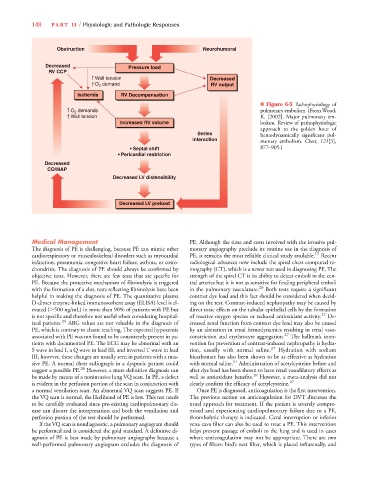
                                                                                             ■ Figure 6-5 Pathophysiology of
                               O  demands                                                    pulmonary embolism. (From Wood,
                                2
                               Wall tension                                                  K. [2002]. Major pulmonary em-
                                               Increased RV volume                           bolism. Review of pathophysiologic
                                                                                             approach to the golden  hour of
                                                                         Series              hemodynamically significant pul-
                                                                       interaction           monary embolism.  Chest, 121[3],
                                                  • Septal shift                             877–905.)
                                               • Pericardial restriction
                       Decreased
                       CO/MAP
                                             Decreased LV distensibility
                                               Decreased LV preload


                  Medical Management                                  PE. Although the time and costs involved with the invasive pul-
                  The diagnosis of PE is challenging, because PE can mimic other  monary angiography preclude its routine use in the diagnosis of
                  cardiorespiratory or musculoskeletal disorders such as myocardial  PE, it remains the most reliable clinical study available. 17  Recent
                  infarction, pneumonia, congestive heart failure, asthma, or costo-  radiological advances now include the spiral chest computed to-
                  chondritis. The diagnosis of PE should always be confirmed by  mography (CT), which is a newer test used in diagnosing PE. The
                  objective tests. However, there are few tests that are specific for  strength of the spiral CT is its ability to detect emboli in the cen-
                  PE. Because the protective mechanism of fibrinolysis is triggered  tral arteries but it is not as sensitive for finding peripheral emboli
                  with the formation of a clot, tests reflecting fibrinolysis have been  in the pulmonary vasculature. 20  Both tests require a significant
                  helpful in making the diagnosis of PE. The quantitative plasma  contrast dye load and this fact should be considered when decid-
                  D-dimer enzyme-linked immunosorbent assay (ELISA) level is el-  ing on the test. Contrast-induced nephropathy may be caused by
                  evated ( 500 ng/mL) in more than 90% of patients with PE but  direct toxic effects on the tubular epithelial cells by the formation
                  is not specific and therefore not useful when considering hospital-  of reactive oxygen species or reduced antioxidant activity. 27  De-
                  ized patients. 26  ABG values are not valuable in the diagnosis of  creased renal function from contrast dye load may also be caused
                  PE, which is contrary to classic teaching. The expected hypoxemia  by an alteration in renal hemodynamics resulting in renal vaso-
                  associated with PE was not found to be consistently present in pa-  constriction and erythrocyte aggregation. 27  The hallmark inter-
                  tients with documented PE. The ECG may be abnormal with an  vention for prevention of contrast-induced nephropathy is hydra-
                  S wave in lead I, a Q wave in lead III, and inverted T wave in lead  tion, usually with normal saline. 27  Hydration with sodium
                  III; however, these changes are usually seen in patients with a mas-  bicarbonate has also been shown to be as effective as hydration
                  sive PE. A normal chest radiograph in a dyspneic patient could  with normal saline. 11  Administration of acetylcysteine before and
                  suggest a possible PE. 26  However, a more definitive diagnosis can  after dye load has been shown to have renal vasodilatory effects as
                  be made by means of a noninvasive lung VQ scan. In PE, a defect  well as antioxidant benefits. 28  However, a meta-analysis did not
                  is evident in the perfusion portion of the scan in conjunction with  clearly confirm the efficacy of acetylcysteine. 27
                  a normal ventilation scan. An abnormal VQ scan suggests PE. If  Once PE is diagnosed, anticoagulation is the first intervention.
                  the VQ scan is normal, the likelihood of PE is low. This test needs  The previous section on anticoagulation for DVT discusses the
                  to be carefully evaluated since pre-existing cardiopulmonary dis-  usual approach for treatment. If the patient is severely compro-
                  ease can distort the interpretation and both the ventilation and  mised and experiencing cardiopulmonary failure due to a PE,
                  perfusion portion of the test should be performed.  thrombolytic therapy is indicated. Caval interruption or inferior
                     If the VQ scan is nondiagnostic, a pulmonary angiogram should  vena cava filter can also be used to treat a PE. This intervention
                  be performed and is considered the gold standard. A definitive di-  helps prevent passage of emboli to the lung and is used in cases
                  agnosis of PE is best made by pulmonary angiography because a  where anticoagulation may not be appropriate. There are two
                  well-performed pulmonary angiogram excludes the diagnosis of  types of filters: bird’s nest filter, which is placed infrarenally, and

