


Page 203 - Cardiac Nursing
P. 203
1
                                   1
                                   0:1
                                /09
                              /29
                              /29
                                /09
                                        M
                                          Pa
                                          Pa
                                        M
                                   0:1
                                     6 P
                                     6 P
                          q
                           xd
                      7-2
                        03.
                          q
                          q
                        03.
                   p
                             6
                             6
                    17
                      7-2
                           xd
                    17
                                           g
                                                    In
                                                    In
                                                      c.
                                                  ara
                                                   a
                                                   a
                                                      c.
         LWBK340-c08_
         LWB
         LWB K34 0-c 08_ p pp177-203.qxd  6/29/09  10:16 PM  Page 179 Aptara Inc.
                 08_
               0-c
            K34
                                                  ara
                                              79
                                              79
                                                A
                                            e 1
                                           g
                                           g
                                            e 1
                                                 p
                                                 p
                                                  t
                                                  t
                                                 p
                                                A
                                                                                             C HAPTER  8 / Sleep   179
                    MEAN SLEEP LATENCY (min)  20
                      15
                      10
                       0 5
                          0930  1330  1730  2130  0130  0530  0930
                                           TIME
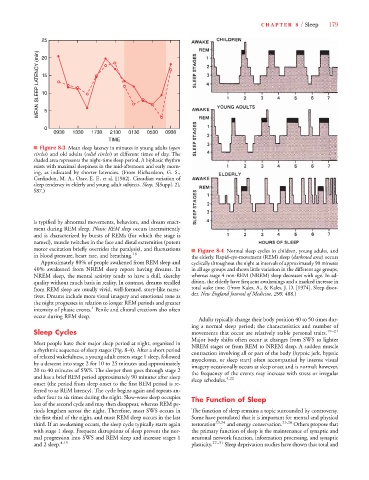
                   ■ Figure 8-3 Mean sleep latency in minutes in young adults (open
                   circles) and old adults (solid circles) at different times of day. The
                   shaded area represents the night-time sleep period. A biphasic rhythm
                   exists with maximal sleepiness in the mid-afternoon and early morn-
                   ing, as indicated by shorter latencies. (From Richardson, G. S.,
                   Carskadon, M. A., Orav, E. F., et al. [1982]. Circadian variation of
                   sleep tendency in elderly and young adult subjects. Sleep, 5[Suppl. 2],
                   S87.)
                   is typified by abnormal movements, behaviors, and dream enact-
                   ment during REM sleep. Phasic REM sleep occurs intermittently
                   and is characterized by bursts of REMs (for which the stage is
                   named), muscle twitches in the face and distal extremities (potent
                   motor excitation briefly overrides the paralysis), and fluctuations  ■ Figure 8-4 Normal sleep cycles in children, young adults, and
                   in blood pressure, heart rate, and breathing. 18    the elderly. Rapid-eye-movement (REM) sleep (darkened area) occurs
                     Approximately 80% of people awakened from REM sleep and  cyclically throughout the night at intervals of approximately 90 minutes
                   40% awakened from NREM sleep report having dreams. In  in all age groups and shows little variation in the different age groups,
                   NREM sleep, the mental activity tends to have a dull, sketchy  whereas stage 4 non-REM (NREM) sleep decreases with age. In ad-
                   quality without much basis in reality. In contrast, dreams recalled  dition, the elderly have frequent awakenings and a marked increase in
                   from REM sleep are usually vivid, well-formed, story-like narra-  total wake time. (From Kales, A., & Kales, J. D. [1974]. Sleep disor-
                   tives. Dreams include more visual imagery and emotional tone as  der. New England Journal of Medicine, 290, 488.)
                   the night progresses in relation to longer REM periods and greater
                                      4
                   intensity of phasic events. Penile and clitoral erections also often
                   occur during REM sleep.
                                                                         Adults typically change their body position 40 to 50 times dur-
                                                                       ing a normal sleep period; the characteristics and number of
                   Sleep Cycles                                        movements that occur are relatively stable personal traits. 19–21
                                                                       Major body shifts often occur at changes from SWS to lighter
                   Most people have their major sleep period at night, organized in  NREM stages or from REM to NREM sleep. A sudden muscle
                   a rhythmic sequence of sleep stages (Fig. 8-4). After a short period  contraction involving all or part of the body (hypnic jerk, hypnic
                   of relaxed wakefulness, a young adult enters stage 1 sleep, followed  myoclonus, or sleep start) often accompanied by intense visual
                   by a descent into stage 2 for 10 to 25 minutes and approximately  imagery occasionally occurs at sleep onset and is normal; however,
                   20 to 40 minutes of SWS. The sleeper then goes through stage 2  the frequency of the events may increase with stress or irregular
                   and has a brief REM period approximately 90 minutes after sleep  sleep schedules. 4,22
                   onset (the period from sleep onset to the first REM period is re-
                   ferred to as REM latency). The cycle begins again and repeats an-
                   other four to six times during the night. Slow-wave sleep occupies  The Function of Sleep
                   less of the second cycle and may then disappear, whereas REM pe-
                   riods lengthen across the night. Therefore, most SWS occurs in  The function of sleep remains a topic surrounded by controversy.
                   the first third of the night, and most REM sleep occurs in the last  Some have postulated that it is important for mental and physical
                   third. If an awakening occurs, the sleep cycle typically starts again  restoration 23,24  and energy conservation. 25,26  Others propose that
                   with stage 1 sleep. Frequent disruptions of sleep prevent the nor-  the primary function of sleep is the maintenance of synaptic and
                   mal progression into SWS and REM sleep and increase stages 1  neuronal network function, information processing, and synaptic
                   and 2 sleep. 4,15                                   plasticity. 27–31  Sleep deprivation studies have shown that total and

