


Page 204 - Cardiac Nursing
P. 204
/09
                                /09
                                   1
                             6
                              /29
                              /29
                                     6 P
                                     6 P
                                        M
                                   1
                                   0:1
                                   0:1
                      7-2
                        03.
                        03.
                    17
                    17
                      7-2
                           xd
                           xd
                             6
                          q
                          q
                          q
                                        M
                                                  t
                                                  ara
                                                  ara
                                                 p
                                                 p
                                                  t
                                                    In
                                                      c.
                                                      c.
                                                   a
                                                   a
                                                    In
                                           g
                                           g
                                            e 1
                                          Pa
                                          Pa
                                           g
                                                A
                                                A
                                                 p
                                            e 1
                                              80
                                              80
               0-c
                 08_
                 08_
               0-c
            K34
         LWBK340-c08_ p p pp177-203.qxd  6/29/09  10:16 PM  Page 180 Aptara Inc.
            K34
                  180    PA R T  I I / Physiologic and Pathologic Responses
                  partial sleep loss impair well being and functioning, with mood  circadian processes via their influence on thermoregulatory and
                  being the most strongly affected, followed by cognitive and motor  neuronal/neurohormonal systems. 45–47  Factors that either oppose
                  performance. 32–34  Most agree that although the exact function of  or enhance these processes can have significant effects on the tim-
                  sleep remains to be discovered, it fulfils a vital need, one that is es-  ing, duration, and structure of sleep as well as daytime alertness.
                  sential to human health and well being. 35
                     Sleep plays an important role in thermoregulatory  36–38  and  Developmental Variations
                  immune processes. 39,40  Special areas in the hypothalamus and  in Sleep Patterns
                  basal forebrain integrate temperature and sleep control through a
                  network of complex interactive processes. For example, an in-  One of the most important factors affecting the pattern of sleep
                  crease in brain temperature before sleep onset increases sleep  across the night is age (see Fig. 8-4). During the first years of life,
                  depth while deep sleep increases heat loss by stimulating vasodi-  the transition from wake to sleep typically occurs through REM
                  latation and reduction of the metabolic rate. Peripheral signals  sleep observed as active sleep in newborns when phasic muscle ac-
                  coming from skin thermosensors going to these brain regions can  tivity and eye movements can be observed. This is in sharp con-
                  also have a significant effect on sleep/wake state. 37,41  In fact, va-  trast to adults in whom sleep is normally entered through NREM
                  sodilatation of  blood vessels in the  feet in response to  local  sleep. The sleep cycle of a newborn occurs every 50 to 60 minutes
                  warmth was recently shown to be an independent predictor of  compared to 90 minutes in the adult, and sleep is intermittently
                  sleep onset. 42,43  Many immune factors such as interleukin-1,  dispersed across both the day and night. Gradually, over a period
                  interleukin-2, and tumor necrosis factor-  have been shown to  of 2 to 6 months, infants develop a consolidated nocturnal sleep
                  promote deep sleep, possibly because of the associated increased  period once appropriate brain structures and process have devel-
                  heat production. 40  Thus, the interaction of sleep, thermoregula-  oped.
                  tion, and immunological responses may explain why patients be-  SWS is at its peak in young children and is much deeper than
                  come sleepy when having fevers and infections. Sleep deprivation  that of adults. For example, it is not uncommon for a child’s
                  has also been associated with reduction in the activity of natural  clothes to be changed and to be put to bed without awakening.
                  killer cells in response to a bacterial or viral load, suggesting a direct  However, a subsequent decrease in SWS occurs across adoles-
                  link between sleep and immune function. 39,44       cence, a trend that continues to occur with age. REM sleep, as a
                                                                      percentage of total sleep time, is relatively well maintained across
                  Regulation of Normal Sleep                          the entire life span. 4
                                                                        With increasing age, particularly in men, sleep becomes lighter
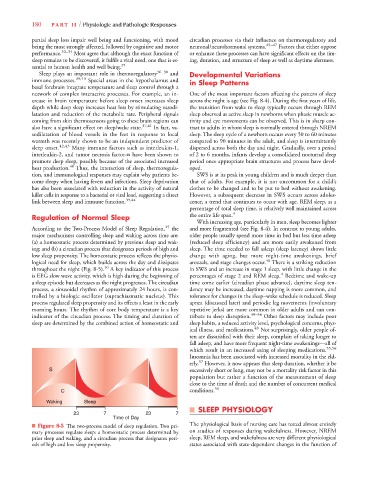
                  According to the Two-Process Model of Sleep Regulation, 45  the  and more fragmented (see Fig. 8-4). In contrast to young adults,
                  major mechanisms controlling sleep and waking across time are:  older people usually spend more time in bed but less time asleep
                  (a) a homeostatic process determined by previous sleep and wak-  (reduced sleep efficiency) and are more easily awakened from
                  ing; and (b) a circadian process that designates periods of high and  sleep. The time needed to fall asleep (sleep latency) shows little
                  low sleep propensity. The homeostatic process reflects the physio-  change with aging,  but more night-time awakenings,  brief
                  logical need for sleep, which builds across the day and dissipates  arousals, and stage changes occur. 48  There is a striking reduction
                  throughout the night (Fig. 8-5). 10  A key indicator of this process  in SWS and an increase in stage 1 sleep, with little change in the
                                                                                                    4
                  is EEG slow wave activity, which is high during the beginning of  percentages of stage 2 and REM sleep. Bedtime and wake-up
                  a sleep episode but decreases as the night progresses. The circadian  time come earlier (circadian phase advance), daytime sleep ten-
                  process, a sinusoidal rhythm of approximately 24 hours, is con-  dency may be increased, daytime napping is more common, and
                  trolled by a biologic oscillator (suprachiasmatic nucleus). This  tolerance for changes in the sleep–wake schedule is reduced. Sleep
                  process regulated sleep propensity and its effects a least in the early  apnea (discussed later) and periodic leg movements (involuntary
                  morning hours. The rhythm of core body temperature is a key  repetitive jerks) are more common in older adults and can con-
                  indicator of the circadian process. The timing and duration of  tribute to sleep disruption. 49–54  Other factors may include poor
                  sleep are determined by the combined action of homeostatic and  sleep habits, a reduced activity level, psychological concerns, phys-
                                                                      ical illness, and medications. 48  Not surprisingly, older people of-
                                                                      ten are dissatisfied with their sleep, complain of taking longer to
                                                                      fall asleep, and have more frequent night-time awakenings—all of
                                                                      which result in an increased using of sleeping medications. 55,56
                                                                      Insomnia has been associated with increased mortality in the eld-
                                                                      erly. 57  However, it now appears that sleep duration, whether it be
                        S                                             excessively short or long, may not be a mortality risk factor in this
                                                                      population but rather a function of the measurement of sleep
                                                                      close to the time of death and the number of concurrent medical
                            C C                                       conditions. 58
                       W Wakkinng  S Sleep
                                                                         SLEEP PHYSIOLOGY
                                23        7             23       7
                                             Time of Day
                  ■ Figure 8-5 The two-process model of sleep regulation. Two pri-  The physiological basis of nursing care has rested almost entirely
                  mary processes regulate sleep: a homeostatic process determined by  on studies of responses during wakefulness. However, NREM
                  prior sleep and waking, and a circadian process that designates peri-  sleep, REM sleep, and wakefulness are very different physiological
                  ods of high and low sleep propensity.               states associated with state-dependent changes in the function of

