


Page 553 - Cardiac Nursing
P. 553
51
                    51
                   p
                   p
                                        0 A
                                     1
                                     1
                                      1:0
                                      1:0
                                              g
                                            Pa
                                              g
                                              g
                                            Pa
                                          M
                                        0 A
                                          M
                                          M
                             3
                              0/0
                              3
                             3
                              0/0
                                  009
                                  009
                                6/2
                                6/2
                        36.
                        36.
                      1-5
                      1-5
                          q
                           xd
                           xd
                          q
                          q
                                                     ara
                 22_
                                                     ara
                                                    t
                                                     ara
                 22_
            K34
         LWBK340-c22_ pp511-536.qxd  30/06/2009  11:00 AM  Page 529 Aptara
            K34
               0-c
               0-c
                                                    t
                                                   p
                                                29
                                               e 5
                                               e 5
                                                  A
                                                   p
                                                  A
                                                29
                                                   p
                                                                          C HAPTER 22 / Acute Coronary Syndromes   529
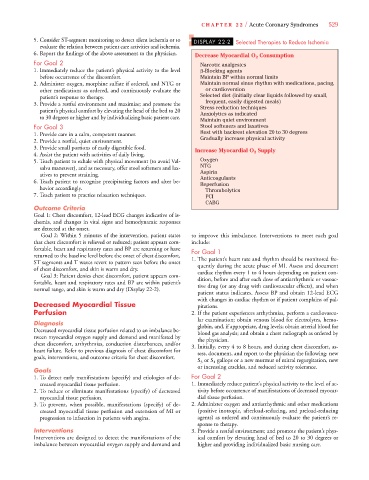
                   5. Consider ST-segment monitoring to detect silent ischemia or to  DISPLAY 22-2 Selected Therapies to Reduce Ischemia
                     evaluate the relation between patient care activities and ischemia.
                   6. Report the findings of the above assessment to the physician.  Decrease Myocardial O 2 Consumption
                   For Goal 2                                            Narcotic analgesics
                   1. Immediately reduce the patient’s physical activity to the level   -Blocking agents
                     before occurrence of the discomfort.                Maintain BP within normal limits
                   2. Administer oxygen, morphine sulfate if ordered, and NTG or  Maintain normal sinus rhythm with medications, pacing,
                     other medications as ordered, and continuously evaluate the  or cardioversion
                     patient’s response to therapy.                      Selected diet (initially clear liquids followed by small,
                                                                           frequent, easily digested meals)
                   3. Provide a restful environment and maximize; and promote the
                                                                         Stress reduction techniques
                     patient’s physical comfort by elevating the head of the bed to 20
                                                                         Anxiolytics as indicated
                     to 30 degrees or higher and by individualizing basic patient care.
                                                                         Maintain quiet environment
                   For Goal 3                                            Stool softeners and laxatives
                   1. Provide care in a calm, competent manner.          Rest with backrest elevation 20 to 30 degrees
                   2. Provide a restful, quiet environment.              Gradually increase physical activity
                   3. Provide small portions of easily digestible food.  Increase Myocardial O 2 Supply
                   4. Assist the patient with activities of daily living.
                   5. Teach patient to exhale with physical movement (to avoid Val-  Oxygen
                     salva maneuver), and as necessary, offer stool softeners and lax-  NTG
                     atives to prevent straining.                        Aspirin
                                                                         Anticoagulants
                   6. Teach patient to recognize precipitating factors and alter be-  Reperfusion
                     havior accordingly.                                   Thrombolytics
                   7. Teach patient to practice relaxation techniques.     PCI
                                                                           CABG
                   Outcome Criteria
                   Goal 1: Chest discomfort, 12-lead ECG changes indicative of is-
                   chemia, and changes in vital signs and hemodynamic responses
                   are detected at the onset.
                     Goal 2: Within 5 minutes of the intervention, patient states  to improve this imbalance. Interventions to meet each goal
                   that chest discomfort is relieved or reduced; patient appears com-  include:
                   fortable, heart and respiratory rates and BP are returning or have  For Goal 1
                   returned to the baseline level before the onset of chest discomfort,  1. The patient’s heart rate and rhythm should be monitored fre-
                   ST segments and T waves revert to pattern seen before the onset  quently during the acute phase of MI. Assess and document
                   of chest discomfort, and skin is warm and dry.        cardiac rhythm every 1 to 4 hours depending on patient con-
                     Goal 3: Patient denies chest discomfort, patient appears com-  dition, before and after each dose of antiarrhythmic or vasoac-
                   fortable, heart and respiratory rates and BP are within patient’s  tive drug (or any drug with cardiovascular effects), and when
                   normal range, and skin is warm and dry (Display 22-2).
                                                                         patient status indicates. Assess BP and obtain 12-lead ECG
                                                                         with changes in cardiac rhythm or if patient complains of pal-
                   Decreased Myocardial Tissue                           pitations.
                   Perfusion                                           2. If the patient experiences arrhythmias, perform a cardiovascu-
                                                                         lar examination; obtain venous blood for electrolytes, hemo-
                   Diagnosis                                             globin, and, if appropriate, drug levels; obtain arterial blood for
                   Decreased myocardial tissue perfusion related to an imbalance be-  blood gas analysis; and obtain a chest radiograph as ordered by
                   tween myocardial oxygen supply and demand and manifested by  the physician.
                   chest discomfort, arrhythmias, conduction disturbances, and/or  3. Initially, every 4 to 8 hours, and during chest discomfort, as-
                   heart failure. Refer to previous diagnosis of chest discomfort for  sess, document, and report to the physician the following: new
                   goals, interventions, and outcome criteria for chest discomfort.
                                                                         S 3 or S 4 gallops or a new murmur of mitral regurgitation, new
                                                                         or increasing crackles, and reduced activity tolerance.
                   Goals
                   1. To detect early manifestations (specify) and etiologies of de-  For Goal 2
                     creased myocardial tissue perfusion.              1. Immediately reduce patient’s physical activity to the level of ac-
                   2. To reduce or eliminate manifestations (specify) of decreased  tivity before occurrence of manifestations of decreased myocar-
                     myocardial tissue perfusion.                        dial tissue perfusion.
                   3. To  prevent, when  possible, manifestations (specify) of de-  2.Administer oxygen and antiarrhythmic and other medications
                     creased myocardial tissue perfusion and extension of MI or  (positive inotropic, afterload-reducing, and preload-reducing
                     progression to infarction in patients with angina.  agents) as ordered and continuously evaluate the patient’s re-
                                                                         sponse to therapy.
                   Interventions                                       3. Provide a restful environment; and promote the patient’s phys-
                   Interventions are designed to detect the manifestations of the  ical comfort by elevating head of bed to 20 to 30 degrees or
                   imbalance between myocardial oxygen supply and demand and  higher and providing individualized basic nursing care.

