


Page 557 - Cardiac Nursing
P. 557
LWBK340-c22_p511-536.qxd  30/06/2009  11:01 AM  Page 533 Aptara


                                                                          C HAP TE R 22 / Acute Coronary Syndromes  533


                                  r
                                 a
                    Nursing Care Plan 22-1           (c (continued) ) )
                                    e
                          i
                                                1
                                              2
                               C
                             g
                                        a
                                        a
                                          n
                                            2
                                            2
                                       l
                                      P
                                                         ti
                                                       on
                                                          nu
                                                           ed
                         NURSING INTERVENTIONS                           RATIONALE
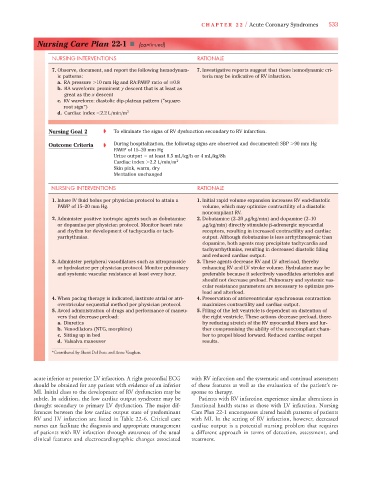
                         7. Observe, document, and report the following hemodynam-  7. Investigative reports suggest that these hemodynamic cri-
                           ic patterns:                                   teria may be indicative of RV infarction.
                           a. RA pressure  10 mm Hg and RA:PAWP ratio of  0.8
                           b. RA waveform: prominent y descent that is at least as
                             great as the x descent
                           c. RV waveform: diastolic dip-plateau pattern (“square-
                             root sign”)
                           d. Cardiac index  2.2 L/min/m 2
                        Nursing Goal 2    ➧  To eliminate the signs of RV dysfunction secondary to RV infarction.
                        Outcome Criteria  ➧  During hospitalization, the following signs are observed and documented: SBP  90 mm Hg
                                             PAWP of 15–20 mm Hg
                                             Urine output   at least 0.5 mL/kg/h or 4 mL/kg/8h
                                             Cardiac index  2.2 L/min/m 2
                                             Skin pink, warm, dry
                                             Mentation unchanged
                         NURSING INTERVENTIONS                           RATIONALE
                         1. Infuse IV fluid bolus per physician protocol to attain a  1. Initial rapid volume expansion increases RV end-diastolic
                           PAWP of 15–20 mm Hg.                           volume, which may optimize contractility of a diastolic
                                                                          noncompliant RV.
                         2. Administer positive inotropic agents such as dobutamine  2. Dobutamine (2–20  g/kg/min) and dopamine (2–10
                           or dopamine per physician protocol. Monitor heart rate   g/kg/min) directly stimulate  -adrenergic myocardial
                           and rhythm for development of tachycardia or tach-  receptors, resulting in increased contractility and cardiac
                           yarrhythmias.                                  output. Although dobutamine is less arrhythmogenic than
                                                                          dopamine, both agents may precipitate tachycardia and
                                                                          tachyarrhythmias, resulting in decreased diastolic filling
                                                                          and reduced cardiac output.
                         3. Administer peripheral vasodilators such as nitroprusside  3. These agents decrease RV and LV afterload, thereby
                           or hydralazine per physician protocol. Monitor pulmonary  enhancing RV and LV stroke volume. Hydralazine may be
                           and systemic vascular resistance at least every hour.  preferable because it selectively vasodilates arterioles and
                                                                          should not decrease preload. Pulmonary and systemic vas-
                                                                          cular resistance parameters are necessary to optimize pre-
                                                                          load and afterload.
                         4. When pacing therapy is indicated, institute atrial or atri-  4. Preservation of atrioventricular synchronous contraction
                           oventricular sequential method per physician protocol.  maximizes contractility and cardiac output.
                         5. Avoid administration of drugs and performance of maneu-  5. Filling of the left ventricle is dependent on distention of
                           vers that decrease preload:                    the right ventricle. These actions decrease preload, there-
                           a. Diuretics                                   by reducing stretch of the RV myocardial fibers and fur-
                           b. Venodilators (NTG, morphine)                ther compromising the ability of the noncompliant cham-
                           c. Sitting up in bed                           ber to propel blood forward. Reduced cardiac output
                           d. Valsalva maneuver                           results.
                         *Contributed by Sherri Del Bene and Anne Vaughan.


                   acute inferior or posterior LV infarction. A right precordial ECG  with RV infarction and the systematic and continual assessment
                   should be obtained for any patient with evidence of an inferior  of these features as well as the evaluation of the patient’s re-
                   MI. Initial clues to the development of RV dysfunction may be  sponse to therapy.
                   subtle. In addition, the low cardiac output syndrome may be  Patients with RV infarction experience similar alterations in
                   thought secondary to primary LV dysfunction. The major dif-  functional health status as those with LV infarction. Nursing
                   ferences between the low cardiac output state of predominant  Care Plan 22-1 encompasses altered health patterns of patients
                   RV and LV infarction are listed in Table 22-6. Critical care  with MI. In the setting of RV infarction, however, decreased
                   nurses can facilitate the diagnosis and appropriate management  cardiac output is a potential nursing problem that requires
                   of patients with RV infarction through awareness of the usual  a different approach in terms of detection, assessment, and
                   clinical features and electrocardiographic changes associated  treatment.

