


Page 558 - Cardiac Nursing
P. 558
LWBK340-c22_p511-536.qxd  30/06/2009  11:01 AM  Page 534 Aptara


                  534    PA R T  IV / Pathophysiology and Management of Heart Disease


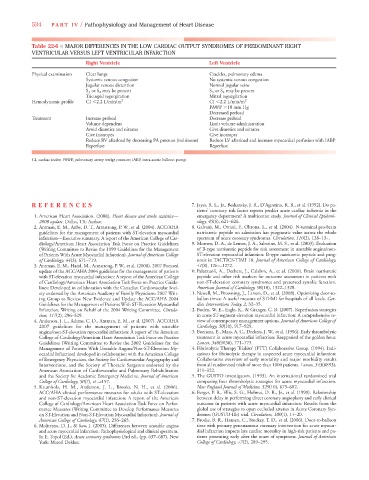
                  Table 22-6 ■ MAJOR DIFFERENCES IN THE LOW CARDIAC OUTPUT SYNDROMES OF PREDOMINANT RIGHT
                  VENTRICULAR VERSUS LEFT VENTRICULAR INFARCTION
                                    Right Ventricle                         Left Ventricle
                  Physical examination  Clear lungs                         Crackles, pulmonary edema
                                    Systemic venous congestion              No systemic venous congestion
                                    Jugular venous distention               Normal jugular veins
                                    S 3 or S 4 may be present               S 3 or S 4 may be present
                                    Tricuspid regurgitation                 Mitral regurgitation
                  Hemodynamic profile  CI  2.2 L/min/m 2                     CI  2.2 L/min/m 2
                                                                            PAWP  18 mm Hg
                                                                            Decreased preload
                  Treatment         Increase preload                        Decrease preload
                                    Volume dependent                        Limit volume administration
                                    Avoid diuretics and nitrates            Give diuretics and nitrates
                                    Give inotropes                          Give inotropes
                                    Reduce RV afterload by decreasing PA pressure (milrinone)  Reduce LV afterload and increase myocardial perfusion with IABP
                                    Reperfuse                               Reperfuse

                  CI, cardiac index; PAWP, pulmonary artery wedge pressure; IABP, intra-aortic balloon pump.


                  R EFE R E NC E S                                     7. Jayes, R. L., Jr., Beshansky, J. R., D’Agostino, R. B., et al. (1992). Do pa-
                                                                        tients’ coronary risk factor reports predict acute cardiac ischemia in the
                   1. American Heart Association. (2008). Heart disease and stroke statistics—  emergency department? A multicenter study. Journal of Clinical Epidemi-
                     2008 update. Dallas, TX: Author.                   ology, 45(6), 621–626.
                   2. Antman, E. M., Anbe, D. T., Armstrong, P. W., et al. (2004). ACC/AHA  8. Galvani, M., Ottani, F., Oltrona, L., et al. (2004). N-terminal pro-brain
                     guidelines for the management of patients with ST-elevation myocardial  natriuretic peptide on admission has prognostic value across the whole
                     infarction—Executive summary. A report of the American College of Car-  spectrum of acute coronary syndromes. Circulation, 110(2), 128–134.
                     diology/American Heart Association Task Force on Practice Guidelines  9. Morrow, D. A., de Lemos, J. A., Sabatine, M. S., et al. (2003). Evaluation
                     (Writing Committee to Revise the 1999 Guidelines for the Management  of B-type natriuretic peptide for risk assessment in unstable angina/non-
                     of Patients With Acute Myocardial Infarction). Journal of American College  ST-elevation myocardial infarction: B-type natriuretic peptide and prog-
                     of Cardiology, 44(3), 671–719.                     nosis in TACTICS-TIMI 18. Journal of American College of Cardiology,
                   3. Antman, E. M., Hand, M., Armstrong, P. W., et al. (2008). 2007 Focused  41(8), 1264–1272.
                     update of the ACC/AHA 2004 guidelines for the management of patients  10. Palazzuoli, A., Deckers, J., Calabro, A., et al. (2006). Brain natriuretic
                     with ST-elevation myocardial infarction: A report of the American College  peptide and other risk markers for outcome assessment in patients with
                     of Cardiology/American Heart Association Task Force on Practice Guide-  non-ST-elevation coronary syndromes and preserved systolic function.
                     lines: Developed in collaboration with the Canadian Cardiovascular Soci-  American Journal of Cardiology, 98(10), 1322–1328.
                     ety endorsed by the American Academy of Family Physicians: 2007 Writ-  11. Newell, M., Browning, J., Larson, D., et al. (2008). Optimizing door-to-
                     ing Group to Review New Evidence and Update the ACC/AHA 2004  ballon times: A useful measure of STEMI for hospitals of all levels. Car-
                     Guidelines for the Management of Patients With ST-Elevation Myocardial  diac Interventions Today, 2, 32–35.
                     Infarction, Writing on Behalf of the 2004 Writing Committee. Circula-  12. Boden, W. E., Eagle, K., & Granger, C. B. (2007). Reperfusion strategies
                          7
                          7
                     tion, 117(2), 296–329.                             in acute ST-segment elevation myocardial infarction: A comprehensive re-
                   4. Anderson, J. L., Adams, C. D., Antman, E. M., et al. (2007). ACC/AHA  view of contemporary management options. Journal of American College of
                     2007  guidelines for the management of patients with unstable  Cardiology, 50(10), 917–929.
                     angina/non-ST-elevation myocardial infarction: A report of the American  13. Boersma, E., Maas, A. C., Deckers, J. W., et al. (1996). Early thrombolytic
                     College of Cardiology/American Heart Association Task Force on Practice  treatment in acute myocardial infarction: Reappraisal of the golden hour.
                     Guidelines (Writing Committee to Revise the 2002 Guidelines for the  Lancet, 348(9030), 771–775.
                     Management of Patients With Unstable Angina/Non-ST-Elevation My-  14. Fibrinolytic Therapy Trialists’ (FTT) Collaborative Group. (1994). Indi-
                     ocardial Infarction) developed in collaboration with the American College  cations for fibrinolytic therapy in suspected acute myocardial infarction:
                     of Emergency Physicians, the Society for Cardiovascular Angiography and  Collaborative overview of early mortality and major morbidity results
                     Interventions, and the Society of Thoracic Surgeons endorsed by the  from all randomised trials of more than 1000 patients. Lancet, 343(8893),
                     American Association of Cardiovascular and Pulmonary Rehabilitation  311–322.
                     and the Society for Academic Emergency Medicine. Journal of American  15. The GUSTO investigators. (1993). An international randomized trial
                     College of Cardiology, 50(7), e1–e157.             comparing four thrombolytic strategies for acute myocardial infarction.
                   5. Krumholz, H. M., Anderson,  J. L., Brooks, N. H., et al. (2006).  New England Journal of Medicine, 329(10), 673–682.
                     ACC/AHA clinical performance measures for adults with ST-elevation  16. Berger, P. B., Ellis, S. G., Holmes, D. R., Jr., et al. (1999). Relationship
                     and non-ST-elevation myocardial infarction: A report of the American  between delay in performing direct coronary angioplasty and early clinical
                     College of Cardiology/American Heart Association Task Force on Perfor-  outcome in patients with acute myocardial infarction: Results from the
                     mance Measures (Writing Committee to Develop Performance Measures  global use of strategies to open occluded arteries in Acute Coronary Syn-
                     on ST-Elevation and Non-ST-Elevation Myocardial Infarction). Journal of  dromes (GUSTO-IIb) trial. Circulation, 100(1), 14–20.
                                         7
                                         7
                     American College of Cardiology, 47(1), 236–265.  17. Brodie, B. R., Hansen, C., Stuckey, T. D., et al. (2006). Door-to-balloon
                   6. Moliterno, D. J., & Saw, J. (2005). Differences between unstable angina  time with primary percutaneous coronary intervention for acute myocar-
                     and acute myocardial infarction: Pathophysiological and clinical spectrum.  dial infarction impacts late cardiac mortality in high-risk patients and pa-
                     In E. Topol (Ed.), Acute coronary syndromes (3rd ed., (pp. 637–687). New  tients presenting early after the onset of symptoms. Journal of American
                                                                                      7
                                                                                      7
                     York: Marcel Dekker.                               College of Cardiology, 47(2), 289–295.

