


Page 564 - Cardiac Nursing
P. 564
9 A
                                        8:2
                                    009
                                             M
                                                 g
                                               P
                                               P
                                  9/2
                         54.
                       7-5
                    p53
                         54.
                                9/0
                               0
                           qxd
                 23_
         LWB
         LWBK340-c23_23_p537-554.qxd  09/09/2009  08:29 AM  Page 540 Aptara
            K34
            K34
               0-c
                                                    40
                                                    40
                                                  e 5
         L L LWB K34 0-c 23_ p53 7-5 54. qxd  0 9/0 9/2 009  0 0 8:2 9 A M  P a a g e 5 40  Apt ara
                                                         ara
                                                       Apt
                  540    PA R T  I V / Pathophysiology and Management of Heart Disease
                                                                      waves and plaque disruption. A decline in laser angioplasty oc-
                                                                      curred because of significant coronary dissections and perforations
                                                                      with early techniques. Laser angioplasty has been used for treat-
                                                                      ment of ISR with good procedural success but disappointing
                                                                      long-term results. Current guidelines conclude that there is no ev-
                                                                      idence that ELCA improves long-term outcomes in coronary le-
                                                                      sions that can be treated safely with stenting or PTCA alone. 3,22
                                                                      Thrombectomy Devices
                                                                      The presence of intracoronary thrombus with plaque rupture and
                                                                      ACS or thrombotic material from degenerative saphenous vein grafts
                                                                      may lead to distal embolization and a “no reflow” phenomenon dur-
                                                                      ing PCI. Dislodgement of thrombotic material distally can occur
                                                                      with device deployment and contribute to increased MI size. Devices
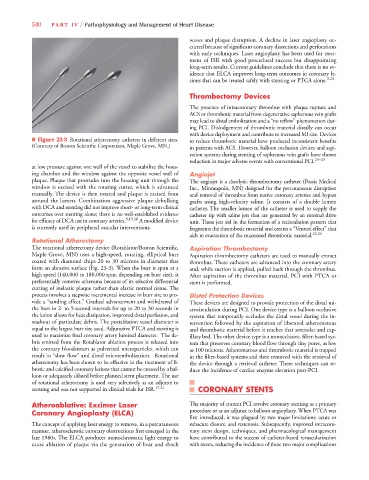
                  ■ Figure 23-3 Rotational atherectomy catheters in different sizes.  to reduce thrombotic material have produced inconsistent benefits
                  (Courtesy of Boston Scientific Corporation, Maple Grove, MN.)  in patients with ACS. However, balloon occlusion devices and aspi-
                                                                      ration systems during stenting of saphenous vein grafts have shown
                                                                      reduction in major adverse events with conventional PCI. 23–25
                  at low pressure against one wall of the vessel to stabilize the hous-
                  ing chamber and the window against the opposite vessel wall of  Angiojet
                  plaque. Plaque that protrudes into the housing unit through the  The angiojet is a rheolytic thrombectomy catheter (Possis Medical
                  window is excised with the rotating cutter, which is advanced  Inc., Minneapolis, MN) designed for the percutaneous disruption
                  manually. The device is then rotated and plaque is excised from  and removal of thrombus from native coronary arteries and bypass
                  around the lumen. Combination aggressive plaque debulking  grafts using high-velocity saline. It consists of a double lumen
                  with DCA and stenting did not improve short- or long-term clinical  catheter. The smaller lumen of the catheter is used to supply the
                  outcomes over stenting alone; there is no well-established evidence  catheter tip with saline jets that are generated by an external drive
                  for efficacy of DCA use in coronary arteries. 3,19,20  A modified device  unit. These jets aid in the formation of a recirculation pattern that
                  is currently used in peripheral vascular interventions.  fragments the thrombotic material and creates a “Venturi effect” that
                                                                      aids in evacuation of the macerated thrombotic material. 23,26
                  Rotational Atherectomy
                  The rotational atherectomy device (Rotablator/Boston Scientific,  Aspiration Thrombectomy
                  Maple Grove, MN) uses a high-speed, rotating, elliptical burr  Aspiration thrombectomy catheters are used to manually extract
                  coated with diamond chips 20 to 30 microns in diameter that  thrombus. These catheters are advanced into the coronary artery
                  form an abrasive surface (Fig. 23-3). When the burr is spun at a  and, while suction is applied, pulled back through the thrombus.
                  high speed (140,000 to 180,000 rpm, depending on burr size), it  After aspiration of the thrombus material, PCI with PTCA or
                  preferentially removes atheroma because of its selective differential  stent is performed.
                  cutting of inelastic plaque rather than elastic normal tissue. The
                  process involves a stepwise incremental increase in burr size to pro-  Distal Protection Devices
                  vide a “sanding effect.” Gradual advancement and withdrawal of  These devices are designed to provide protection of the distal mi-
                  the burr in 2- to 5-second intervals for up to 20 to 30 seconds in  crocirculation during PCI. One device type is a balloon occlusive
                  the lesion allows for heat dissipation, improved distal perfusion, and  system that temporarily occludes the distal vessel during the in-
                  washout of particulate debris. The postablation vessel diameter is  tervention followed by the aspiration of liberated atheromatous
                  equal to the largest burr size used. Adjunctive PTCA and stenting is  and thrombotic material before it reaches that arteriolar and cap-
                  used to maximize final coronary artery luminal diameter.  The de-  illary bed. The other device type is a nonocclusive, filter-based sys-
                  bris emitted from the Rotablator ablation process is released into  tem that preserves coronary blood flow through tiny pores, as low
                  the coronary bloodstream as pulverized microparticles, which can  as 100 microns. Atheromatous and thrombotic material is trapped
                  result in “slow flow” and distal microembolization.  Rotational  in the filter-based systems and then removed with the retrieval of
                  atherectomy has been shown to be effective in the treatment of fi-  the device through a retrieval catheter. These techniques can re-
                  brotic and calcified coronary lesions that cannot be crossed by a bal-  duce the incidence of cardiac enzyme elevation post-PCI.
                  loon or adequately dilated before planned stent placement. The use
                  of rotational atherectomy is used very selectively as an adjunct to
                  stenting and was not supported in clinical trials for ISR. 17,21  CORONARY STENTS

                  Atheroablative: Excimer Laser                       The majority of current PCI involve coronary stenting as a primary
                  Coronary Angioplasty (ELCA)                         procedure or as an adjunct to balloon angioplasty. When PTCA was
                                                                      first introduced, it was plagued by two major limitations: acute or
                  The concept of applying laser energy to remove, in a percutaneous  subacute closure, and restenosis. Subsequently, improved intracoro-
                  manner, atherosclerotic coronary obstructions first emerged in the  nary stent design, techniques, and pharmacological management
                  late 1980s. The ELCA produces monochromatic light energy to  have contributed to the success of catheter-based revascularization
                  cause ablation of plaque via the generation of heat and shock  with stents, reducing the incidence of these two major complications

