


Page 563 - Cardiac Nursing
P. 563
9/2
                                    009
                                9/0
                                  9/2
                                    009
                                        8:2
                                        8:2
                                        0
                                        0
                                9/0
                         54.
                         54.
                       7-5
                       7-5
                         54.
                               0
                               0
                           qxd
                           qxd
                                           9 A
                                                    39
                                                    39
                                                  e 5
                                                  e 5
                                                    39
                                                         ara
                                                         ara
                                                       Apt
                                                       Apt
                                                 g
                                             M
                                               P
                                           9 A
                                             M
                                               P
                                                a
                                                 g
                                               P
                                                a
            K34
            K34
         LWB
         LWBK340-c23_23_p537-554.qxd  09/09/2009  08:29 AM  Page 539 Aptara
         LWB
                 23_
                 23_
               0-c
            K34
               0-c
                    p53
                    p53
                                   C HAPTER 2 3 / Interventional Cardiology Techniques: Percutaneous Coronary Intervention  539
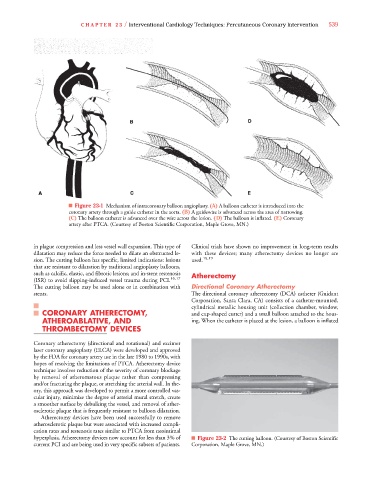
                              ■ Figure 23-1 Mechanism of intracoronary balloon angioplasty. (A) A balloon catheter is introduced into the
                              coronary artery through a guide catheter in the aorta. (B) A guidewire is advanced across the area of narrowing.
                              (C) The balloon catheter is advanced over the wire across the lesion. (D) The balloon is inflated. (E) Coronary
                              artery after PTCA. (Courtesy of Boston Scientific Corporation, Maple Grove, MN.)
                   in plague compression and less vessel wall expansion. This type of  Clinical trials have shown no improvement in long-term results
                   dilatation may reduce the force needed to dilate an obstructed le-  with these  devices; many atherectomy  devices no  longer are
                   sion. The cutting balloon has specific, limited indications: lesions  used. 18,19
                   that are resistant to dilatation by traditional angioplasty balloons,
                   such as calcific, elastic, and fibrotic lesions; and in-stent restenosis  Atherectomy
                   (ISR) to avoid slipping-induced vessel trauma during PCI. 16,17
                   The cutting balloon may be used alone or in combination with  Directional Coronary Atherectomy
                   stents.                                             The directional coronary atherectomy (DCA) catheter (Guidant
                                                                       Corporation, Santa Clara, CA) consists of a catheter-mounted,
                                                                       cylindrical metallic housing unit (collection chamber, window,
                      CORONARY ATHERECTOMY,                            and cup-shaped cutter) and a small balloon attached to the hous-
                      ATHEROABLATIVE, AND                              ing. When the catheter is placed at the lesion, a balloon is inflated
                      THROMBECTOMY DEVICES

                   Coronary atherectomy (directional and rotational) and excimer
                   laser coronary angioplasty (ELCA) were developed and approved
                   by the FDA for coronary artery use in the late 1980 to 1990s, with
                   hopes of resolving the limitations of PTCA. Atherectomy device
                   technique involves reduction of the severity of coronary blockage
                   by removal of atheromatous plaque rather than compressing
                   and/or fracturing the plaque, or stretching the arterial wall. In the-
                   ory, this approach was developed to permit a more controlled vas-
                   cular injury, minimize the degree of arterial mural stretch, create
                   a smoother surface by debulking the vessel, and removal of ather-
                   osclerotic plaque that is frequently resistant to balloon dilatation.
                     Atherectomy devices have been used successfully to remove
                   atherosclerotic plaque but were associated with increased compli-
                   cation rates and restenosis rates similar to PTCA from neointimal
                   hyperplasia. Atherectomy devices now account for less than 3% of  ■ Figure 23-2 The cutting balloon. (Courtesy of Boston Scientific
                   current PCI and are being used in very specific subsets of patients.  Corporation, Maple Grove, MN.)

