


Page 566 - Cardiac Nursing
P. 566
009
                                        0
                                  9/2
                                    009
                                        0
                                           9 A
                                           9 A
                                        8:2
                                        8:2
                           qxd
                           qxd
                         54.
                         54.
                               0
                                9/0
                                  9/2
                               0
                                9/0
                                                    42
                                                    42
                                                  e 5
                                                  e 5
                                                    42
                                                         ara
                                                         ara
                                                       Apt
                                                       Apt
                                               P
                                               P
                                             M
                                             M
                                               P
                                                 g
                                                 g
                                                a
                                                a
               0-c
            K34
               0-c
                 23_
                 23_
         LWB
         LWBK340-c23_23_p537-554.qxd  09/09/2009  08:29 AM  Page 542 Aptara
         L L LWB
            K34
            K34
                    p53
                    p53
                       7-5
                         54.
                       7-5
                  542    PA R T  I V / Pathophysiology and Management of Heart Disease
                  ■ Figure 23-6 The BX Velocity Coronary Stent used for delivery
                  of Sirolimus: The CYPHERR ™  Sirolimus-Eluding Stent. (Courtesy of
                  Cordis, A Johnson & Johnson Company, Miami Lakes, FL.)
                  coronary vessel leading to vascular complications. The clinical
                  success of this technology depends on the complex interaction be-
                  tween the stent, coating matrix, drug, and vessel wall. 34
                  Sirolimus-Eluting Stent (SES)
                  The first DES approved for use in PCI by the FDA in 2003 was
                  the CYPHERR TM  sirolimus-eluting stent (Fig. 23-6). The CYPHER
                  stent has a stainless steel stent platform, the BX Velocity, covered     ™
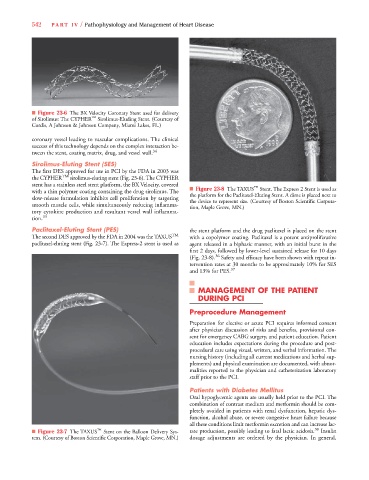
                  with a thin polymer coating containing the drug sirolimus. The  ■ Figure 23-8 The TAXUS  Stent. The Express 2 Stent is used as
                  slow-release formulation inhibits cell proliferation by targeting  the platform for the Paclitaxel-Eluting Stent. A dime is placed next to
                                                                      the device to represent size. (Courtesy of Boston Scientific Corpora-
                  smooth muscle cells, while simultaneously reducing inflamma-  tion, Maple Grove, MN.)
                  tory cytokine production and resultant vessel wall inflamma-
                  tion. 35
                  Paclitaxel-Eluting Stent (PES)                      the stent platform and the drug paclitaxel is placed on the stent
                  The second DES approved by the FDA in 2004 was the TAXUS TM  with a copolymer coating. Paclitaxel is a potent antiproliferative
                  paclitaxel-eluting stent (Fig. 23-7). The Express-2 stent is used as  agent released in a biphasic manner, with an initial burst in the
                                                                      first 2 days, followed by lower-level sustained release for 10 days
                                                                      (Fig. 23-8). 36  Safety and efficacy have been shown with repeat in-
                                                                      tervention rates at 30 months to be approximately 10% for SES
                                                                      and 13% for PES. 37
                                                                         MANAGEMENT OF THE PATIENT
                                                                         DURING PCI
                                                                      Preprocedure Management
                                                                      Preparation for elective or acute PCI requires informed consent
                                                                      after physician discussion of risks and benefits, provisional con-
                                                                      sent for emergency CABG surgery, and patient education. Patient
                                                                      education includes expectations during the procedure and post-
                                                                      procedural care using visual, written, and verbal information. The
                                                                      nursing history (including all current medications and herbal sup-
                                                                      plements) and physical examination are documented, with abnor-
                                                                      malities reported to the physician and catheterization laboratory
                                                                      staff prior to the PCI.
                                                                      Patients with Diabetes Mellitus
                                                                      Oral hypoglycemic agents are usually held prior to the PCI. The
                                                                      combination of contrast medium and metformin should be com-
                                                                      pletely avoided in patients with renal dysfunction, hepatic dys-
                                                                      function, alcohol abuse, or severe congestive heart failure because
                                                                      all these conditions limit metformin excretion and can increase lac-
                  ■ Figure 23-7 The TAXUS ™  Stent on the Balloon Delivery Sys-  tate production, possibly leading to fatal lactic acidosis. 38  Insulin
                  tem. (Courtesy of Boston Scientific Corporation, Maple Grove, MN.)  dosage adjustments are ordered  by the physician. In general,

