


Page 565 - Cardiac Nursing
P. 565
9/0
                                  9/2
                               0
                         54.
                           qxd
                                             M
                                               P
                                    009
                    p53
                                        8:2
                                                    41
                                                    41
                                                  e 5
                                               P
                                                 g
                       7-5
                         54.
                                           9 A
                                                       Apt
                                                         ara
            K34
               0-c
                 23_
            K34
         LWB K34 0-c 23_ p53 7-5 54. qxd  0 9/0 9/2 009  0 0 8:2 9 A M  P a a g e 5 41  Apt ara
         L L LWB
         LWBK340-c23_23_p537-554.qxd  09/09/2009  08:29 AM  Page 541 Aptara
                                   C HAPTER 2 3 / Interventional Cardiology Techniques: Percutaneous Coronary Intervention  541
                   A
                   B
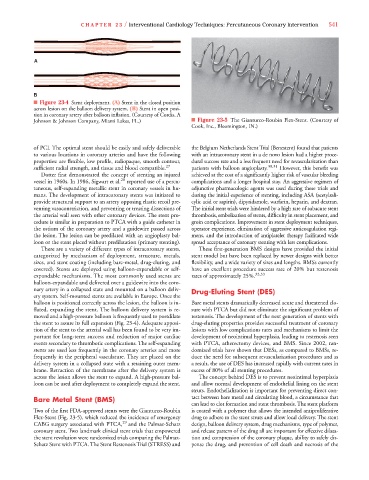
                   ■ Figure 23-4 Stent deployment. (A) Stent in the closed position
                   across lesion on the balloon delivery system. (B) Stent in open posi-
                   tion in coronary artery after balloon inflation. (Courtesy of Cordis, A
                   Johnson & Johnson Company, Miami Lakes, FL.)        ■ Figure 23-5 The Gianturco-Roubin Flex-Stent. (Courtesy of
                                                                       Cook, Inc., Bloomington, IN.)
                   of PCI. The optimal stent should be easily and safely deliverable  the Belgium Netherlands Stent Trial (Benestent) found that patients
                   to various locations in coronary arteries and have the following  with an intracoronary stent in a de novo lesion had a higher proce-
                   properties: are flexible, low profile, radiopaque, smooth contour,  dural success rate and a less frequent need for revascularization than
                   sufficient radial strength, and tissue and blood compatible. 27  patients with balloon angioplasty. 30,31  However, this benefit was
                     Dotter first demonstrated the concept of stenting an injured  achieved at the cost of a significantly higher risk of vascular bleeding
                   vessel in 1960s. In 1986, Sigwart et al. 28  reported use of a percu-  complications and a longer hospital stay. An aggressive regimen of
                   taneous, self-expanding metallic stent in coronary vessels in hu-  adjunctive pharmacologic agents was used during these trials and
                   mans. The development of intracoronary stents was initiated to  during the initial experience of stenting, including ASA (acetylsali-
                   provide structural support to an artery opposing elastic recoil pre-  cylic acid or aspirin), dipyridamole, warfarin, heparin, and dextran.
                   venting vasoconstriction, and preventing or treating dissections of  The initial stent trials were hindered by a high rate of subacute stent
                   the arterial wall seen with other coronary devices. The stent pro-  thrombosis, embolization of stents, difficulty in stent placement, and
                   cedure is similar in preparation to PTCA with a guide catheter in  groin complications. Improvement in stent deployment techniques,
                   the ostium of the coronary artery and a guidewire passed across  operator experience, elimination of aggressive anticoagulation regi-
                   the lesion. The lesion can be predilated with an angioplasty bal-  mens, and the introduction of antiplatelet therapy facilitated wide
                   loon or the stent placed without predilatation (primary stenting).  spread acceptance of coronary stenting with less complications.
                     There are a variety of different types of intracoronary stents,  These first-generation BMS designs have provided the initial
                   categorized by mechanism of deployment, structure, metals,  stent model but have been replaced by newer designs with better
                   sizes, and stent coating (including bare-metal, drug-eluting, and  flexibility, and a wide variety of sizes and lengths. BMSs currently
                   covered). Stents are deployed using balloon-expandable or self-  have an excellent procedure success rate of 20% but restenosis
                   expandable mechanisms. The most commonly used stents are  rates of approximately 25%. 32,33
                   balloon-expandable and delivered over a guidewire into the coro-
                   nary artery in a collapsed state and mounted on a balloon deliv-  Drug-Eluting Stent (DES)
                   ery system. Self-mounted stents are available in Europe. Once the
                   balloon is positioned correctly across the lesion, the balloon is in-  Bare metal stents dramatically decreased acute and threatened clo-
                   flated, expanding the stent. The balloon delivery system is re-  sure with PTCA but did not eliminate the significant problem of
                   moved and a high-pressure balloon is frequently used to postdilate  restenosis. The development of the next generation of stents with
                   the stent to assure its full expansion (Fig. 23-4). Adequate apposi-  drug-eluting properties provides successful treatment of coronary
                   tion of the stent to the arterial wall has been found to be very im-  lesions with low complications rates and mechanisms to limit the
                   portant for long-term success and reduction of major cardiac  development of neointimal hyperplasia, leading to restenosis seen
                   events secondary to thrombotic complications. The self-expanding  with PTCA, atherectomy devices, and BMS. Since 2002, ran-
                   stents are used less frequently in the coronary arteries and more  domized trials have shown that DESs, as compared to BMSs, re-
                   frequently in the peripheral vasculature. They are placed on the  duce the need for subsequent revascularization procedures and as
                   delivery system in a collapsed state with a retaining outer mem-  a result, the use of DES has increased rapidly with current rates in
                   brane. Retraction of the membrane after the delivery system is  excess of 80% of all stenting procedures.
                   across the lesion allows the stent to expand. A high-pressure bal-  The concept behind DES is to prevent neointimal hyperplasia
                   loon can be used after deployment to completely expand the stent.  and allow normal development of endothelial lining on the stent
                                                                       struts. Endothelialization is important for preventing direct con-
                   Bare Metal Stent (BMS)                              tact between bare metal and circulating blood, a circumstance that
                                                                       can lead to clot formation and stent thrombosis. The stent platform
                   Two of the first FDA-approved stents were the Gianturco-Roubin  is coated with a polymer that allows the intended antiproliferative
                   Flex-Stent (Fig. 23-5), which reduced the incidence of emergency  drug to adhere to the stent struts and allow local delivery. The stent
                   CABG surgery associated with PTCA, 29  and the Palmaz-Schatz  design, balloon delivery system, drug mechanisms, type of polymer,
                   coronary stent. Two landmark clinical stent trials that empowered  and release pattern of the drug all are important for effective dilata-
                   the stent revolution were randomized trials comparing the Palmaz-  tion and compression of the coronary plaque, ability to safely dis-
                   Schatz Stent with PTCA. The Stent Restenosis Trial (STRESS) and  pense the drug, and prevention of cell death and necrosis of the

