


Page 628 - Cardiac Nursing
P. 628
0
                              6/3
                              6/3
                           xd
                              0
                             0
                                  009
                                     1
                                     1
                                0/2
                                0/2
                                  009
                    59
                      5-6
                      5-6
                   p
                   p
                    59
                          q
                          q
                           xd
                        22.
                        22.
                          q
                                                A
                                                A
                                                 p
                                              04
                                              04
                                                A
                                                 t
                                                  ara
                                                  ara
                                                 p
                                                 p
                                                 t
                                        5
                                         Pa
                                         Pa
                                      7:4
                                      7:4
                                        5
                                           g
                                            e 6
                                            e 6
                                         Pa
                                           g
                                           g
            K34
               0-c
                 25_
         LWBK340-c25_
         LWB K34 0-c 25_ pp595-622.qxd  06/30/2009  17:45  Page 604 Aptara
         LWB
                  604    PA R T  I V / Pathophysiology and Management of Heart Disease
                  surgery. Contributing factors of atrial fibrillation (AF) may in-
                  clude electrolyte or metabolic disturbances, increased circulating
                  catecholamines, volume overload, hypoxia, and myocardial is-  A
                  chemia or MI. Although atrial tachyarrhythmias may occur any
                  time during the first few days to weeks after cardiac surgery, they
                  frequently peak around the second or third day postoperative.
                  Atrial fibrillation after cardiac surgery may be associated with im-
                  portant complications including stroke, renal dysfunction, and
                                      38
                  prolonged hospitalization. Risk factors for postoperative AF in-
                  clude advanced age, history of congestive heart failure or AF,  B
                  chronic obstructive lung disease, male sex, history of rheumatic
                  heart disease, prolonged aortic cross-clamp time, and bicaval can-
                  nulation. 39  The onset of tachyarrhythmias is often preceded by
                  frequent premature atrial contractions. Medications commonly
                  used to control the ventricular response in AF and flutter include
                  diltiazem (either intravenous drip or orally), digoxin, and  -  C
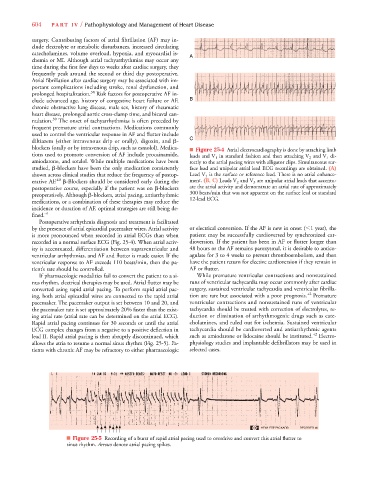
                  blockers (orally or by intravenous drip, such as esmolol). Medica-  ■ Figure 25-4 Atrial electrocardiography is done by attaching limb
                  tions used to promote conversion of AF include procainamide,  leads and V 1 in standard fashion and then attaching V 2 and V 3 di-
                                                                                                            V
                  amiodarone, and sotalol. While multiple medications have been  rectly to the atrial pacing wires with alligator clips. Simultaneous sur-
                  studied,  -blockers have been the only medication consistently  face lead and unipolar atrial lead ECG recordings are obtained. (A)
                  shown across clinical studies that reduce the frequency of postop-  Lead V 1 is the surface or reference lead. There is no atrial enhance-
                                                                                    V
                  erative AF. 40   -Blockers should be considered early during the  ment. (B, C) Leads V 2 and V 3 are unipolar atrial leads that accentu-
                  postoperative course, especially if the patient was on  -blockers  ate the atrial activity and demonstrate an atrial rate of approximately
                  preoperatively. Although  -blockers, atrial pacing, antiarrhythmic  300 beats/min that was not apparent on the surface lead or standard
                  medications, or a combination of these therapies may reduce the  12-lead ECG.
                  incidence or duration of AF, optimal strategies are still being de-
                  fined. 41
                     Postoperative arrhythmia diagnosis and treatment is facilitated
                  by the presence of atrial epicardial pacemaker wires. Atrial activity  or electrical conversion. If the AF is new in onset ( 1 year), the
                  is more pronounced when recorded in atrial ECGs than when  patient may be successfully cardioverted by synchronized car-
                  recorded in a normal surface ECG (Fig. 25-4). When atrial activ-  dioversion. If the patient has been in AF or flutter longer than
                  ity is accentuated, differentiation between supraventricular and  48 hours or the AF remains paroxysmal, it is desirable to antico-
                  ventricular arrhythmias, and AF and flutter is made easier. If the  agulate for 3 to 4 weeks to prevent thromboembolism, and then
                  ventricular response to AF exceeds 110 beats/min, then the pa-  have the patient return for elective cardioversion if they remain in
                  tient’s rate should be controlled.                  AF or flutter.
                     If pharmacologic modalities fail to convert the patient to a si-  While premature ventricular contractions and nonsustained
                  nus rhythm, electrical therapies may be used. Atrial flutter may be  runs of ventricular tachycardia may occur commonly after cardiac
                  converted using rapid atrial pacing. To perform rapid atrial pac-  surgery, sustained ventricular tachycardia and ventricular fibrilla-
                  ing, both atrial epicardial wires are connected to the rapid atrial  tion are rare but associated with a poor prognosis. 42  Premature
                  pacemaker. The pacemaker output is set between 10 and 20, and  ventricular contractions and nonsustained runs of ventricular
                  the pacemaker rate is set approximately 20% faster than the exist-  tachycardia should be treated with correction of electrolytes, re-
                  ing atrial rate (atrial rate can be determined on the atrial ECG).  duction or elimination of arrhythmogenic drugs such as cate-
                  Rapid atrial pacing continues for 30 seconds or until the atrial  cholamines, and ruled out for ischemia. Sustained ventricular
                  ECG complex changes from a negative to a positive deflection in  tachycardia should be cardioverted and antiarrhythmic agents
                  lead II. Rapid atrial pacing is then abruptly discontinued, which  such as amiodarone or lidocaine should be instituted. 42  Electro-
                  allows the atria to resume a normal sinus rhythm (Fig. 25-5). Pa-  physiology studies and implantable defibrillators may be used in
                  tients with chronic AF may be refractory to either pharmacologic  selected cases.
                                                                                             HEWLETT-PACKARD  REORDER 40
                              ■ Figure 25-5 Recording of a burst of rapid atrial pacing used to overdrive and convert this atrial flutter to
                              sinus rhythm. Arrows denote atrial pacing spikes.

