


Page 634 - Cardiac Nursing
P. 634
LWBK340-c25_p595-622.qxd  06/30/2009  17:45  Page 610 Aptara


                  610    PA R T  IV / Pathophysiology and Management of Heart Disease

                  with an acute exacerbation of heart failure and, in some cases, car-  ischemia that is evident during the immediate postoperative pe-
                  diogenic shock. Maintenance of adequate nutrition during the  riod. The transplanted heart benefits from pharmacologic  -re-
                  preoperative phase is difficult because of the anorexia, nausea, and  ceptor stimulation in the early postoperative period. Isoproterenol
                  impaired digestion and absorption associated with serious cardiac  is used routinely for up to 4 days to augment contractility, atri-
                  failure.                                            oventricular conduction, and heart rate. The denervated heart
                     After transplantation, interventions to improve nutritional sta-  cannot respond to the autonomic nervous system and depends on
                  tus are important because the patient is immunosuppressed. Post-  circulating catecholamines. Atrial pacing is now commonly used
                  operative basal metabolic requirements are increased at the same  to support heart rate and dopamine is used to support contractil-
                  time corticosteroid therapy is accelerating protein catabolism.  ity. Underlying bradycardia and junctional rhythms are not un-
                  Maintaining adequate nutrition is important to minimize postop-  common during this time. Because node dysfunction can occur as
                  erative complications and to facilitate recovery and rehabilita-  a result of injury during procurement, surgery, or distortion of the
                      66
                  tion. Diet becomes an important factor in minimizing some of  atria with transplantation, or it may be acquired as the result of
                                                                                   68
                  the side effects of corticosteroid therapy. 67  Diet can be supple-  cardiac rejection. Temporary atrial pacing may also be used for
                  mented with hyperalimentation and intravenous lipid prepara-  arrhythmia issues during the immediate postoperative period.
                  tions in sicker patients.                           Once the heart has recovered from the trauma of surgery, a nor-
                     Preoperative cardiac failure potentially contributes to postop-  mal intrinsic donor heart rate of approximately 95 to 110
                  erative renal and hepatic dysfunctions as a result of the chronic  beats/min becomes evident. Sinus node dysfunction is common,
                  low cardiac output state. Elevated serum creatinine levels are evi-  and 6% to 10% of patients may require permanent pacemaker
                  dence of renal dysfunction. Because cyclosporine and tacrolimus  implantation. 69
                  may induce nephrotoxicity, careful attention must be given to  Blood pressure control with sodium nitroprusside therapy is
                  monitoring renal status. An elevated preoperative serum creati-  usually required for the first 24 to 48 hours after surgery. In pa-
                  nine may be an indication to reduce cyclosporine/tacrolimus  tients with high preoperative pulmonary artery pressures, inhaled
                  dosage or even delay by a few days postoperative administration of  nitric oxide therapy may be used to dilate the pulmonary vascular
                  the drug. Weekly urine creatinine clearance tests may be ordered  bed and reduce afterload in the graft right ventricle. Pulmonary
                  to follow postoperative renal function closely.     artery pressures decrease over the next few days, while the right
                     Preoperative hepatomegaly from chronic heart failure may pre-  ventricle adjusts to its new workload. Dopamine hydrochloride is
                  cipitate postoperative bleeding due to clotting deficiencies associ-  administered at doses of 3 mcg/kg per minute or less to enhance
                  ated with compromised hepatic function. Vitamin K deficiency  renal vascular blood flow. This drug is usually discontinued after
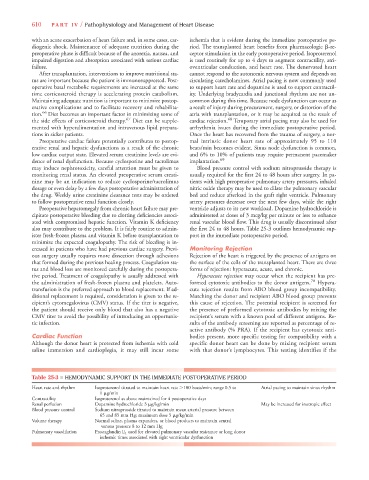
                  also may contribute to the problem. It is fairly routine to admin-  the first 24 to 48 hours. Table 25-3 outlines hemodynamic sup-
                  ister fresh-frozen plasma and vitamin K before transplantation to  port in the immediate postoperative period.
                  minimize the expected coagulopathy. The risk of bleeding is in-
                  creased in patients who have had previous cardiac surgery. Previ-  Monitoring Rejection
                  ous surgery usually requires more dissection through adhesions  Rejection of the heart is triggered by the presence of antigens on
                  that formed during the previous healing process. Coagulation sta-  the surface of the cells of the transplanted heart. There are three
                  tus and blood loss are monitored carefully during the postopera-  forms of rejection: hyperacute, acute, and chronic.
                  tive period. Treatment of coagulopathy is usually addressed with  Hyperacute rejection may occur when the recipient has pre-
                  the administration of fresh-frozen plasma and platelets. Auto-  formed cytotoxic antibodies to the donor antigens. 70  Hypera-
                  transfusion is the preferred approach to blood replacement. If ad-  cute rejection results from ABO blood group incompatibility.
                  ditional replacement is required, consideration is given to the re-  Matching the donor and recipient ABO blood group prevents
                  cipient’s cytomegalovirus (CMV) status. If the titer is negative,  this cause of rejection. The potential recipient is screened for
                  the patient should receive only blood that also has a negative  the presence of preformed cytotoxic antibodies by mixing the
                  CMV titer to avoid the possibility of introducing an opportunis-  recipient’s serum with a known pool of different antigens. Re-
                  tic infection.                                      sults of the antibody screening are reported as percentage of re-
                                                                      active antibody (% PRA). If the recipient has cytotoxic anti-
                  Cardiac Function                                    bodies present, more specific testing for compatibility with a
                  Although the donor heart is protected from ischemia with cold  specific donor heart can be done by mixing recipient serum
                  saline immersion and cardioplegia, it may still incur some  with that donor’s lymphocytes. This testing identifies if the


                  Table 25-3 ■ HEMODYNAMIC SUPPORT IN THE IMMEDIATE POSTOPERATIVE PERIOD
                  Heart rate and rhythm  Isoproterenol titrated to maintain heart rate  100 beats/min; range 0.5 to  Atrial pacing to maintain sinus rhythm
                                         1  g/min
                  Contractility        Isoproterenol as above maintained for 4 postoperative days
                  Renal perfusion      Dopamine hydrochloride 3  g/kg/min                    May be increased for inotropic effect
                  Blood pressure control  Sodium nitroprusside titrated to maintain mean arterial pressure between
                                         65 and 85 mm Hg; maximum dose 5  g/kg/min
                  Volume therapy       Normal saline, plasma expanders, or blood products to maintain central
                                         venous pressure 8 to 12 mm Hg
                  Pulmonary vasodilation  Prostaglandin E 1 used for elevated pulmonary vascular resistance or long donor
                                         ischemic times associated with right ventricular dysfunction

