


Page 635 - Cardiac Nursing
P. 635
LWBK340-c25_p595-622.qxd  06/30/2009  17:45  Page 611 Aptara


                                                                                   C HAPTER 2 5 / Cardiac Surgery  611

                   potential recipient has cytotoxic antibodies that will react to
                   that specific donor heart.                           Table 25-4 ■ INTERNATIONAL SOCIETY OF HEART AND
                     Acute rejection is the most frequently occurring form of rejec-  LUNG TRANSPLANTATION STANDARD GRADING OF
                   tion and is a major cause of death within the first year after trans-  CARDIAC REJECTION
                   plantation. 54  Preoperative immunosuppressive therapy is begun  Revised
                   for prevention of acute cardiac rejection. Routine monitoring for  Grade (2004)  Old Grade  Nomenclature
                   acute rejection is centered around endomyocardial biopsy. With
                   cyclosporine/tacrolimus therapy, there are few clinically evident  0R  0  No rejection
                   signs and symptoms of acute rejection. The objective is to detect  1R  1  A, Focal, mild
                   acute rejection in its early stages at a time when the process can be  2  B, Diffuse, mild
                                                                                             One aggressive infiltrate, focal moderate
                   reversed, thus preventing serious, permanent damage to the new  2R  3     A, Multifocal aggressive, moderate
                   heart. Therefore, biopsy remains the gold standard for monitoring  3R     B, Diffuse inflammatory process
                   and early detection of acute rejection. Because acute rejection is  4     Diffuse, aggressive, with necrosis, severe
                   expected to occur during the first 3 months after surgery, biopsy           acute rejection
                   is performed within the first 14 days after transplantation, and
                   then up to once per week during this crucial time interval. Any
                   time that rejection is detected, biopsies are performed frequently
                   to monitor the progress of antirejection treatment. By 1 month,
                   the biopsy schedule is tapered to every other week, then once per  myocyte and vascular necrosis with hemorrhage and a mixed in-
                   month after the third month. Patients are then monitored indefi-  filtrate of immunoblasts and neutrophils ISHLT grade 3R (old
                   nitely by biopsy every 4 months to annually, depending on the  scales 3B and 4). 71  Resolving rejection is evidenced by active fi-
                   transplant center. Many centers stop biopsy surveillance 5 years  brosis, which represents reparative changes. Table 25-4 outlines
                   posttransplant, unless clinically indicated.        the heart biopsy grading system adopted by the ISHLT in 1990, 72
                     The biopsy procedure is routinely performed in the catheteri-  and revised in 2005. Treatment of rejection depends on the grade
                   zation laboratory but may be performed in the operating room or  of rejection, length of time from transplantation, clinical find-
                   echocardiography laboratory. It can be performed in 15 to 30  ings, symptoms, and the presence or absence of hemodynamic
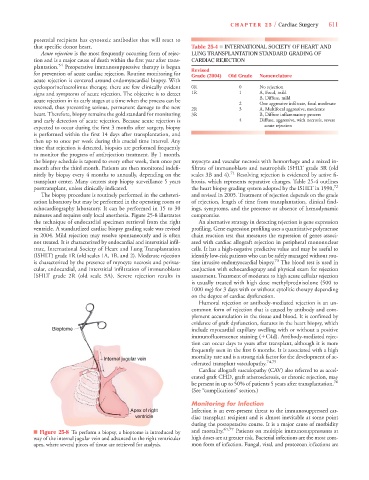
                   minutes and requires only local anesthesia. Figure 25-8 illustrates  compromise.
                   the technique of endocardial specimen retrieval from the right  An alternative strategy in detecting rejection is gene expression
                   ventricle. A standardized cardiac biopsy grading scale was revised  profiling. Gene expression profiling uses a quantitative polymerase
                   in 2004. Mild rejection may resolve spontaneously and is often  chain reaction test that measures the expression of genes associ-
                   not treated. It is characterized by endocardial and interstitial infil-  ated with cardiac allograft rejection in peripheral mononuclear
                   trate, International Society of Heart and Lung Transplantation  cells. It has a high-negative predictive value and may be useful to
                   (ISHLT) grade 1R (old scales 1A, 1B, and 2). Moderate rejection  identify low-risk patients who can be safely managed without rou-
                   is characterized by the presence of myocyte necrosis and perivas-  tine invasive endomyocardial biopsy. 73  The blood test is used in
                   cular, endocardial, and interstitial infiltration of immunoblasts  conjuction with echocardiograpy and physical exam for rejection
                   ISHLT  grade 2R (old scale 3A). Severe rejection results in  assessment. Treatment of moderate to high acute cellular rejection
                                                                       is usually treated with high dose methylprednisolone (500 to
                                                                       1000 mg) for 3 days with or without cytolitic therapy depending
                                                                       on the degree of cardiac dysfunction.
                                                                         Humoral rejection or antibody-mediated rejection is an un-
                                                                       common form of rejection that is caused by antibody and com-
                                                                       plement accumulation in the tissue and blood. It is confimed by
                                                                       evidence of graft dysfunction, features in the heart biopsy, which
                         Bioptome                                      include myocardial capillary swelling with or without a positive
                                                                       immunofluorescence staining (
C4d). Antibody-mediated rejec-
                                                                       tion can occur days to years after transplant, although it is more
                                                                       frequently seen in the first 6 months. It is associated with a high
                                                                       mortality rate and is a strong risk factor for the development of ac-
                                          Inter
                                          Int er n n nana  jugular vein
                                          nter
                                              al al a a a a a a a a a
                                              al jugu
                                                                       celerated transplant vasculopathy. 74,75
                                                                         Cardiac allograft vasculopathy (CAV) also referred to as accel-
                                                                       erated graft CHD, graft atherosclerosis, or chronic rejection, may
                                                                       be present in up to 50% of patients 5 years after transplantation. 76
                                                                       (See “complications” section.)
                                                                       Monitoring for Infection
                                                   Ape
                                                    pe
                                                   Ape ex x  x   f  f of o o o  rig ght  Infection is an ever-present threat to the immunosuppressed car-
                                                   Ape
                                                     x
                                                     ex
                                                    ve
                                                        cle
                                                    ve en n n n n ntri ri r tr cle e e  diac transplant recipient and is almost inevitable at some point
                                                    ve
                                                    ve
                                                    ve
                                                    ve
                                                      n
                                                        ic
                                                        i
                                                        c
                                                       t
                                                       tr
                                                       tr
                                                       t
                                                                       during the postoperative course. It is a major cause of morbidity
                   ■ Figure 25-8 To perform a biopsy, a bioptome is introduced by  and mortality. 61,77  Patients on multiple immunosuppressants at
                   way of the internal jugular vein and advanced to the right ventricular  high doses are at greater risk. Bacterial infections are the most com-
                   apex, where several pieces of tissue are retrieved for analysis.  mon form of infection. Fungal, viral, and protozoan infections are

