


Page 657 - Cardiac Nursing
P. 657
CHAPTER 26 / Mechanical Circulatory Assist Devices  633


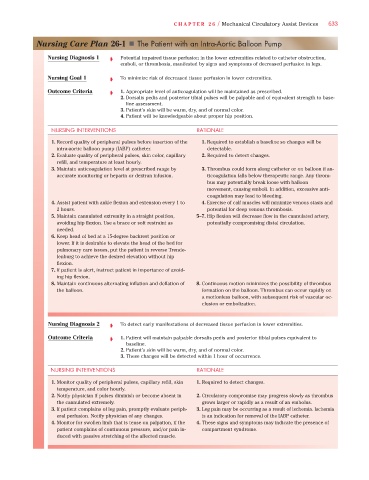
             Nursing Care Plan 26-1           The Patient with an Intra-Aortic Balloon Pump

                 Nursing Diagnosis 1    ç  Potential impaired tissue perfusion in the lower extremities related to catheter obstruction,
                                        emboli, or thrombosis, manifested by signs and symptoms of decreased perfusion in legs.
                 Nursing Goal 1      ç  To minimize risk of decreased tissue perfusion in lower extremities.

                 Outcome Criteria    ç  1. Appropriate level of anticoagulation will be maintained as prescribed.
                                        2. Dorsalis pedis and posterior tibial pulses will be palpable and of equivalent strength to base-
                                          line assessment.
                                        3. Patient’s skin will be warm, dry, and of normal color.
                                        4. Patient will be knowledgeable about proper hip position.

                  NURSING INTERVENTIONS                          RATIONALE
                  1. Record quality of peripheral pulses before insertion of the  1. Required to establish a baseline so changes will be
                    intra-aortic balloon pump (IABP) catheter.       detectable.
                  2. Evaluate quality of peripheral pulses, skin color, capillary  2. Required to detect changes.
                    refill, and temperature at least hourly.
                  3. Maintain anticoagulation level at prescribed range by   3. Thrombus could form along catheter or on balloon if an-
                    accurate monitoring or heparin or dextran infusion.  ticoagulation falls below therapeutic range. Any throm-
                                                                     bus may potentially break loose with balloon
                                                                     movement, causing emboli. In addition, excessive anti-
                                                                     coagulation may lead to bleeding.
                  4. Assist patient with ankle flexion and extension every 1 to   4. Exercise of calf muscles will minimize venous stasis and
                    2 hours.                                         potential for deep venous thrombosis.
                  5. Maintain cannulated extremity in a straight position,  5–7. Hip flexion will decrease flow in the cannulated artery,
                    avoiding hip flexion. Use a brace or soft restraint as  potentially compromising distal circulation.
                    needed.
                  6. Keep head of bed at a 15-degree backrest position or
                    lower. If it is desirable to elevate the head of the bed for
                    pulmonary care issues, put the patient in reverse Trende-
                    lenburg to achieve the desired elevation without hip
                    flexion.
                  7. If patient is alert, instruct patient in importance of avoid-
                    ing hip flexion.
                  8. Maintain continuous alternating inflation and deflation of  8. Continuous motion minimizes the possibility of thrombus
                    the balloon.                                   formation on the balloon. Thrombus can occur rapidly on
                                                                   a motionless balloon, with subsequent risk of vascular oc-
                                                                   clusion or embolization.


                 Nursing Diagnosis 2    ç  To detect early manifestations of decreased tissue perfusion in lower extremities.
                 Outcome Criteria    ç  1. Patient will maintain palpable dorsalis pedis and posterior tibial pulses equivalent to
                                          baseline.
                                        2. Patient’s skin will be warm, dry, and of normal color.
                                        3. These changes will be detected within 1 hour of occurrence.

                  NURSING INTERVENTIONS                          RATIONALE

                  1. Monitor quality of peripheral pulses, capillary refill, skin  1. Required to detect changes.
                    temperature, and color hourly.
                  2. Notify physician if pulses diminish or become absent in  2. Circulatory compromise may progress slowly as thrombus
                    the cannulated extremely.                      grows larger or rapidly as a result of an embolus.
                  3. If patient complains of leg pain, promptly evaluate periph-  3. Leg pain may be occurring as a result of ischemia. Ischemia
                    eral perfusion. Notify physician of any changes.  is an indication for removal of the IABP catheter.
                  4. Monitor for swollen limb that is tense on palpation, if the  4. These signs and symptoms may indicate the presence of
                    patient complains of continuous pressure, and/or pain in-  compartment syndrome.
                    duced with passive stretching of the affected muscle.

