


Page 656 - Cardiac Nursing
P. 656
632    P AR T IV / Pathophysiology and Management of Heart Disease


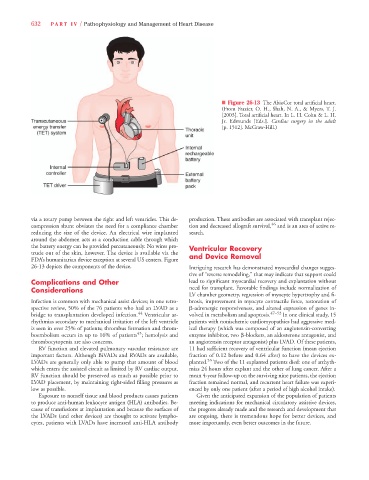
                                                                         n Figure 26-13 The AbioCor total artificial heart.
                                                                         (From Frazier, O. H., Shah, N. A., & Myers, T. J.
                                                                         [2003]. Total artificial heart. In L. H. Cohn & L. H.
                                                                         Jr. Edmunds [Eds.].  Cardiac surgery in the adult
                                                                         [p. 1512]. McGraw-Hill.)


           via a rotary pump between the right and left ventricles. This de-  production. These antibodies are associated with transplant rejec-
           compression shunt obviates the need for a compliance chamber  tion and decreased allograft survival, 46  and is an area of active re-
           reducing the size of the device. An electrical wire implanted  search.
           around the abdomen acts as a conduction cable through which
           the battery energy can be provided percutaneously. No wires pro-  Ventricular Recovery
           trude out of the skin, however. The device is available via the  and Device Removal
           FDA’s humanitarian device exception at several US centers. Figure
           26-13 depicts the components of the device.         Intriguing research has demonstrated myocardial changes sugges-
                                                               tive of “reverse remodeling,” that may indicate that support could
           Complications and Other                             lead to significant myocardial recovery and explantation without
           Considerations                                      need for transplant. Favorable findings include normalization of
                                                               LV chamber geometry, regression of myocyte hypertrophy and fi-
           Infection is common with mechanical assist devices; in one retro-  brosis, improvement in myocyte contractile force, restoration of
           spective review, 50% of the 76 patients who had an LVAD as a  b-adrenergic responsiveness, and altered expression of genes in-
           bridge to transplantation developed infection. 44  Ventricular ar-  volved in metabolism and apoptosis. 47–52  In one clinical study, 15
           rhythmias secondary to mechanical irritation of the left ventricle  patients with nonischemic cardiomyopathies had aggressive med-
           is seen in over 25% of patients; thrombus formation and throm-  ical therapy (which was composed of an angiotensin-converting
                                              45
           boembolism occurs in up to 16% of patients ; hemolysis and  enzyme inhibitor, two b-blockers, an aldosterone antagonist, and
           thrombocytopenia are also concerns.                 an angiotensin receptor antagonist) plus LVAD. Of these patients,
              RV function and elevated pulmonary vascular resistance are  11 had sufficient recovery of ventricular function (mean ejection
           important factors. Although BiVADs and RVADs are available,  fraction of 0.12 before and 0.64 after) to have the devices ex-
                                                                     53
           LVADs are generally only able to pump that amount of blood  planted. Two of the 11 explanted patients died: one of arrhyth-
           which enters the assisted circuit as limited by RV cardiac output.  mias 24 hours after explant and the other of lung cancer. After a
           RV function should be preserved as much as possible prior to  mean 4-year follow-up on the surviving nine patients, the ejection
           LVAD placement, by maintaining right-sided filling pressures as  fraction remained normal, and recurrent heart failure was experi-
           low as possible.                                    enced by only one patient (after a period of high alcohol intake).
              Exposure to nonself tissue and blood products causes patients  Given the anticipated expansion of the population of patients
           to produce anti-human leukocyte antigen (HLA) antibodies. Be-  meeting indications for mechanical circulatory assistive devices,
           cause of transfusions at implantation and because the surfaces of  the progress already made and the research and development that
           the LVADs (and other devices) are thought to activate lympho-  are ongoing, there is tremendous hope for better devices, and
           cytes, patients with LVADs have increased anti-HLA antibody  more importantly, even better outcomes in the future.

