


Page 653 - Cardiac Nursing
P. 653
CHAPTER 26 / Mechanical Circulatory Assist Devices  629


            Percutaneous Centrifugal Pumps                     LVAD to the aorta (or into the pulmonary artery if it is in RVAD
            Another percutaneously placed VAD is the left atrial to femoral  configuration). Negative pressure is applied after ejection, caus-
            artery VAD (e.g., Tandem Heart TM ). A venous catheter is placed  ing the blood sac to fill. Backward flow is prevented by placement
            in the left atrium via transseptal puncture from the right atrium.  of inflow and outflow disk valves in the pump. The blood sac is
            An arterial cannula is inserted in the iliac artery. The pump is a  filled by means of a cannula placed in either the left atrium or
            centrifugal model providing continuous flow. The device is used  the LV. It can be controlled in one of three modes: (1) a fixed rate
            for short-term stabilization, for hemodynamic support during  that is asynchronous with the patient’s heart and delivers variable
            PCIs, or as a bridge to recovery or surgical treatment. It requires  stroke volumes, (2) triggering of the pump by the R wave of
            anticoagulation (ideal activated clotting time of 250 to 350   the ECG (not practical for long-term support or in ambulatory
            seconds). Studies have shown improvement in cardiac output (the  patients), or (3) triggering of pump ejection by reaching full-fill
            pump can move 4 to 5 L/min of blood), cardiac index, and other  (also called fill-to-empty mode). 36  Infectious risk is increased in
            metabolic parameters. Mortality rates were comparable between  the paracorporeal device (where the pump is external). Conduits
            IABP and VAD, but there were more complications (e.g., bleed-  from the atrium or ventricle and the return conduits to the aorta
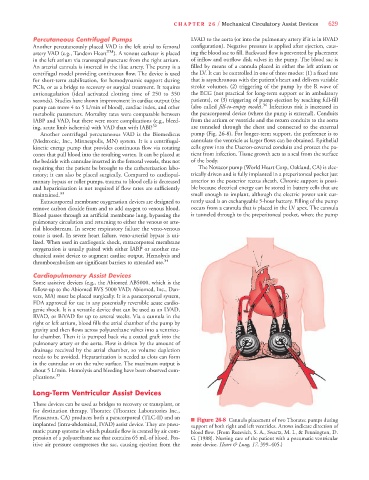
            ing, acute limb ischemia) with VAD than with IABP. 32  are tunneled through the chest and connected to the external
              Another centrifugal percutaneous VAD is the Biomedicus  pump (Fig. 26-8). For longer-term support, the preference is to
            (Medtronic, Inc., Minneapolis, MN) system. It is a centrifugal-  cannulate the ventricle as larger flows can be obtained. Epithelial
            kinetic energy pump that provides continuous flow via rotating  cells grow into the Dacron-covered conduits and protect the pa-
            cones that pull blood into the resulting vortex. It can be placed at  tient from infection. Tissue growth acts as a seal from the surface
            the bedside with cannulae inserted in the femoral vessels, thus not  of the body.
            requiring that the patient be brought to the catheterization labo-  The Novacor pump (World Heart Corp, Oakland, CA) is elec-
            ratory; it can also be placed surgically. Compared to cardiopul-  trically driven and is fully implanted in a preperitoneal pocket just
            monary bypass or roller pumps, trauma to blood cells is decreased  anterior to the posterior rectus sheath. Chronic support is possi-
            and heparinization is not required if flow rates are sufficiently  ble because electrical energy can be stored in battery cells that are
            maintained. 33                                     small enough to implant, although the electric power unit cur-
              Extracorporeal membrane oxygenation devices are designed to  rently used is an exchangeable 5-hour battery. Filling of the pump
            remove carbon dioxide from and to add oxygen to venous blood.  occurs from a cannula that is placed in the LV apex. The cannula
            Blood passes through an artificial membrane lung, bypassing the  is tunneled through to the preperitoneal pocket, where the pump
            pulmonary circulation and returning to either the venous or arte-
            rial bloodstream. In severe respiratory failure the veno-venous
            route is used. In severe heart failure, veno-arterial bypass is uti-
            lized. When used in cardiogenic shock, extracorporeal membrane
            oxygenation is usually paired with either IABP or another me-
            chanical assist device to augment cardiac output. Hemolysis and
            thromboembolism are significant barriers to extended use. 34

            Cardiopulmonary Assist Devices
            Some assistive devices (e.g., the Abiomed AB5000, which is the
            follow-up to the Abiomed BVS 5000 VAD; Abiomed, Inc., Dan-
            vers, MA) must be placed surgically. It is a paracorporeal system,
            FDA approved for use in any potentially reversible acute cardio-
            genic shock. It is a versatile device that can be used as an LVAD,
            RVAD, or BiVAD for up to several weeks. Via a cannula in the
            right or left atrium, blood fills the atrial chamber of the pump by
            gravity and then flows across polyurethane valves into a ventricu-
            lar chamber. Then it is pumped back via a coated graft into the
            pulmonary artery or the aorta. Flow is driven by the amount of
            drainage received by the atrial chamber, so volume depletion
            needs to be avoided. Heparanization is needed as clots can form
            in the cannulae or on the valve surface. The maximum output is
            about 5 L/min. Hemolysis and bleeding have been observed com-
            plications. 35


            Long-Term Ventricular Assist Devices
            These devices can be used as bridges to recovery or transplant, or
            for destination therapy. Thoratec (Thoratec Laboratories Inc.,
            Pleasanton, CA) produces both a paracorporeal (TLC-II) and an  n Figure 26-8 Cannula placement of two Thoratec pumps during
            implanted (intra-abdominal, IVAD) assist device. They are pneu-  support of both right and left ventricles. Arrows indicate direction of
            matic pump systems in which pulsatile flow is created by air com-  blood flow. (From Ruzevich, S. A., Swartz, M. I., & Pennington, D.
            pression of a polyurethane sac that contains 65 mL of blood. Pos-  G. [1988]. Nursing care of the patient with a pneumatic ventricular
            itive air pressure compresses the sac, causing ejection from the  assist device. Heart & Lung, 17, 399–405.)

