


Page 652 - Cardiac Nursing
P. 652
628    P AR T IV / Pathophysiology and Management of Heart Disease


           multiple invasive monitoring and infusion lines. Often, due to  occurring during the patient’s diastole or asynchronous with
           their critical condition, patients will be intubated and on ventila-  their cardiac cycle. Although it was previously thought that pul-
           tor support. Care must be taken to prevent or minimize atelecta-  satile flow patterns were more desirable, studies have shown
           sis. These patients also are at greater risk for respiratory tract in-  equivalent flow generation and clinical outcomes. 27,28  Continu-
           fection. Careful suctioning technique and prevention of  ous flow pumps are generally smaller, because they do not re-
           aspiration reduce this risk.                        quire a reservoir chamber. The remainder of this section will
              Prolonged hypotension from the shock state may jeopardize  describe several assistive devices in order of increasing durations
           renal function. Monitoring urine output and quality closely may  of use.
           contribute to early recognition and treatment of renal dysfunc-
           tion, thus avoiding acute renal failure. Psychosocial support of  Short-Term Ventricular Assist Devices
           the patient and family is also important. The patient requires in-
           terventions that minimize stress, disorientation, and sleep depri-  Percutaneous Axial Flow Pump
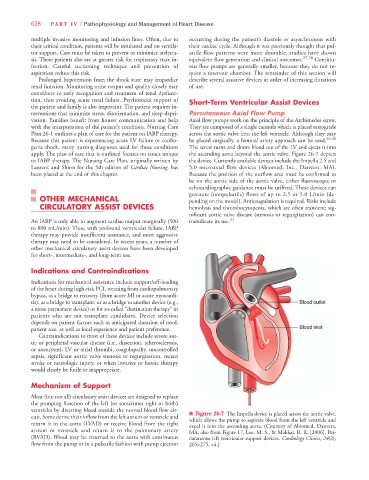
           vation. Families benefit from honest communication and help  Axial flow pumps work on the principle of the Archimedes screw.
           with the interpretation of the patient’s condition. Nursing Care  They are composed of a single cannula which is placed retrograde
           Plan 26-1 outlines a plan of care for the patient on IABP therapy.  across the aortic valve into the left ventricle. Although they may
           Because this patient is experiencing acute LV failure or cardio-  be placed surgically, a femoral artery approach can be used. 29,30
           genic shock, many nursing diagnoses used for those conditions  The screw turns and draws blood out of the LV and ejects it into
           apply. The plan of care that is outlined focuses on issues unique  the ascending aorta beyond the aortic valve. Figure 26-7 depicts
           to IABP therapy. The Nursing Care Plan, originally written by  the device. Currently available devices include the Impella 2.5 and
           Laurent and Shinn for the 5th edition of Cardiac Nursing, has  5.0 microaxial flow devices (Abiomed, Inc., Danvers, MA).
           been placed at the end of this chapter.             Because the position of the outflow area must be confirmed to
                                                               be on the aortic side of the aortic valve, either fluoroscopic or
                                                               echocardiographic guidance must be utilized. These devices can
                                                               generate (nonpulsatile) flows of up to 2.5 or 5.0 L/min (de-
              OTHER MECHANICAL                                 pending on the model). Anticoagulation is required. Risks include
              CIRCULATORY ASSIST DEVICES                       hemolysis and thrombocytopenia, which are often transient; sig-
                                                               nificant aortic valve disease (stenosis or regurgitation) can con-
           An IABP is only able to augment cardiac output marginally (500  traindicate its use. 31
           to 800 mL/min). Thus, with profound ventricular failure, IABP
           therapy may provide insufficient assistance, and more aggressive
           therapy may need to be considered. In recent years, a number of
           other mechanical circulatory assist devices have been developed
           for short-, intermediate-, and long-term use.

           Indications and Contraindications
           Indications for mechanical assistance include support/off-loading
           of the heart during high-risk PCI, weaning from cardiopulmonary
           bypass, as a bridge to recovery (from acute MI or acute myocardi-
           tis), as a bridge to transplant, or as a bridge to another device (e.g.,
           a more permanent device) or for so-called “destination therapy” in
           patients who are not transplant candidates. Device selection
           depends on patient factors such as anticipated duration of need,
           patient size, as well as local experience and patient preference.
              Contraindications to most of these devices include severe aor-
           tic or peripheral vascular disease (i.e., dissection, atherosclerosis,
           or aneurysm), LV or atrial thrombi, coagulopathy, uncontrolled
           sepsis, significant aortic valve stenosis or regurgitation, recent
           stroke or neurologic injury, or when invasive or heroic therapy
           would clearly be futile or inappropriate.

           Mechanism of Support
           Most (but not all) circulatory assist devices are designed to replace
           the pumping function of the left (or sometimes right or both)
           ventricles by diverting blood outside the normal blood flow cir-  n Figure 26-7 The Impella device is placed across the aortic valve,
           cuit. Some derive their inflow from the left atrium or ventricle and  which allows the pump to aspirate blood from the left ventricle and
           return it to the aorta (LVAD) or receive blood from the right  expel it into the ascending aorta. (Courtesy of Abiomed, Danvers,
           atrium or ventricle and return it to the pulmonary artery  MA; also from Figure 17, Lee, M. S., & Makkar, R. R. [2006]. Per-
           (RVAD). Blood may be returned to the aorta with continuous  cutaneous left ventricular support devices. Cardiology Clinics, 24(2),
           flow from the pump or in a pulsatile fashion with pump ejection  265–275, vii.)

