


Page 725 - Cardiac Nursing
P. 725
7
                                /1/
                                 09
                           qxd
                    p65
                       5-7
                         04.
                                               701
                                                  Ap
                                                    tar
                                             g
                                     49
                                        AM
                                           P
            K34
               0-c
                 28_
         LWB K34 0-c 28_ p65 5-7 04. qxd  7 /1/ 09  9: 49  AM  P a a g e e  701  Ap tar a a
         LWB
         LWBK340-c28_p655-704.qxd  7/1/09  9:9:49 AM  Page 701 Aptara
                                                              C HAPTER 2 8 / Pacemakers and Implantable Defibrillators  701
                                                                         Frequent and thorough follow-up care can help detect potential
                                                                       problems early, preventing devastating results. ICDs have become
                                                                       sophisticated and complex, providing information on patient ac-
                                                                       tivity, heart rate, frequency of arrhythmia, as well as ICD status.
                                                                       ICDs have continued to improve, enhancing patient safety and
                                                                       comfort. Remote monitoring of ICDs can assist with regular fol-
                                                                       low-up, and many ICDs have warning beeps or tones to alert the
                                                                       patient of a change with their ICD system.
                                                                       Special Considerations
                                                                       Sex and Racial Differences
                                                                       ICD therapy is recommended in all patients with HF and LV ejec-
                                                                       tion fraction of 35% or less. Previous studies have shown a disparity
                                                                       in which patients receive costly cardiovascular technologies. Her-
                                                                       nandez et al. 110  obtained data from the AHA, Get with the Guide-
                                                                       lines Program between January 2005 and June 2007 using a 30% EF
                                                                       as implanting criteria. They compared baseline characteristics of pa-
                                                                       tients that received ICD therapy with the characteristics of patients
                                                                       who did not receive ICD therapy. Review of the 13,034 patients el-
                                                                       igible for ICD therapy resulted in the following findings: (1) the fre-
                                                                       quency of ICD therapy was low with only 35.4% of qualified pa-
                                                                       tients receiving an ICD, (2) women were approximately 40% less
                                                                       likely than men to receive and ICD, and (3) black patients were ap-
                                                                       proximately 30% less likely than white  patients to receive an
                                                                       ICD. 110
                                                                         Awareness programs should address the recommendation for
                                                                       ICD therapy and the need for eliminating sex and racial dispari-
                                                                       ties. Programs such a Get with the Guidelines 111  and the National
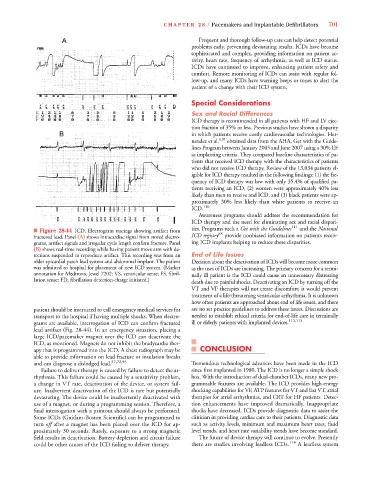
                   ■ Figure 28-44 ICD. Electrogram tracings showing artifact from  88
                   fractured lead. Panel (A) shows intracardiac signal from stored electro-  ICD registry  provide nonbiased information on patients receiv-
                   grams, artifact signals and irregular cycle length confirm fracture. Panel  ing ICD implants helping to reduce these disparities.
                   (B) shows real-time recording while having patient move arm with de-
                   tections suspended to reproduce artifact. This recording was from an  End of Life Issues
                   older epicardial patch lead system and abdominal implant. The patient  Decision about the deactivation of ICDs will become more common
                   was admitted to hospital for placement of new ICD system. (Marker  as the uses of ICDs are increasing. The primary concern for a termi-
                   annotation for Medtronic Jewel 7202: VS, ventricular sense; FS, fibril-  nally ill patient is the ICD could cause an unnecessary distressing
                   lation sense; FD, fibrillation detection-charge initiated.)
                                                                       death due to painful shocks. Deactivating an ICD by turning off the
                                                                       VT and VF therapies will not create discomfort; it would prevent
                                                                       treatment of a life-threatening ventricular arrhythmia. It is unknown
                                                                       how often patients are approached about end of life issues, and there
                   patient should be instructed to call emergency medical services for  are no set practice guidelines to address these issues. Discussions are
                   transport to the hospital if having multiple shocks. When electro-  needed to establish ethical criteria for end-of-life care in terminally
                   grams are available, interrogation of ICD can confirm fractured  ill or elderly patients with implanted devices. 112,113
                   lead artifact (Fig. 28-44). In an emergency situation, placing a
                   large ICD/pacemaker magnet over the ICD can deactivate the
                   ICD, as mentioned. Magnets do not inhibit the bradycardia ther-
                   apy that is programmed into the ICD. A chest radiograph may be  CONCLUSION
                   able to provide information on lead fracture or insulation breaks
                   and can diagnose a dislodged lead. 57,72,93         Tremendous technological advances have been made in the ICD
                     Failure to deliver therapy is caused by failure to detect the ar-  since first implanted in 1980. The ICD is no longer a simple shock
                   rhythmia. This failure could be caused by a sensitivity problem,  box. With the introduction of dual-chamber ICDs, many new pro-
                   a change in VT rate, deactivation of the device, or system fail-  grammable features are available. The ICD provides high-energy
                   ure. Inadvertent deactivation of the ICD is rare but potentially  shocking capabilities for VF, ATP features for VT and fast VT, atrial
                   devastating. The device could be inadvertently deactivated with  therapies for atrial arrhythmias, and CRT for HF patients. Detec-
                   use of a magnet, or during a programming session. Therefore, a  tion enhancements  have improved  dramatically. Inappropriate
                   final interrogation with a printout should always be performed.  shocks have decreased. ICDs provide diagnostic data to assist the
                   Some ICDs (Guidant-Boston Scientific) can be programmed to  clinician in providing cardiac care to their patients. Diagnostic data
                   turn off after a magnet has been placed over the ICD for ap-  such as activity levels, minimum and maximum heart rates, fluid
                   proximately 30 seconds. Rarely, exposure to a strong magnetic  level trends, and heart rate variability trends have become standard.
                   field results in deactivation. Battery depletion and circuit failure  The future of device therapy will continue to evolve. Presently
                   could be other causes of the ICD failing to deliver therapy.  there are studies involving leadless ICDs. 114  A leadless system

