


Page 721 - Cardiac Nursing
P. 721
P
                               7
                                        AM
                       5-7
                    p65
                           qxd
                         04.
                                                  Ap
                                               697
                                             g
                                                    tar
                                     49
                                 09
                                /1/
            K34
               0-c
                 28_
         LWBK340-c28_p655-704.qxd  7/1/09  9:9:49 AM  Page 697 Aptara
         LWB K34 0-c 28_ p65 5-7 04. qxd  7 /1/ 09  9: 49  AM  P a a g e e  697  Ap tar a a
         LWB
                                                              C HAPTER 2 8 / Pacemakers and Implantable Defibrillators  697
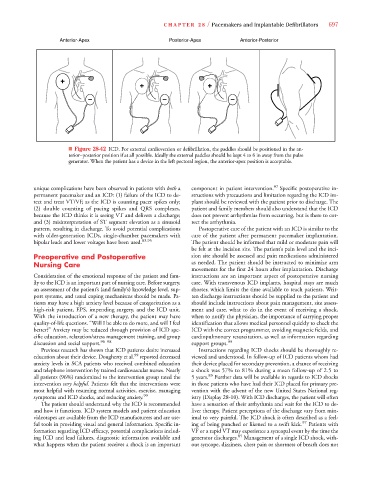
                            Anterior-Apex                      Posterior-Apex          Anterior-Posterior


                                Figure 28-42 ICD. For external cardioversion or defibrillation, the paddles should be positioned in the an-
                              terior–posterior position if at all possible. Ideally the external paddles should be kept 4 to 6 in away from the pulse
                              generator. When the patient has a device in the left pectoral region, the anterior-apex position is acceptable.


                   unique complications have been observed in patients with both a  component in patient intervention. 97  Specific postoperative in-
                   permanent pacemaker and an ICD: (1) failure of the ICD to de-  structions with precautions and limitation regarding the ICD im-
                   tect and treat VT/VF, as the ICD is counting pacer spikes only;  plant should be reviewed with the patient prior to discharge. The
                   (2) double counting of pacing spikes and QRS complexes,  patient and family members should also understand that the ICD
                   because the ICD thinks it is seeing VT and delivers a discharge;  does not prevent arrhythmias from occurring, but is there to cor-
                   and (3) misinterpretation of ST segment elevation as a sinusoid  rect the arrhythmia.
                   pattern, resulting in discharge. To avoid potential complications  Postoperative care of the patient with an ICD is similar to the
                   with older-generation ICDs, single-chamber pacemakers with  care of the patient after permanent pacemaker implantation.
                   bipolar leads and lower voltages have been used. 83,95  The patient should be informed that mild or moderate pain will
                                                                       be felt at the incision site. The patient’s pain level and the inci-
                   Preoperative and Postoperative                      sion site should be assessed and pain medications administered
                   Nursing Care                                        as needed. The patient should be instructed to minimize arm
                                                                       movements for the first 24 hours after implantation. Discharge
                   Consideration of the emotional response of the patient and fam-  instructions are an important aspect of postoperative nursing
                   ily to the ICD is an important part of nursing care. Before surgery,  care. With transvenous ICD implants, hospital stays are much
                   an assessment of the patient’s (and family’s) knowledge level, sup-  shorter, which limits the time available to teach patients. Writ-
                   port systems, and usual coping mechanisms should be made. Pa-  ten discharge instructions should be supplied to the patient and
                   tients may have a high anxiety level because of categorization as a  should include instructions about pain management, site assess-
                   high-risk patient, EPS, impending surgery, and the ICD unit.  ment and care, what to do in the event of receiving a shock,
                   With the introduction of a new therapy, the patient may have  when to notify the physician, the importance of carrying proper
                   quality-of-life questions. “Will I be able to do more, and will I feel  identification that allows medical personnel quickly to check the
                   better?” Anxiety may be reduced through provision of ICD spe-  ICD with the correct programmer, avoiding magnetic fields, and
                   cific education, relaxation/stress management training, and group  cardiopulmonary resuscitation, as well as information regarding
                   discussion and social support. 96–98                support groups. 99
                     Previous research has shown that ICD patients desire increased  Instructions regarding ICD shocks should be thoroughly re-
                                                    99
                   education about their device. Dougherty et al. reported decreased  viewed and understood. In follow-up of ICD patients whom had
                   anxiety levels in SCA patients who received combined education  their device placed for secondary prevention, a chance of receiving
                   and telephone intervention by trained cardiovascular nurses. Nearly  a shock was 57% to 81% during a mean follow-up of 2.5 to
                   all patients (96%) randomized to the intervention group rated the  5 years. 83  Further data will be available in regards to ICD shocks
                                    l
                   intervention very helpful. Patients felt that the interventions were  in those patients who have had their ICD placed for primary pre-
                                    l
                   most helpful with resuming normal activities, exercise, managing  vention with the advent of the new United States National reg-
                   symptoms and ICD shocks, and reducing anxiety. 99   istry (Display 28-10). With ICD discharges, the patient will often
                     The patient should understand why the ICD is recommended  have a sensation of their arrhythmia and wait for the ICD to de-
                   and how it functions. ICD system models and patient education  liver therapy. Patient perceptions of the discharge vary from min-
                   videotapes are available from the ICD manufacturers and are use-  imal to very painful. The ICD shock is often described as a feel-
                   ful tools in providing visual and general information. Specific in-  ing of being punched or likened to a swift kick. 97  Patients with
                   formation regarding ICD efficacy, potential complications includ-  VF or a rapid VT may experience a syncopal event by the time the
                                                                                      85
                   ing ICD and lead failures, diagnostic information available and  generator discharges. Management of a single ICD shock, with-
                   what happens when the patient receives a shock is an important  out syncope, dizziness, chest pain or shortness of breath does not

