


Page 730 - Cardiac Nursing
P. 730
1
                                   1
                                   1
                                /09
                                /09
                                /09
                                     4 A
                                        M
                                        M
                                   2:0
                                   2:0
                                     4 A
                              /30
                        21.
                          q
                          q
                      5-7
                      5-7
                        21.
                             6
                             6
                              /30
                          q
                           xd
                           xd
                                          Pa
                                                  t
                                                  ara
                                                  ara
                                                 p
                                                 p
                                                  t
                                                     In
                                                      c.
                                                      c.
                                                   a
                                                   a
                                                     In
                                                 p
                                           g
                                           g
                                            e 7
                                          Pa
                                          Pa
                                           g
                                              06
                                                A
                                                A
                                            e 7
                                              06
                                              06
                    70
            K34
               0-c
         LWBK340-c29_
         LWB K34 0-c 29_ pp705-721.qxd  6/30/09  12:04 AM  Page 706 Aptara Inc.
         LWB
                 29_
                   p
                    70
                 29_
                   p
                  706    PA R T  I V / Pathophysiology and Management of Heart Disease
                                                                      Table 29-1 ■ CLINICAL MANIFESTATIONS OF INFECTIVE
                                                                      ENDOCARDITIS
                                                                      Symptoms      Physical Examination Findings
                                                                      Fever         Fever
                                                                      Chills and sweats  Changing or new heart murmur
                                                                      Malaise       Evidence of systemic emboli
                                                                      Weight loss   Splenomegaly
                                                                      Anorexia      Janeway lesions (small hemorrhages on palms or soles
                                                                      Stroke symptoms  of feet)
                                                                      Myalgias      Splinter hemorrhages (hemorrhagic streaks at finger
                                                                      Arthralgias     nail tips)
                                                                      Confusion     Osler’s nodules (small, tender nodules on finger or toe
                                                                      CHF             pads)
                                                                      aggressive surgical intervention in cases complicated by CHF, inva-
                                                                      sive abscesses, and prosthetic valve infections. 6
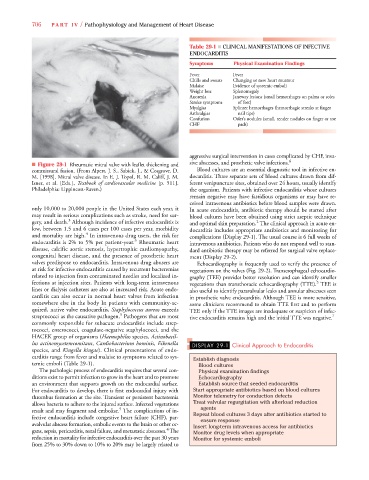
                  ■ Figure 29-1 Rheumatic mitral valve with leaflet thickening and
                  commissural fusion. (From Alpert, J. S., Sabick, J., & Cosgrove, D.  Blood cultures are an essential diagnostic tool in infective en-
                  M. [1998]. Mitral valve disease. In E. J. Topol, R. M. Califf, J. M.  docarditis. Three separate sets of blood cultures drawn from dif-
                  Isner, et al.  [Eds.], Textbook of cardiovascular medicine  [p. 511].  ferent venipuncture sites, obtained over 24 hours, usually identify
                  Philadelphia: Lippincott-Raven.)                    the organism. Patients with infective endocarditis whose cultures
                                                                      remain negative may have fastidious organisms or may have re-
                                                                      ceived intravenous antibiotics before blood samples were drawn.
                  only 10,000 to 20,000 people in the United States each year, it  In acute endocarditis, antibiotic therapy should be started after
                  may result in serious complications such as stroke, need for sur-  blood cultures have been obtained using strict aseptic technique
                              3
                  gery, and death. Although incidence of infective endocarditis is  and optimal skin preparation. The clinical approach in acute en-
                                                                                            2
                  low, between 1.5 and 6 cases per 100 cases per year, morbidity  docarditis includes appropriate antibiotics and monitoring for
                                    4
                  and mortality are high. In intravenous drug users, the risk for  complications (Display 29-1). The usual course is 6 full weeks of
                                                    5
                  endocarditis is 2% to 5% per patient-year. Rheumatic heart  intravenous antibiotics. Patients who do not respond well to stan-
                  disease, calcific aortic stenosis, hypertrophic cardiomyopathy,  dard antibiotic therapy may be referred for surgical valve replace-
                  congenital heart disease, and the presence of prosthetic heart  ment (Display 29-2).
                  valves predispose to endocarditis. Intravenous drug abusers are  Echocardiography is frequently used to verify the presence of
                  at risk for infective endocarditis caused by recurrent bacteremias  vegetations on the valves (Fig. 29-2). Transesophageal echocardio-
                  related to injection from contaminated needles and localized in-  graphy (TEE) provides better resolution and can identify smaller
                  fections at injection sites. Patients with long-term intravenous  vegetations than transthoracic echocardiography (TTE). TEE is
                                                                                                                5
                  lines or dialysis catheters are also at increased risk. Acute endo-  also useful to identify paravalvular leaks and annular abscesses seen
                  carditis can also occur in normal heart valves from infection  in prosthetic valve endocarditis. Although TEE is more sensitive,
                  somewhere else in the body In patients with community-ac-  some clinicians recommend to obtain TTE first and to perform
                  quired, native valve endocarditis, Staphylococcus aureus exceeds  TEE only if the TTE images are inadequate or suspicion of infec-
                                               5
                  streptococci as the causative pathogen. Pathogens that are most  tive endocarditis remains high and the initial TTE was negative. 7
                  commonly responsible for subacute endocarditis include strep-
                  tococci, enterococci, coagulase-negative staphylococci, and the
                  HACEK group of organisms (Haemophilus species, Actinobacil-
                  lus actinomycetemcomitans, Cardiobacterium hominis, Eikenella  DISPLAY 29-1 Clinical Approach to Endocarditis
                  species, and Kingella kingae). Clinical presentations of endo-
                  carditis range from fever and malaise to symptoms related to sys-  Establish diagnosis
                  temic emboli (Table 29-1).                             Blood cultures
                     The pathologic process of endocarditis requires that several con-  Physical examination findings
                  ditions exist to permit infection to grow in the heart and to promote  Echocardiography
                  an environment that supports growth on the endocardial surface.  Establish source that seeded endocarditis
                  For endocarditis to develop, there is first endocardial injury with  Start appropriate antibiotics based on blood cultures
                  thrombus formation at the site. Transient or persistent bacteremia  Monitor telemetry for conduction defects
                  allows bacteria to adhere to the injured surface. Infected vegetations  Treat valvular regurgitation with afterload reduction
                                               5
                  result and may fragment and embolize. The complications of in-  agents
                  fective endocarditis include congestive heart failure (CHF), par-  Repeat blood cultures 3 days after antibiotics started to
                                                                          ensure response
                  avalvular abscess formation, embolic events to the brain or other or-  Insert long-term intravenous access for antibiotics
                                                              4
                  gans, sepsis, pericarditis, renal failure, and metastatic abscesses. The  Monitor drug levels when appropriate
                  reduction in mortality for infective endocarditis over the past 30 years  Monitor for systemic emboli
                  from 25% to 30% down to 10% to 20% may be largely related to

