


Page 720 - Cardiac Nursing
P. 720
P
                                        AM
                                     49
                                                  Ap
                                               696
                                             g
                                 09
                         04.
                       5-7
                    p65
                                /1/
                               7
                           qxd
            K34
         L L LWB
               0-c
                 28_
         LWB K34 0-c 28_ p65 5-7 04. qxd  7 /1/ 09  9: 49  AM  P a a g e e  696  Ap tar a a
                                                    tar
         LWBK340-c28_p655-704.qxd  7/1/09  9:9:49 AM  Page 696 Aptara
                  696    PA R T  I V / Pathophysiology and Management Disease
                                                                      because it may cause permanent damage to the ICD. Inadvertent
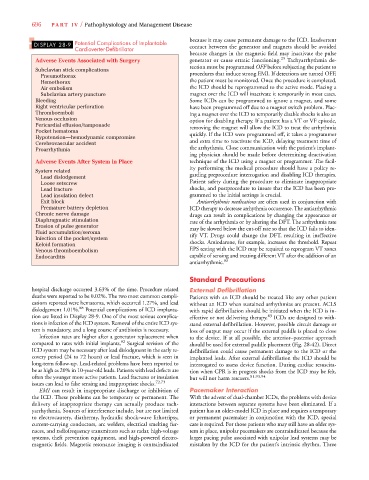
                   DISPLAY 28-9  Potential Complications of Implantable  contact between the generator and magnets should be avoided
                                Cardioverter-Defibrillator
                                                                      because changes in the magnetic field may inactivate the pulse
                    Adverse Events Associated with Surgery            generator or cause erratic functioning. 25  Tachyarrhythmia de-
                                                                      tection must be programmed OFF before subjecting the patient to
                    Subclavian stick complications
                     Pneumothorax                                     procedures that induce strong EMI. If detections are turned OFF,
                     Hemothorax                                       the patient must be monitored. Once the procedure is completed,
                     Air embolism                                     the ICD should be reprogrammed to the active mode. Placing a
                     Subclavian artery puncture                       magnet over the ICD will inactivate it temporarily in most cases.
                    Bleeding                                          Some ICDs can be programmed to ignore a magnet, and some
                    Right ventricular perforation                     have been programmed off due to a magnet switch problem. Plac-
                    Thromboemboli                                     ing a magnet over the ICD to temporarily disable shocks is also an
                    Venous occlusion                                  option for disabling therapy. If a patient has a VT or VF episode,
                    Pericardial effusion/tamponade                    removing the magnet will allow the ICD to treat the arrhythmia
                    Pocket hematoma                                   quickly. If the ICD were programmed off, it takes a programmer
                    Hypotension—hemodynamic compromise
                    Cerebrovascular accident                          and extra time to reactivate the ICD, delaying treatment time of
                    Proarrhythmia                                     the arrhythmia. Close communication with the patient’s implant-
                                                                      ing physician should be made before determining deactivation
                    Adverse Events After System in Place              technique of the ICD using a magnet or programmer. The facil-
                                                                      ity performing the medical procedure should have a policy re-
                    System related
                     Lead dislodgement                                garding preprocedure interrogation and disabling ICD therapies.
                     Loose setscrew                                   Patient safety during the procedure to eliminate inappropriate
                     Lead fracture                                    shocks, and postprocedure to insure that the ICD has been pro-
                     Lead insulation defect                           grammed to the initial settings is crucial.
                     Exit block                                         Antiarrhythmic medications are often used in conjunction with
                     Premature battery depletion                      ICD therapy to decrease arrhythmia occurrence. The antiarrhythmic
                    Chronic nerve damage                              drugs can result in complications by changing the appearance or
                    Diaphragmatic stimulation                         rate of the arrhythmia or by altering the DFT. The arrhythmia rate
                    Erosion of pulse generator                        may be slowed below the cut-off rate so that the ICD fails to iden-
                    Fluid accumulation/seroma                         tify VT. Drugs could change the DFT, resulting in ineffective
                    Infection of the pocket/system
                    Keloid formation                                  shocks. Amiodarone, for example, increases the threshold. Repeat
                    Venous thromboembolism                            EPS testing with the ICD may be required to reprogram VT zones
                    Endocarditis                                      capable of sensing and treating different VT after the addition of an
                                                                      antiarrhythmic. 93
                                                                      Standard Precautions
                  hospital discharge occurred 3.63% of the time. Procedure related  External Defibrillation
                  deaths were reported to be 0.02%. The two most common compli-  Patients with an ICD should be treated like any other patient
                  cations reported were hematoma, which occurred 1.27%, and lead  without an ICD when sustained arrhythmias are present. ACLS
                  dislodgement 1.01%. 88  Potential complications of ICD implanta-  with rapid defibrillation should be initiated when the ICD is in-
                  tion are listed in Display 28-9. One of the most serious complica-  effective or not delivering therapy. 83  ICDs are designed to with-
                  tions is infection of the ICD system. Removal of the entire ICD sys-  stand external defibrillation. However, possible circuit damage or
                  tem is mandatory, and a long course of antibiotics is necessary.  loss of output may occur if the external paddle is placed to close
                     Infection rates are higher after a generator replacement when  to the device. If at all possible, the anterior–posterior approach
                  compared to rates with initial implants, 92  Surgical revision of the  should be used for external paddle placement (Fig. 28-42). Direct
                  ICD system may be necessary after lead dislodgment in the early re-  defibrillation could cause permanent damage to the ICD or the
                  covery period (24 to 72 hours) or lead fracture, which is seen in  implanted leads. After external defibrillation the ICD should be
                  long-term follow-up. Lead-related problems have been reported to  interrogated to assess device function. During cardiac resuscita-
                  be as high as 20% in 10-year-old leads. Patients with lead defects are  tion when CPR is in progress shocks from the ICD may be felt,
                  often the younger more active patients. Lead fractures or insulation  but will not harm rescuers. 81,93,94
                  issues can lead to false sensing and inappropriate shocks. 72,73
                     EMI can result in inappropriate discharge or inhibition of  Pacemaker Interaction
                  the ICD. These problems can be temporary or permanent. The  With the advent of dual-chamber ICDs, the problems with device
                  delivery of inappropriate therapy can actually produce tach-  interactions between separate systems have been eliminated. If a
                  yarrhythmia. Sources of interference include, but are not limited  patient has an older-model ICD in place and requires a temporary
                  to electrocautery, diathermy, hydraulic shock-wave lithotripsy,  or permanent pacemaker in conjunction with the ICD, special
                  current-carrying conductors, arc welders, electrical smelting fur-  care is required. For those patients who may still have an older sys-
                  naces, and radiofrequency transmitters such as radar, high-voltage  tem in place, unipolar pacemakers are contraindicated because the
                  systems, theft prevention equipment, and high-powered electro-  larger pacing pulse associated with unipolar lead systems may be
                  magnetic fields. Magnetic resonance imaging is contraindicated  mistaken by the ICD for the patient’s intrinsic rhythm. Three

