


Page 742 - Cardiac Nursing
P. 742
2:0
                                   2:0
                                   1
                                    1
                                   1
                                     4 A
                                          Pa
                                          Pa
                                        M
                                     4 A
                                        M
                                /09
                           xd
                           xd
                          q
                          q
                          q
                             6
                                /09
                                /09
                              /30
                             6
                              /30
                                          Pa
                                                  ara
                                                  ara
                                                  t
                                                 p
                                                  t
                                                   a
                                                      c.
                                                      c.
                                                     In
                                                   a
                                                     In
                                                 p
                                            e 7
                                            e 7
                                           g
                                           g
                                           g
                                              18
                                                A
                                                 p
                                                A
                                              18
                                              18
                    70
                    70
               0-c
            K34
            K34
                 29_
                 29_
                 29_
                   p
               0-c
                      5-7
         LWBK340-c29_ p pp705-721.qxd  6/30/09  12:04 AM  Page 718 Aptara Inc.
                      5-7
                        21.
                        21.
         LWB
         LWB
                  718    PA R T  I V / Pathophysiology and Management of Heart Disease
                     Electrocardiography often shows a pattern of left ventricular hy-  Medical Management
                  pertrophy, although its absence does not exclude the presence of
                  critical aortic stenosis. Patients with aortic stenosis may demon-  Because aortic stenosis is a mechanical problem, there is no effec-
                  strate ST-T-wave changes typical of left ventricular strain. QRS  tive medical management. The course of aortic stenosis varies in
                  voltage changes in the precordial leads correlates poorly with the  its progression; therefore, patients should be followed-up carefully
                  severity of obstruction in aortic stenosis in adults. 10  by their health care providers with serial physical examinations
                     Exercise testing in patients with mild-to-moderate aortic stenosis  and periodic echocardiography. Patients with mild aortic stenosis
                  with equivocal symptoms may be accomplished with caution in the  undergo echocardiography every 2 years. Patients with asympto-
                  hands of a cardiologist and can provide relevant information regard-  matic severe aortic stenosis are followed-up with serial echocar-
                  ing exercise tolerance. In patients with known severe aortic stenosis  diograms every 6 to 12 months and should be taught to recognize
                  and classic symptoms such as syncope, dyspnea, and chest pain, ex-  the symptoms of worsening aortic stenosis, such as dyspnea, chest
                  ercise testing carries increased risk of ventricular tachyarrhythmias  pain, and near syncope or syncope.
                  and ventricular fibrillation and should not be performed.
                     Gated blood pool radionuclide scans provide information regard-  Interventional and Surgical
                  ing ventricular function similar to echocardiography and left ven-  Management
                  triculography. Gated pool scans may be useful in patients in
                  whom left ventriculography cannot be performed (i.e., patients  Percutaneous Aortic Catheter Balloon
                  with elevated creatinine), or those in whom the left ventricle can-  Valvuloplasty
                  not be clearly imaged with echocardiography.        Percutaneous aortic catheter  balloon valvuloplasty is accom-
                     Chest radiography may be negative even in advanced disease.  plished by passing a guide wire across the stenotic aortic valve into
                  Heart size may be normal or only minimally enlarged. The left  the apex of the left ventricle. A balloon-tipped catheter is ad-
                  ventricular border and apex may be rounded, demonstrating a  vanced retrograde across the stenotic valve. The balloon is inflated,
                  boot-shaped silhouette. Identifiable calcification of the aortic  fracturing calcified nodules and separating the fused commissures.
                  valve and aorta may be present. As disease progresses, left atrial  The aortic valve ring is also stretched to increase the size of the
                  enlargement, pulmonary hypertension, and CHF may become  aortic valve orifice. Restenosis is a major problem in balloon aor-
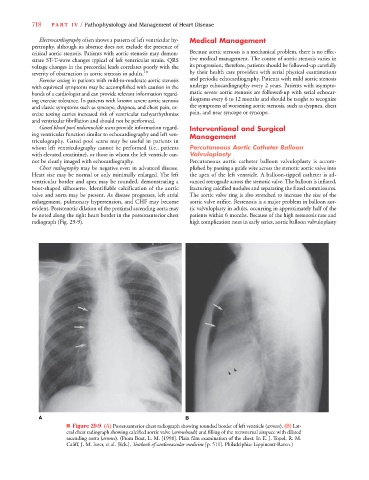
                  evident. Poststenotic dilation of the proximal ascending aorta may  tic valvuloplasty in adults, occurring in approximately half of the
                  be noted along the right heart border in the posteroanterior chest  patients within 6 months. Because of the high restenosis rate and
                  radiograph (Fig. 29-9).                             high complication rates in early series, aortic balloon valvuloplasty
                     A                                               B
                              ■ Figure 29-9 (A) Posteroanterior chest radiograph showing rounded border of left ventricle (arrows).s (B) Lat-
                              eral chest radiograph showing calcified aortic valve (arrowheads) and filling of the retrosternal airspace with dilateds
                                             s
                              ascending aorta (arrows). (From Boxt, L. M. [1998]. Plain film examination of the chest. In E. J. Topol, R. M.
                              Califf, J. M. Isner, et al. [Eds.], Textbook of cardiovascular medicine [p. 511]. Philadelphia: Lippincott-Raven.)

