


Page 739 - Cardiac Nursing
P. 739
2:0
                                   2:0
                                   1
                                    1
                                   1
                                     4 A
                                          Pa
                                          Pa
                                        M
                                     4 A
                                        M
                                /09
                           xd
                           xd
                          q
                          q
                          q
                             6
                                /09
                                /09
                              /30
                             6
                              /30
                                          Pa
                                                  ara
                                                  ara
                                                  t
                                                 p
                                                  t
                                                   a
                                                      c.
                                                      c.
                                                     In
                                                   a
                                                     In
                                                 p
                                            e 7
                                            e 7
                                           g
                                           g
                                           g
                                              15
                                                A
                                                 p
                                                A
                                              15
                                              15
                        21.
         LWBK340-c29_
         LWB
         LWB K34 0-c 29_ p p pp705-721.qxd  6/30/09  12:04 AM  Page 715 Aptara Inc.
            K34
                 29_
                 29_
               0-c
                      5-7
                      5-7
                        21.
                    70
                    70
                                                                      C HAPTER 2 9 / Acquired Valvular Heart Disease  715
                   fully monitored, however, and referred for mitral valve repair or
                   replacement before significant left ventricular dysfunction or pul-  MITRAL VALVE PROLAPSE
                   monary hypertension occurs.
                                                                       Cause
                   Surgical Management                                 Mitral valve prolapse (MVP) refers to a variable clinical syndrome
                   Two surgical approaches are used to treat mitral regurgitation. Mi-  that is the result of a variety of pathologic mechanisms of one or
                                                                                                               10
                   tral valve repair uses reconstructive techniques as well as a rigid  more portions of the mitral valve leaflets and apparatus.  During
                   prosthetic ring to repair the mitral valve apparatus, thus sparing  ventricular systole, one or both of the mitralleaflets prolapse above
                   the valve and avoiding the consequences of valve replacement. Mi-  the plane of the mitral valve annulus. MVP syndrome may also be
                   tral valve replacement involves implantation of a prosthetic valve,  known as Barlow syndrome, myxomatous valve syndrome, or click-
                   either mechanical or bioprosthetic. The mitral valve apparatus is  murmur syndrome. The most common cause of MVP is myxoma-
                   preserved whenever possible as it contributes to the preservation  tous  degeneration,  but it is also causedby Marfan syndrome,
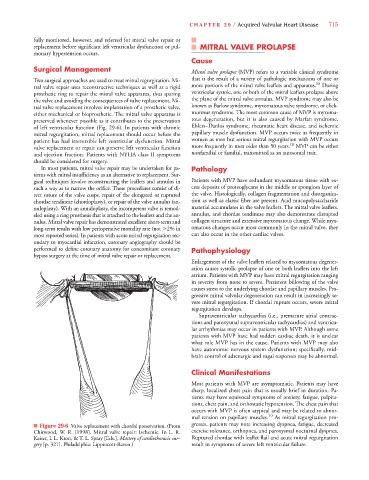
                   of left ventricular function (Fig. 29-6). In patients with chronic  Ehlers–Danlos syndrome, rheumatic heart disease, and ischemic
                   mitral regurgitation, mitral replacement should occur before the  papillary muscle dysfunction. MVP occurs twice as frequently in
                   patient has had irreversible left ventricular dysfunction. Mitral  women as men but serious mitral regurgitation with MVP occurs
                                                                                                       10
                   valve replacement or repair can preserve left ventricular function  more frequently in men older than 50 years.  MVP can be either
                   and ejection fraction. Patients with NYHA class II symptoms  nonfamilial or familial, transmitted as an autosomal trait.
                   should be considered for surgery.
                     In most patients, mitral valve repair may be undertaken for pa-  Pathology
                   tients with mitral insufficiency as an alternative to replacement. Sur-
                   gical techniques involve reconstructing the leaflets and annulus in  Patients with MVP have redundant myxomatous tissue with ex-
                   such a way as to narrow the orifice. These procedures consist of di-  cess deposits of proteoglycans in the middle or spongiosa layer of
                   rect suture of the valve cusps, repair of the elongated or ruptured  the valve. Histologically, collagen fragmentation and disorganiza-
                   chordae tendineae (chordoplasty), or repair of the valve annulus (an-  tion as well as elastic fiber are present. Acid mucopolysaccharide
                   nuloplasty). With an annuloplasty, the incompetent valve is remod-  material accumulates in the valve leaflets. The mitral valve leaflets,
                   eled using a ring prosthesis that is attached to the leaflets and the an-  annulus, and chordae tendineae may also demonstrate disrupted
                   nulus. Mitral valve repair has demonstrated excellent short-term and  collagen structure and extensive myxomatous change. While myx-
                   long-term results with low perioperative mortality rate (not  2% in  omatous changes occur most commonly in the mitral valve, they
                   most reported series). In patients with acute mitral regurgitation sec-  can also occur in the other cardiac valves.
                   ondary to myocardial infarction, coronary angiography should be
                   performed to define coronary anatomy for concomitant coronary  Pathophysiology
                   bypass surgery at the time of mitral valve repair or replacement.
                                                                       Enlargement of the valve leaflets related to myxomatous degener-
                                                                       ation causes systolic prolapse of one or both leaflets into the left
                                                                       atrium. Patients with MVP may have mitral regurgitation ranging
                                                                       in severity from none to severe. Persistent billowing of the valve
                                                                       causes stress to the underlying chordae and papillary muscles. Pro-
                                                                       gressive mitral valvular degeneration can result in increasingly se-
                                                                       vere mitral regurgitation. If chordal rupture occurs, severe mitral
                                                                       regurgitation develops.
                                                                         Supraventricular tachycardias (i.e., premature atrial contrac-
                                                                       tions and paroxysmal supraventricular tachycardias) and ventricu-
                                                                       lar arrhythmias may occur in patients with MVP. Although some
                                                                       patients with MVP have had sudden cardiac death, it is unclear
                                                                       what role MVP has in the cause. Patients with MVP may also
                                                                       have autonomic nervous system dysfunction; specifically, mid-
                                                                       brain control of adrenergic and vagal responses may be abnormal.
                                                                       Clinical Manifestations
                                                                       Most patients with MVP are asymptomatic. Patients may have
                                                                       sharp, localized chest pain that is usually brief in duration. Pa-
                                                                       tients may have equivocal symptoms of anxiety, fatigue, palpita-
                                                                       tions, chest pain, and orthostatic hypotension. The chest pain that
                                                                       occurs with MVP is often atypical and may be related to abnor-
                                                                       mal tension on papillary muscles. 10  As mitral regurgitation pro-
                   ■ Figure 29-6 Valve replacement with chordal preservation. (From  gresses, patients may note increasing dyspnea, fatigue, decreased
                   Chitwood, W. R. [1998]. Mitral valve repair: Ischemic. In L. R.  exercise tolerance, orthopnea, and paroxysmal nocturnal dyspnea.
                   Kaiser, I. L. Kron, & T. L. Spray [Eds.], Mastery of cardiothoracic sur-  Ruptured chordae with leaflet flail and acute mitral regurgitation
                   gery [p. 321]. Philadelphia: Lippincott-Raven.)     result in symptoms of severe left ventricular failure.

