


Page 747 - Cardiac Nursing
P. 747
LWBK340-c30_p722-737.qxd  09/09/2009  08:31 AM  Page 723 Aptara


                                                        C HAP TE R  30 / Pericardial, Myocardial, and Endocardial Disease  723

                   viral pericarditis is nearly always preceded by a recent respiratory,  The pericardium itself does not produce electrical activity. The
                   gastrointestinal, or “flu-like” illness. A prodrome of fever, malaise,  electrocardiogram (ECG) changes seen in pericarditis are a result
                   and myalgia is common in acute pericarditis, although older pa-  of superficial inflammation of the myocardium underneath the
                   tients may not exhibit fever. 1                     pericardium. The ECG of a patient with pericarditis may be nor-
                     A major symptom of pericarditis is chest pain that is retroster-  mal, atypically abnormal with nonspecific changes, or have a four-
                   nal or left precordial, radiating to the trapezius ridge and varying  stage sequence that is diagnostic. Figure 30-1 shows the electro-
                   with posture. The pain is transmitted through the phrenic nerves,  cardiographic manifestations of pericarditis.
                   and usually occurs on the left side. Shoulder pain should be dis-  In stage I, there are ST segment deviations, primarily due to
                   tinguished from trapezius ridge pain by having the patient physi-  inflammation on the ventricular surfaces. PR segment deviations
                   cally point to the specific site of pain. Frequently the chest pain  are also usually present. Stage I is virtually pathognomonic of
                   caused by pericarditis induces shallow tachypnea as patients at-  acute pericarditis when it involves all or almost all leads with early
                                                 2
                   tempt to splint their chest movement. The pain is generally  ST junction elevations that produce an appearance of T waves
                   worse when lying supine and is relieved by sitting.  “jacked-up” on the QRS interval, but that is otherwise normal. 2
                     A pericardial friction rub is pathognomonic for pericarditis,  The ST segment is always depressed in aVR. 4
                   but is frequently not present, may come and go, and can vary in  In early stage II, the ST segments return to baseline, and PR
                   quality and intensity. Auscultation for a pericardial friction rub is  segments may now be depressed. In late stage II, the T waves flat-
                   accomplished with the diaphragm of the stethoscope at the left  ten and then invert. In stage III, the ECG is characteristic of dif-
                   middle to lower sternal border during both inspiration and expi-  fuse myocardial injury. In stage IV, the ECG evolves back to the
                                                                                     2
                                                   2
                   ration, while the patient changes positions. Often best heard at  prepericarditis state. Stage IV may last days or months. 4
                   end expiration while the patient is leaning forward, the sound is  The changes seen in the ECG of a patient with pericarditis
                   classically a rasping or creaking with a triple cadence, but can also  can occur over hours, particularly from stages I to II, or can take
                   be bi- or monophasic. 1                             place over days or weeks, most often as stage III evolves to stage
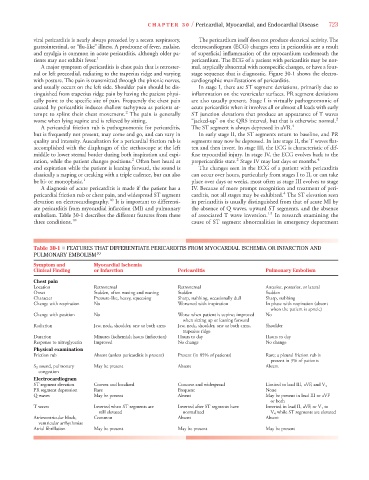
                     A diagnosis of acute pericarditis is made if the patient has a  IV. Because of more prompt recognition and treatment of peri-
                                                                                                     4
                   pericardial friction rub or chest pain, and widespread ST segment  carditis, not all stages may be exhibited. The ST elevation seen
                   elevation on electrocardiography. 10  It is important to differenti-  in pericarditis is usually distinguished from that of acute MI by
                   ate pericarditis from myocardial infarction (MI) and pulmonary  the absence of Q waves, upward ST segments, and the absence
                   embolism. Table 30-1 describes the different features from these  of associated T wave inversion. 13  In research examining the
                   three conditions. 10                                cause of ST segment abnormalities in emergency department


                   Table 30-1 ■ FEATURES THAT DIFFERENTIATE PERICARDITIS FROM MYOCARDIAL ISCHEMIA OR INFARCTION AND
                   PULMONARY EMBOLISM  10
                   Symptom and         Myocardial Ischemia
                   Clinical Finding    or Infarction              Pericarditis                 Pulmonary Embolism
                   Chest pain
                   Location            Retrosternal               Retrosternal                 Anterior, posterior, or lateral
                   Onset               Sudden, often waxing and waning  Sudden                 Sudden
                   Character           Pressure-like, heavy, squeezing  Sharp, stabbing, occasionally dull  Sharp, stabbing
                   Change with respiration  No                    Worsened with inspiration    In phase with respiration (absent
                                                                                                 when the patient is apneic)
                   Change with position  No                       Worse when patient is supine; improved  No
                                                                    when sitting up or leaning forward
                   Radiation           Jaw, neck, shoulder, one or both arms  Jaw, neck, shoulder, one or both arms,   Shoulder
                                                                    trapezius ridge
                   Duration            Minutes (ischemia); hours (infarction)  Hours to day    Hours to day
                   Response to nitroglycerin  Improved            No change                    No change
                   Physical examination
                   Friction rub        Absent (unless pericarditis is present)  Present (in 85% of patients)  Rare; a pleural friction rub is
                                                                                                 present in 3% of patients
                   S 3 sound, pulmonary  May be present           Absent                       Absent
                     congestion
                   Electrocardiogram
                   ST segment elevation  Convex and localized     Concave and widespread       Limited to lead III, aVF, and V 1
                   PR segment depression  Rare                    Frequent                     None
                   Q waves             May be present             Absent                       May be present in lead III or aVF
                                                                                                 or both
                   T waves             Inverted when ST segments are   Inverted after ST segments have  Inverted in lead II, aVF, or V 1 to
                                                                                                 V 4 while ST segments are elevated
                                        still elevated              normalized                   V
                   Atrioventricular block,  Common                Absent                       Absent
                     ventricular arrhythmias
                   Atrial fibrillation  May be present             May be present               May be present

