


Page 748 - Cardiac Nursing
P. 748
009
                                  9/2
                                           1 A
                                        8:3
                                9/0
                         37.
                         37.
                               0
                           qxd
                                                    24
                                                    24
                                                         ara
                                                       Apt
                                                  e 7
                                               P
                                             M
                                                 g
                                               P
                       2-7
            K34
               0-c
                 30_
            K34
         LWB K34 0-c 30_ p72 2-7 37. qxd  0 9/0 9/2 009  0 0 8:3 1 A M  P a a g e 7 24  Apt ara
         L L LWB
         LWBK340-c30_30_p722-737.qxd  09/09/2009  08:31 AM  Page 724 Aptara
                    p72
                  724    PA R T  I V / Pathophysiology and Management of Heart Disease


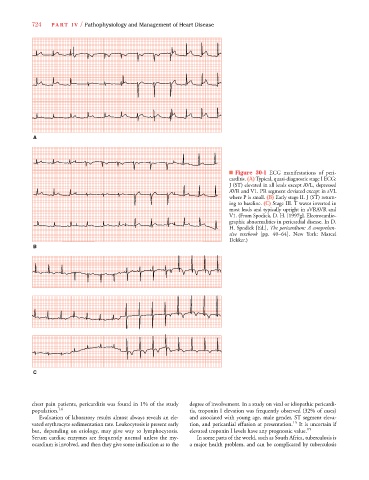
                                                                                   ■ Figure 30-1 ECG manifestations of  peri-
                                                                                   carditis. (A) Typical, quasi-diagnostic stage I ECG:
                                                                                   J (ST) elevated in all leads except AVL, depressed
                                                                                   AVR and V1. PR segment deviated except in aVL
                                                                                   where P is small. (B) Early stage II. J (ST) return-
                                                                                   ing to baseline. (C) Stage III. T waves inverted in
                                                                                   most leads and typically upright in aVRAVR and
                                                                                   V1. (From Spodick, D. H. [1997g]. Electrocardio-
                                                                                   graphic abnormalities in pericardial disease. In D.
                                                                                   H. Spodick [Ed.], The pericardium: A comprehen-
                                                                                   sive textbook  [pp. 40–64]. New  York: Marcel
                                                                                   Dekker.)
                   B


                   C


                  chest pain patients, pericarditis was found in 1% of the study  degree of involvement. In a study on viral or idiopathic pericardi-
                  population. 14                                      tis, troponin I elevation was frequently observed (32% of cases)
                     Evaluation of laboratory results almost always reveals an ele-  and associated with young age, male gender, ST segment eleva-
                  vated erythrocyte sedimentation rate. Leukocytosis is present early  tion, and pericardial effusion at presentation. 15  It is uncertain if
                  but, depending on etiology, may give way to lymphocytosis.  elevated troponin I levels have any prognostic value. 15
                  Serum cardiac enzymes are frequently normal unless the my-  In some parts of the world, such as South Africa, tuberculosis is
                  ocardium is involved, and then they give some indication as to the  a major health problem, and can be complicated by tuberculosis

