


Page 751 - Cardiac Nursing
P. 751
g
                                                  e 7
                                               P
                    p72
                                               P
                                                         ara
                                        8:3
                                                       Apt
                                                    27
                                                    27
                               0
                           qxd
                                9/0
                                    009
                                  9/2
                                           1 A
                                             M
                       2-7
                         37.
                         37.
            K34
               0-c
                 30_
            K34
         LWB K34 0-c 30_ p72 2-7 37. qxd  0 9/0 9/2 009  0 0 8:3 1 A M  P a a g e 7 27  Apt ara
         L L LWB
         LWBK340-c30_30_p722-737.qxd  09/09/2009  08:31 AM  Page 727 Aptara
                                                        C HAPTER  30 / Pericardial, Myocardial, and Endocardial Disease  727
                   Etiology                                            Assessment Findings
                   The most common causes of cardiac tamponade include effusions  A hemodynamically significant effusion may result in the symp-
                   secondary to neoplasm, idiopathic pericarditis, acute MI resulting  toms of dyspnea, right heart failure, sinus tachycardia, and hy-
                   in pericarditis and/or cardiac rupture, catheter- or pacemaker-in-  potension. Cardiac tamponade is a life-threatening condition
                   duced perforation of the right heart, coronary vessel perforation  that is diagnosed clinically by elevated jugular venous pressure,
                                                            5
                   during percutaneous interventions, and cardiac surgery. Trauma  hypotension, and pulsus paradoxus in the setting of a pericar-
                                                                                 3
                   can also cause pericardial tamponade. Tamponade is reported in  dial effusion. Although cardiac tamponade increases filling
                   15% of patients with idiopathic pericarditis but in as many as 60%  pressures, cardiac volumes are reduced. Right and left heart fill-
                   of those with neoplastic, tuberculosis, or purulent pericarditis. 38  ing pressures are increased and equalized, but the amount of
                                                                       fluid in the pulmonary veins is modest. Therefore, in cardiac
                   Pathophysiology                                     tamponade, lungs are typically clear despite profound shortness
                   Cardiac tamponade results from a pericardial effusion that in-  of breath. 5
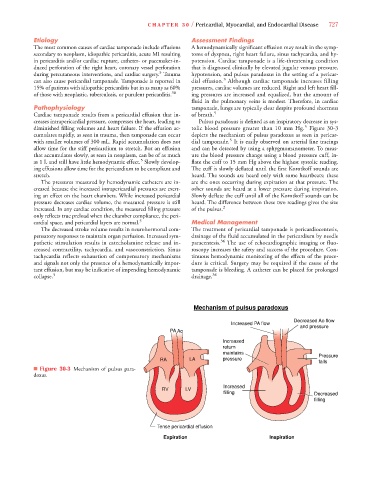
                   creases intrapericardial pressure, compresses the heart, leading to  Pulsus paradoxus is defined as an inspiratory decrease in sys-
                                                                                                            5
                   diminished filling volumes and heart failure. If the effusion ac-  tolic blood pressure greater than 10 mm Hg. Figure 30-3
                   cumulates rapidly, as seen in trauma, then tamponade can occur  depicts the mechanism of pulsus paradoxus as seen in pericar-
                                                                                   5
                   with smaller volumes of 300 mL. Rapid accumulation does not  dial tamponade. It is easily observed on arterial line tracings
                   allow time for the stiff pericardium to stretch. But an effusion  and can be detected by using a sphygmomanometer. To meas-
                   that accumulates slowly, as seen in neoplasm, can be of as much  ure the blood pressure change using a blood pressure cuff, in-
                                                      5
                   as 1 L and still have little hemodynamic effect. Slowly develop-  flate the cuff to 15 mm Hg above the highest systolic reading.
                   ing effusions allow time for the pericardium to be compliant and  The cuff is slowly deflated until the first Korotkoff sounds are
                   stretch.                                            heard. The sounds are heard only with some heartbeats; these
                     The pressures measured by hemodynamic catheters are in-  are the ones occurring during expiration at that pressure. The
                   creased because the increased intrapericardial pressures are exert-  other sounds are heard at a lower pressure during inspiration.
                   ing an effect on the heart chambers. While increased pericardial  Slowly deflate the cuff until all of the Korotkoff sounds can be
                   pressure decreases cardiac volume, the measured pressure is still  heard. The difference between these two readings gives the size
                   increased. In any cardiac condition, the measured filling pressure  of the pulsus.  2
                   only reflects true preload when the chamber compliance, the peri-
                   cardial space, and pericardial layers are normal. 5  Medical Management
                     The decreased stroke volume results in neurohormonal com-  The treatment of pericardial tamponade is pericardiocentesis,
                   pensatory responses to maintain organ perfusion. Increased sym-  drainage of the fluid accumulated in the pericardium by needle
                   pathetic stimulation results in catecholamine release and in-  paracentesis. 36  The use of echocardiographic imaging or fluo-
                   creased contractility, tachycardia, and vasoconstriction. Sinus  roscopy increases the safety and success of the procedure. Con-
                   tachycardia reflects exhaustion of compensatory mechanisms  tinuous hemodynamic monitoring of the effects of the proce-
                   and signals not only the presence of a hemodynamically impor-  dure is critical. Surgery may be required if the cause of the
                   tant effusion, but may be indicative of impending hemodynamic  tamponade is bleeding. A catheter can be placed for prolonged
                   collapse. 5                                         drainage. 36
                                                                       Mechanism of pulsus paradoxus
                                                                                                        Decreased Ao flow
                                                                                    Increased PA flow
                                                                                                          and pressure
                                                                PA Ao
                                                                                 Increased
                                                                                 return
                                                                                 maintains                      Pressure
                                                            RA        LA         pressure
                                                                                                                falls
                   ■ Figure 30-3 Mechanism of  pulsus  para-
                   doxus.
                                                                                 Increased
                                                             RV      LV
                                                                                 filling                       Decreased
                                                                                                               filling


                                                           Tense pericardial effusion
                                                             Expiration                         Inspiration

