


Page 750 - Cardiac Nursing
P. 750
LWBK340-c30_p722-737.qxd  09/09/2009  08:31 AM  Page 726 Aptara


                  726    PA R T  IV / Pathophysiology and Management of Heart Disease

                  acute idiopathic pericarditis. Pericardial effusions occur with  Assessment Findings
                  heart failure and LVH, and are also common after cardiac sur-  A 2003 task force of the American College of Cardiology, the Amer-
                  gery. Effusions associated with cardiac surgery usually resolve af-  ican Heart Association, and the American Society of Echocardiogra-
                            6
                  ter a month. In a population of patients in Italy, neoplastic eti-  phy gave the use of echocardiography for evaluation of all patients
                  ology was found in 33 of 450 patients with acute pericardial  with suspected pericardial disease an evidence class I recommenda-
                  disease (7.3%). Four percent of these patients presented with  tion. 37  Pericardial effusions are classified according to the distance
                  acute pericardial disease as the first manifestation of their malig-  between the left ventricular posterior wall and pericardium. Echocar-
                  nancy. 35  Pericardial effusions are also seen secondary to uremia  diography can classify mild ( 10 mm), moderate (10 to 20 mm),
                  of renal failure and hypothyroidism. In a population of patients  and severe ( 20 mm) effusions. 3,20  “Noncompressing” effusions do
                  in Turkey, uremic pericarditis resulting from poorly controlled  not produce changes in CO or pulsus paradoxus. If the effusions are
                  renal failure due to economic considerations was the most com-  caused by a systemic disease, then the symptoms are related to that
                  mon cause of pericardial effusion. 20  Tuberculosis is responsible  disease. A pericardial rub may or may not be appreciated. The ECG
                  for approximately 70% of cases of large pericardial effusions in  shows reduced voltage, and these changes are nonspecific and unre-
                  developing countries. 21                            liable for diagnosis. Cardiomegaly on chest x-ray film may be ob-
                                                                      served if effusion is present. If the effusion is visible on radiography,
                  Pathophysiology                                     then there is at least 250 mL of fluid accumulated. 2
                  The normal pericardium has a reserve capacity of 150 to 250
                  mL. An increase of volume of this amount in the pericardial  Medical Management
                  space will not result in a major increase in intrapericardial pres-  Pericardial effusion can be treated medically, with pericardiocen-
                  sure. Intrapericardial pressure will increase once this reserve vol-  tesis or with surgery. 20  Patients presenting for the first time with
                  ume is exceeded, and is also a function of how quickly the vol-  pericardial effusion are usually hospitalized to determine the cause
                  ume in the pericardial space accumulates. If fluid accumulates  of the effusion and to observe for the development of cardiac tam-
                  slowly, the normally stiff pericardium will stretch. However, if  ponade. 34  Medical management involves treatment of the peri-
                  there is increased stiffness of the pericardium, as seen in con-  carditis as discussed above with NSAIDs. Conservative treatment
                  strictive pericarditis, small amounts of fluid will result in in-  with clinical and echocardiographic monitoring is usually the ap-
                                                                                                   3
                  creased pericardial pressure. Once the intrapericardial pressure  proach for small or moderate effusions. Uremic pericardial effu-
                  is elevated, the filling of the cardiac chambers becomes limited  sions are often treated with aggressive hemodialysis. 20
                                                            5
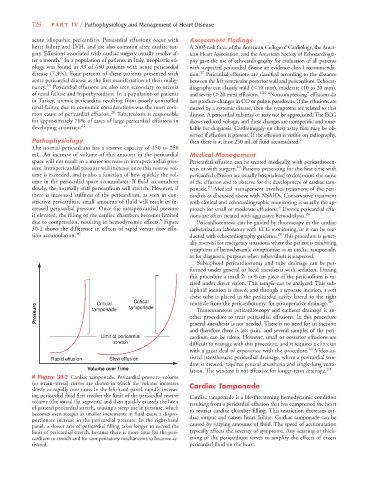
                  due to compression, resulting in hemodynamic effects. Figure  Pericardiocentesis can be guided by fluoroscopy in the cardiac
                  30-2 shows the difference in effects of rapid versus slow effu-  catheterization laboratory with ECG monitoring, or it can be con-
                                                                                                   20
                  sion accumulation. 36                               ducted with echocardiography guidance. This procedure is gener-
                                                                      ally reserved for emergency situations where the patient is exhibiting
                                                                      symptoms of hemodynamic compromise as in cardiac tamponade,
                                                                      or for diagnostic purposes when tuberculosis is suspected.
                                                                        Subxiphoid pericardiostomy and tube drainage can be per-
                                                                      formed under general or local anesthesia with sedation. During
                                                                      this procedure a small 2- to 4-cm piece of the pericardium is ex-
                                                                      cised under direct vision. This sample can be analyzed. This sub-
                                                                      xiphoid incision is closed, and through a separate incision, a soft
                                                                      chest tube is placed in the pericardial cavity lateral to the right
                                                    Critical
                                                                                                                   20
                                                                      ventricle from the pericardiotomy, for postoperative drainage.
                                        Critical
                    Pressure          tamponade   tamponade           other procedure to treat pericardial effusions. In this procedure
                                                                        Transcutaneous pericardioscopy and catheter drainage is an-
                                                                      general anesthesia is not needed. There is no need for an incision
                                                                      and therefore there is less pain, and several samples of the peri-
                                         Limit of pericardial         cardium can be taken. However, small or posterior effusions are
                                             stretch                  difficult to manage with this procedure, and it requires a clinician
                                                                      with a great deal of experience with the procedure. 20  Video-as-
                         Rapid effusion     Slow effusion             sisted transthoracic pericardial drainage, where a pericardial win-
                                                                      dow is created, requires general anesthesia and single-lung venti-
                                     Volume over Time                                                              20
                                                                      lation. The window is not effective for longer-term drainage.
                  ■ Figure 30-2 Cardiac tamponade. Pericardial pressure–volume
                  (or strain–stress) curves are shown in which the volume increases  Cardiac Tamponade
                  slowly or rapidly over time. In the left-hand panel, rapidly increas-
                  ing pericardial fluid first reaches the limit of the pericardial reserve  Cardiac tamponade is a life-threatening hemodynamic condition
                  volume (the initial flat segment) and then quickly exceeds the limit  resulting from a pericardial effusion that has compressed the heart
                  of parietal pericardial stretch, causing a steep rise in pressure, which  to restrict cardiac chamber filling. This restriction decreases car-
                  becomes even steeper as smaller increments in fluid cause a dispro-
                  portionate increase in the pericardial pressure. In the right-hand  diac output and causes heart failure. Cardiac tamponade can be
                  panel, a slower rate of pericardial filling takes longer to exceed the  caused by varying amounts of fluid. The speed of accumulation
                  limit of pericardial stretch, because there is more time for the peri-  typically affects the severity of symptoms. Any scarring or thick-
                  cardium to stretch and for compensatory mechanisms to become ac-  ening of the pericardium serves to amplify the effects of excess
                  tivated.                                            pericardial fluid on the heart.

