


Page 818 - Cardiac Nursing
P. 818
A
                                                 A
                                                 A
                                       2
                        3-7
                        3-7
                                                 A
                                                               ara
                                                 A
                                        009
                                                  M
                                             2:0
                                            1
                                        009
                     p78
                                                  M
                                                 A
                                                    Pa
                               d
                                                         94
                                                       e 7
                                  0
                                   /
                                 3
                                  0
                             qx
                                     6
                                    0
                          98.
                          98.
                                                 A
                                                            Apt
                                                 A
                                                 A
            K34
         LWBK340-c34_p78p783-798.qxd  30/06/2009  12:07 AM  Page 794 Aptara
            K34
                  34_
                0-c
         LWB K34 0-c 34_ p78 3-7 98. qx d  3 0 / 0 6 / / 2 009  1 2:0 7 A M  Pa g g e 7 94  Apt ara
                                             2:0
                                               7 A
         LWB
                                                 A
                  794    PA R T  V / Health Promotion and Disease Prevention
                  patients avoid excessive weight gain. Patients must also be aware  of importance in smoking cessation than do men. 107  If family
                  that the risks of continued smoking far outweigh the risks of gain-  members or close friends smoke, it is important to initiate a plan
                  ing a few pounds. Weight gain cannot be treated lightly because  to help the patient resist the temptation to smoke when around
                  67% of women in one study stated that they were very concerned  others who are smoking. It is imperative to prepare the patient for
                  or somewhat concerned about weight gain after cessation. 117  In an-  this situation if the family member or friend who smokes lives
                  other study, up to 75% of women and 35% of men reported an un-  with the patient. Previous preparation is particularly important
                  willingness to gain 5 or more pounds as a result of stopping smok-  for women living with a smoker because the odds of relapsing are
                  ing. In particular, more than half of women younger than 25 years  2.5 times higher in this population. 16  The ideal situation, of
                  and 39% of women older than 40 years stated that they were un-  course, is when the family member or friend attempts to quit at
                                     71
                  willing to gain any weight. It is important to note that weight gain  the same time the patient does; therefore, interventions that tar-
                  is not just a concern of women. Weight gain in the first 3 months  get other smokers in the household at the same time seem pru-
                  after cessation was predictive of relapse to smoking for men. In fact,  dent. If this is not feasible, the nurse should counsel the family
                  the risk of relapse increased by 17% for every kilogram of weight  member or friend to (1) not smoke in the presence of the patient
                  gained. 118  Providers must therefore openly discuss the possibility of  if possible; (2) remove all cigarettes and other tobacco products
                  weight gain but stress to the patient that the amount of weight  from the household; and (3) refrain from offering cigarettes to the
                  gained is usually limited and that a program of exercise and a  patient who is trying to quit. Family members and friends should
                                             61
                  healthy diet can control weight gain. In addition, current studies  also be encouraged to provide daily positive reinforcement for pa-
                  indicate that NRT, particularly the gum, and bupropion SR have  tients successful at quitting. It may also be appropriate for the
                  been shown to at least delay postcessation weight gain. 61,62  In the  nurse to teach the patient some basic assertiveness skills, so that
                  case of bupropion SR, weight gain was actually significantly less  the patient is prepared to ask assertively that the family member
                  compared with placebo, 3.8 kg versus 5.6 kg, respectively. 87  or friend not smoke in his or her presence, not offer him or her
                                                                      cigarettes, and so forth. The Enhancing Recovery in Coronary
                  Social Support                                      Heart Disease Patients (ENRICHD) Social Support Instrument
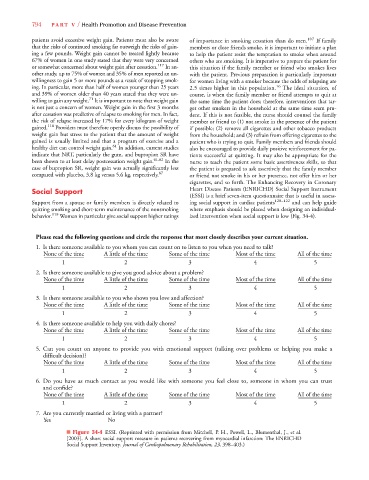
                                                                      (ESSI) is a brief seven-item questionnaire that is useful in assess-
                  Support from a spouse or family members is directly related to  ing social support in cardiac patients 120–122  and can help guide
                  quitting smoking and short-term maintenance of the nonsmoking  where emphasis should be placed when designing an individual-
                  behavior. 119 Women in particular give social support higher ratings  ized intervention when social support is low (Fig. 34-4).
                    Please read the following questions and circle the response that most closely describes your current situation.
                    1. Is there someone available to you whom you can count on to listen to you when you need to talk?
                      None of the time    A little of the time  Some of the time     Most of the time    All of the time
                            1                    2                    3                    4                   5
                    2. Is there someone available to give you good advice about a problem?
                      None of the time    A little of the time  Some of the time     Most of the time    All of the time
                            1                    2                    3                    4                   5
                    3. Is there someone available to you who shows you love and affection?
                      None of the time    A little of the time  Some of the time     Most of the time    All of the time
                            1                    2                    3                    4                   5
                    4. Is there someone available to help you with daily chores?
                      None of the time    A little of the time  Some of the time     Most of the time    All of the time
                            1                    2                    3                    4                   5
                    5. Can you count on anyone to provide you with emotional support (talking over problems or  helping you make a
                      difficult decision)?
                      None of the time    A little of the time  Some of the time     Most of the time    All of the time
                            1                    2                    3                    4                   5
                    6. Do you  have as much contact as you would like with someone you  feel close to, someone in whom you can trust
                      and confide?
                      None of the time    A little of the time  Some of the time     Most of the time    All of the time
                            1                    2                    3                    4                   5
                    7. Are you currently married or living with a partner?
                      Yes                  No
                              ■ Figure 34-4 ESSI. (Reprinted with permission from Mitchell, P. H., Powell, L., Blumenthal, J., et al.
                              [2003]. A short social support measure in patients recovering from myocardial infarction: The ENRICHD
                              Social Support Inventory. Journal of Cardiopulmonary Rehabilitation, 23, 398–403.)

